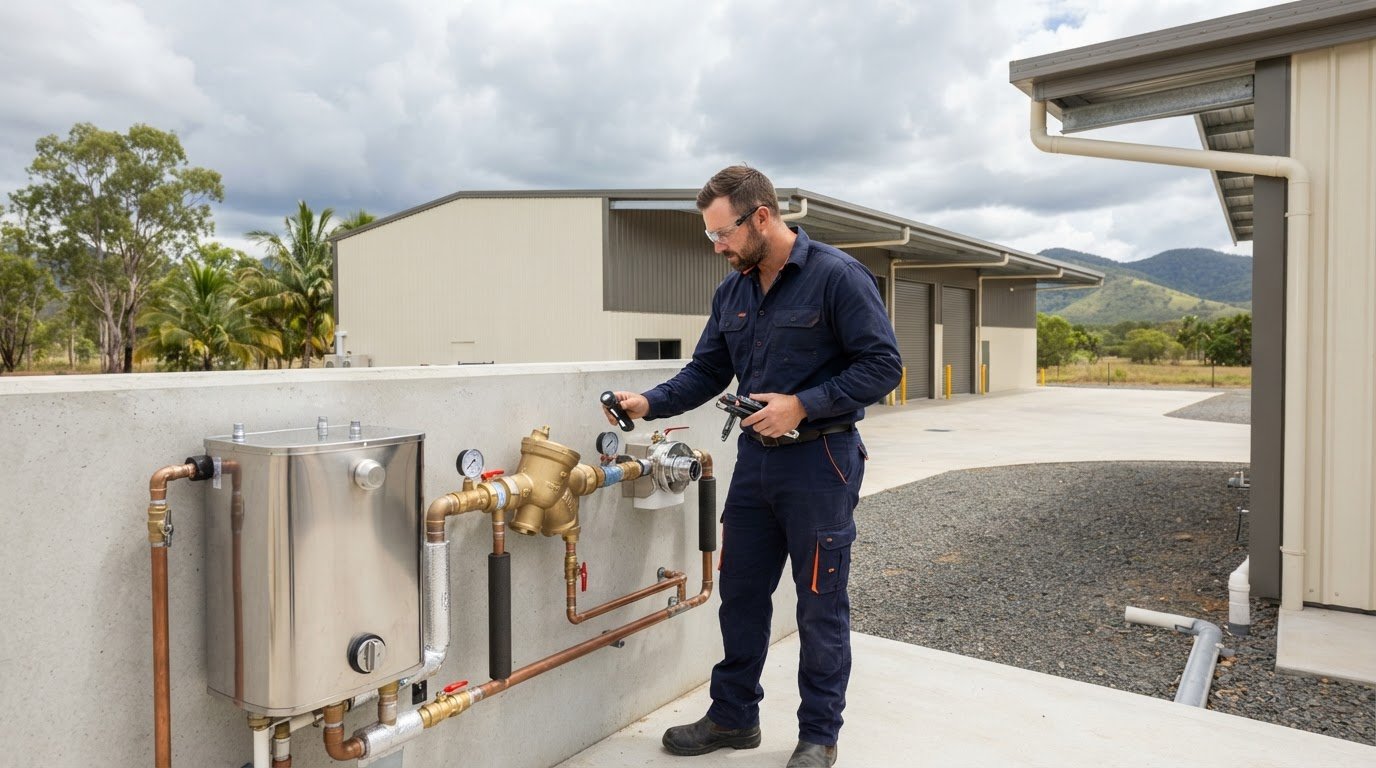
Commercial Property Plumbing Maintenance Checklist for Central Queensland Facilities
What if the costliest threat to your facility's daily operations isn't major plant failure, but an uninspected roof drain or an expired compliance tag? Prioritising commercial property plumbing maintenance eliminates unexpected business closures far more effectively than scrambling for emergency callouts when trade waste overflows or a sudden wet season downpour overwhelms your gutters.
Managing commercial sites across Rockhampton, Gracemere, and the Capricorn Coast means balancing strict regulatory expectations with demanding tenant schedules. You shouldn't have to spend your week chasing unreliable trades for statutory paperwork or wondering whether your site meets local council bylaws. By establishing a structured servicing routine, you protect your building assets, ensure workplace health standards, and replace reactive panic with predictable operational expenditure.
In this guide, you will discover the mandatory Queensland testing schedules, practical site checks, and trade waste protocols needed to keep your facility audit-ready. From backflow prevention devices and thermostatic mixing valves to roof plumbing inspections ahead of severe regional storms, here is everything you need to maintain continuous compliance without the headache.
Key Takeaways
- Establish a structured commercial property plumbing maintenance schedule to identify minor component wear before it causes operational shutdowns.
- Stay on top of mandatory annual Queensland testing requirements for backflow prevention devices and thermostatic mixing valves to ensure audit readiness.
- Protect facility interiors and stock by inspecting commercial roof plumbing and stormwater infrastructure before severe Central Queensland storm activity arrives.
- Maintain trade waste apparatus and commercial hot water delivery to comply with local council regulations and avoid disruptive sewer blockages.
- Partner with an endorsed, licensed plumber to ensure all site logs, council submissions, and QBCC compliance certificates remain up to date.
The Commercial Property Plumbing Maintenance Inspection Checklist
Preventing unscheduled downtime requires a systematic approach rather than guesswork. Commercial assets endure far higher usage volumes than domestic fixtures, meaning minor wear escalates quickly into structural damage or regulatory non-compliance. Establishing a structured preventative maintenance schedule protects your capital assets and satisfies commercial property insurance underwriters who demand proof of site upkeep. Facility managers in regional hubs like Rockhampton must implement clear routines that track asset condition over time. By engaging a licensed plumber to oversee scheduled maintenance and maintain precise on-site logbooks, you eliminate operational surprises and keep commercial property plumbing maintenance completely predictable.
Monthly Amenity and Fixture Walkthroughs
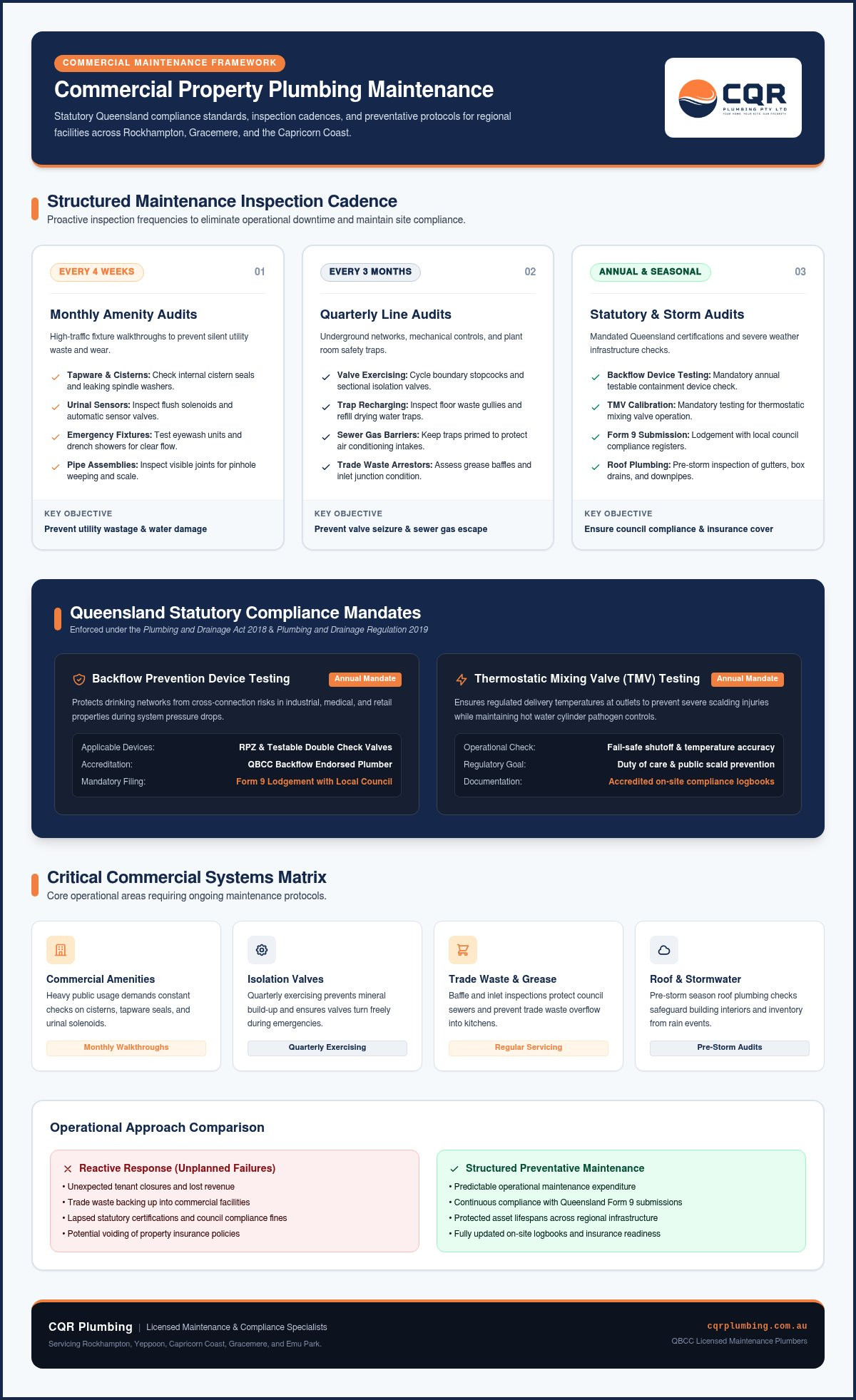
Commercial washrooms experience intense daily wear. High-traffic amenities must undergo systematic visual audits every four weeks to catch small defects before they disrupt staff or customers. During these walkthroughs, facility staff should check:
- Tapware and Cisterns: Check for weeping internal cistern seals and leaking spindle washers that silently inflate utility consumption.
- Urinals and Sensor Valves: Inspect electronic flush solenoids and auto-sensors to stop continuous flushing cycles or inadequate washdowns.
- Safety Fixtures: Test emergency eyewash units and drench showers to verify clean water flow and unimpeded mechanical operation.
- Pipe Assemblies: Check visible joints on accessible plumbing systems for pinhole weeping, scale deposits, or sudden pressure loss.
Quarterly Drainage and Isolation Valve Audits
Beyond daily amenities, underground drainage networks and line controls require disciplined quarterly reviews. Mineral build-up in regional water supplies can quickly seize manual brassware. Exercising your primary boundary stopcocks and internal sectional valves every three months stops gates from freezing open during a pipe burst emergency. Plant rooms require equal diligence; inspect floor waste gullies regularly and recharge drying water traps to prevent foul sewer gas from entering air conditioning intakes.
For sites handling high effluent loads, quarterly checks must assess grease arrestor baffles and inlet junctions before scheduled pump-outs to stop trade waste backing up into commercial kitchens. Commercial property plumbing maintenance works best when managed by experienced trades who understand regional infrastructure requirements. Review our dedicated real estate and strata plumbing services to streamline compliance across your entire site portfolio.
Statutory Compliance: Backflow Prevention and TMV Testing Mandates
Statutory obligations under the Queensland Plumbing and Drainage Act 2018 and Plumbing and Drainage Regulation 2019 remove all ambiguity around servicing schedules. Facility managers carry strict legal duties to safeguard the public potable network and prevent scalding events on site. Commercial property plumbing maintenance is incomplete without accredited annual certifications that prove your compliance to municipal inspectors. Failing to maintain these assets voids property insurance cover and risks substantial administrative fines from local authorities.
Annual Backflow Prevention Device Certification
Any cross-connection between potable water supply lines and potential contamination sources demands mechanical containment. In industrial workshops, medical suites, and retail complexes across Central Queensland, high and medium hazard processes threaten the municipal drinking network if pressure drops occur. Every testable backflow prevention device, including reduced pressure zone devices and testable double check valves, requires mandatory annual inspection under Queensland law.
Testing must be completed by a licensed plumber carrying the specific Queensland Building and Construction Commission (QBCC) backflow endorsement. Following testing, certified results must be recorded on an official Form 9 inspection report and lodged directly with Rockhampton Regional Council or Livingstone Shire Council depending on your asset location. Learn more about our endorsed backflow and TMV testing procedures to maintain your local council register without administrative friction.
Thermostatic Mixing Valve (TMV) Calibration Standards
Water heaters must store water at 60°C or higher to inhibit Legionella bacteria growth, yet this temperature causes severe scalding within seconds. Thermostatic Mixing Valves bridge this safety gap by precisely blending hot and cold supplies to deliver tapware temperatures in compliance with AS/NZS 3500.4. In high-risk environments such as childcare centres, medical clinics, and aged care facilities, annual field testing under AS/NZS 4032.3 is non-negotiable.
Annual servicing involves distinct technical procedures:
- Thermal Shut-Off Audits: Plumbers isolate cold water lines to ensure the valve cuts mixed delivery instantly, preventing direct scalding discharges.
- Internal Strainer Maintenance: Technicians clear particulate matter and mineral scale that restrict balance across hot and cold inlet ports.
- Element Calibration: Licensed contractors verify that delivery temperatures remain within statutory limits before updating the on-site compliance register.
If your property has compliance audits approaching, you can easily request a quote to book an accredited inspection and lodge your council documentation correctly.
Stormwater and Roof Plumbing Integrity for Central Queensland Weather
Tropical squalls and severe cyclonic storms across Central Queensland push commercial drainage infrastructure to its absolute limits. When sudden monsoon troughs dump immense rainfall over Rockhampton and the Capricorn Coast, commercial catchments gather thousands of litres of water per minute. Commercial property plumbing maintenance must account for these regional weather patterns through disciplined, semi-annual inspections scheduled directly before and after the summer wet season. An overlooked seam or choked rain head will not just cause minor leaks, it can quickly collapse suspended ceilings and destroy expensive warehouse inventory.
Commercial Box Gutter and Sump Maintenance
Large commercial roof profiles rely on heavy-gauge box gutters that require completely unobstructed flow paths. Under the updated AS/NZS 3500.3:2025 stormwater requirements, carrying capacities must handle local peak rainfall intensities without backing up into building flashings. During every roof inspection, licensed technicians examine several key catchment points:
- Industrial Sumps and Rain Heads: Technicians clear out heavy eucalyptus debris, silt accumulations, and bird nesting material that choke discharge outlets.
- Seams and Expansion Joints: Inspect metal expansion joints and soldered seams where intense Central Queensland UV exposure and thermal movement cause seal failure.
- Overflow Scuppers: Ensure emergency scuppers remain clear so excess storm volume safely discharges externally if a primary downpipe becomes overwhelmed.
Review our specialised commercial roof plumbing maintenance programs to secure your building envelope before the storm season begins.
Stormwater Grate and Underground Pipe Clearing
Collecting storm volume from large roof profiles is pointless if below-ground networks cannot transport it away. Underground pipework must carry stormwater efficiently to the lawful point of discharge mandated by Rockhampton Regional Council or Livingstone Shire Council. Silt, heavy gravel, and site rubbish washing across industrial hardstands quickly choke subterranean retention cells and carpark pits.
Maintenance teams use high-pressure water jetting to scour compacted sediment out of low-gradient stormwater lines. Deploying CCTV drain cameras identifies sub-surface joint displacements caused by shifting reactive clay soils, as well as aggressive tree roots exploiting pipe joins. Catching these restrictions during routine commercial property plumbing maintenance guarantees your facility drains freely during sudden tropical deluges, protecting car parks, loading docks, and customer access routes from severe localized flooding.
Commercial Hot Water Systems and Trade Waste Protocols
Sanitisation standards and daily tenant operations grind to a halt when industrial hot water plants fail or trade waste networks back up. Commercial facilities cannot rely on basic domestic servicing routines. High-demand plant rooms operate under continuous pressure, and local council environmental officers strictly police what leaves your site. Integrating targeted plant room checks and trade waste management into your commercial property plumbing maintenance program preserves capital equipment and avoids costly trade waste infringement notices.
Plant Room Hot Water Servicing and Anode Replacement
Storage cylinders in commercial manifolds work continuously under heavy thermal stress. Without preventative care, internal tank corrosion accelerates, leading to ruptured pressure vessels and sudden facility shutdowns. Magnesium sacrificial anodes must be inspected every twelve months and replaced when depleted by more than fifty percent. Technicians must also manually ease Temperature and Pressure Relief (TPR) valves every six months to confirm the valve seat operates smoothly and discharges freely.
For gas-fired continuous flow manifolds or bulk storage plants, licensed gas fitters must carry out regular gas tightness tests along the fuel train. Checking line pressure and gas load adequacy ensures high-output burners run cleanly without flame lifting or dangerous incomplete combustion. For facilities expanding operations down the coast, see how local conditions affect compliance in our guide on commercial plumbing services in Yeppoon.
Trade Waste and Grease Arrestor Management
Commercial discharge into municipal sewers is strictly governed by the Water Supply (Safety and Reliability) Act 2008. Both Rockhampton Regional Council and Livingstone Shire Council require approved pre-treatment apparatus wherever kitchens, workshops, or wash bays operate. Waste streams containing fats, oils, grease, or chemical residues cannot enter the main sewer directly. Maintaining these systems requires routine on-site discipline:
- Pre-Treatment Interceptors: Confirm all commercial preparation sinks, floor drains, and dishwashers discharge exclusively through compliant grease arrestors.
- Dry Basket Arrestors: Kitchen staff should empty and clean dry basket screens daily to trap solid food scraps before they enter grease traps.
- Apparatus Baffles and Seals: Licensed technicians inspect internal baffles and airtight access lid seals during routine audits to prevent raw sewer fumes escaping into food prep areas.
- Sampling Access: Keep inspection shafts clear so council officers can sample discharge streams during random water quality audits.
Scheduling regular pump-outs with accredited liquid waste carriers is essential, but internal plumbing baffles must be inspected regularly to confirm the unit separates waste effectively. Thorough commercial property plumbing maintenance keeps your trade waste approvals in good standing year after year.
Selecting a Licensed Commercial Maintenance Partner in Central Queensland
Choosing a contractor to service your facility is an operational decision that directly impacts asset lifespans and regulatory compliance. Commercial sites cannot afford trial-and-error maintenance from contractors accustomed only to basic residential repairs. Effective commercial property plumbing maintenance requires an accountable partner who provides clear scope of work documentation, holds high-level trade endorsements, and delivers transparent, audit-ready reporting after every visit.
Commercial Contractor Vetting Criteria
Before granting site access to your plant rooms or trade waste infrastructure, facility managers should rigorously verify contractor qualifications. A reputable commercial plumbing provider must demonstrate verified trade competencies, including:
- QBCC Licences and Endorsements: Confirm your contractor holds an active licence as a licensed plumber with formal endorsements for backflow prevention testing and licensed gas fitting.
- Safety and WHS Systems: Verify site-specific Safe Work Method Statements (SWMS), working at heights certifications for roof work, and current public liability policies.
- Digital Compliance Reporting: Ensure the contractor generates clear digital job logs, photographic evidence of repairs, and statutory paperwork that integrate cleanly with your asset registers.
Review our established track record serving Rockhampton commercial properties to see how verified licensing and local trade experience protect regional facilities.
Establishing Service Level Agreements (SLAs)
Unplanned plumbing failures require immediate, decisive intervention. A structured Service Level Agreement removes uncertainty during a crisis by setting clear parameters for emergency plumbing versus routine calls. When a burst supply main floods a tenancy or a critical kitchen line chokes, rapid response times are vital to limit structural damage and inventory loss.
Your service contract should clearly define escalation paths, after-hours emergency gas support, and guaranteed arrival windows for high-priority hazards. It should also establish routine maintenance cycles so preventative tasks never slip past council deadlines. You can outline your facility's operational requirements and lock in a tailored commercial property plumbing maintenance plan by submitting your site details through our online quote request.
Protect Your Commercial Facility With Proactive Plumbing Care
Staying ahead of commercial property plumbing maintenance protects your bottom line, safeguards building occupants, and prevents minor component wear from escalating into severe operational shutdowns. Implementing regular fixture audits, clearing roof drainage networks before the Central Queensland wet season, and tracking annual backflow and TMV testing ensures your facility remains compliant with state legislation and local council directives.
CQR Plumbing provides dependable commercial support across Rockhampton, Yeppoon, and Gracemere. Backed by QBCC licensed plumbers holding specialised commercial compliance endorsements, our team pairs rapid response times with detailed digital compliance reporting and direct Form 9 lodgement support. We ensure your statutory maintenance records remain audit-ready and your capital assets stay protected.
Taking charge of your maintenance schedule today stops unexpected emergencies tomorrow. Partner with an accountable local specialist to keep your site operating smoothly and safely all year round.
Frequently Asked Questions
How often does Queensland law require backflow prevention testing on commercial sites?
Under the Plumbing and Drainage Regulation 2019, commercial properties across Queensland must have every testable backflow prevention device inspected and certified annually. Testing must be completed by a licensed plumber holding an accredited backflow endorsement. The technician records valve pressure differentials on a statutory Form 9 report, submitting copies to the property asset log and the local authority, such as Rockhampton Regional Council or Livingstone Shire Council.
What is the difference between residential and commercial plumbing maintenance?
Commercial facilities handle significantly higher occupant loads, run industrial plant equipment, and face strict statutory compliance mandates that residential properties never encounter. While domestic plumbing centres on standard household fixtures, commercial property plumbing maintenance includes servicing high-capacity grease arrestors, managing trade waste discharge, testing complex hot water manifolds, and maintaining large roof catchments. Commercial maintenance also requires formal risk management documentation, site inductions, and audit-ready reporting.
Why is TMV testing compulsory for commercial buildings and aged care facilities?
Thermostatic Mixing Valves are legally mandated under the Plumbing and Drainage Regulation 2019 to prevent scalding injuries in public washrooms. Water heaters must store hot water at 60°C or higher to stop bacterial growth like Legionella, but mixed tapware delivery must not exceed safe temperature thresholds under AS/NZS 3500.4. Annual testing verifies that the thermal shut-off mechanism stops water delivery immediately if cold water flow fails.
What happens if a commercial property ignores trade waste requirements?
Discharging untreated wastewater into council sewer systems breaches the Water Supply (Safety and Reliability) Act 2008 and local government directives. Commercial operators in Rockhampton and Livingstone Shire face substantial council fines, inflated trade waste utility rates, and forced operational closures. Blocked private boundary junctions can also push raw sewage back into commercial prep areas, creating severe health hazards and voiding food safety licences.
How quickly can emergency plumbing issues be addressed in Rockhampton and Yeppoon?
CQR Plumbing provides rapid response times with 24/7 emergency response availability across Rockhampton, Yeppoon, Gracemere, and the Capricorn Coast. When unexpected failures occur, such as choked sewer lines, burst main supply pipes, or gas leaks, licensed technicians attend quickly with high-pressure jetters and diagnostic CCTV equipment. Swift intervention limits inventory damage, maintains structural integrity, and keeps business disruptions as brief as possible.
Can regular commercial plumbing maintenance reduce property insurance premiums?
Yes. Documented commercial property plumbing maintenance demonstrates clear risk management to property insurers and underwriter assessors. After major storm events or internal flood claims, assessors investigate whether unmaintained gutters or degraded pipe seals contributed to the loss. Maintaining written logs of semi-annual roof inspections, cleared stormwater sumps, and regular valve testing protects your claims from being denied for avoidable maintenance negligence.
What documentation should a commercial plumber provide after completing scheduled servicing?
A licensed contractor must provide structured, audit-ready documentation after every scheduled site visit. This includes digital service reports detailing completed inspections, clear notes on identified faults, and formal compliance submissions such as Queensland Form 9 test logs for backflow devices. If gas work is completed, the technician must supply a gas compliance certificate. Facility managers should also receive transparent condition reports for asset budgeting.
Disclaimer
The information in this article is provided for general educational purposes only and should not be relied upon as professional plumbing, gasfitting, or legal advice. Every property and plumbing system is different, and the information may not be applicable to your specific circumstances. CQR Plumbing recommends that all plumbing and gasfitting work be inspected and carried out by a licensed professional in accordance with applicable Australian Standards and Queensland regulations. If you require advice specific to your property, please contact CQR Plumbing for an assessment.