Electric Hot Water System Not Heating: Step-by-Step Diagnostic Guide
A sudden blast of freezing water during your morning shower does not mean your cylinder is finished. When you are dealing with an electric hot water system not heating, the immediate dread is facing a total tank replacement or trying to guess whether you need a plumber or an electrician. It is a frustrating disruption to your routine, particularly when you are left second-guessing off-peak controlled load schedules or switchboard trips.
Most sudden loss-of-heat problems stem from a single, isolated component rather than structural failure. You will discover why your water heater is running cold, which basic external checks you can carry out safely without touching electrical wiring, and when it is time to call in a licensed professional. Here is a step-by-step diagnostic walkthrough to help you identify the exact fault and get your hot water running again without delay.
Key Takeaways
- Determine whether an electric hot water system not heating stems from power supply loss, a tripped thermal cut-out, or an isolated valve failure before assuming the tank has failed.
- Perform safe, non-invasive checks at your switchboard and relief valves without opening electrical terminal panels or breaching Queensland safety regulations.
- Distinguish between electrical element faults and mechanical plumbing issues, including how a seized tempering valve can deliver cold water while the cylinder is piping hot.
- Assess your cylinder's age and structural condition to make an informed choice between a targeted component repair and a full replacement.
- Understand how regional off-peak controlled load schedules and local water quality across Central Queensland influence heating performance and element life.
Why Is Your Electric Hot Water System Not Heating?
When you turn on the shower and get nothing but an icy blast, the root problem rarely requires scrapping the entire unit. In most Australian properties, electric storage water heaters rely on an insulated steel cylinder that heats and stores potable water through one or two resistive immersion elements. Each element is regulated by a mechanical thermostat and protected by a high-temperature thermal cut-out switch. If you are dealing with an electric hot water system not heating, the failure almost always traces back to three distinct failure points: electrical power disruption, safety cut-off activation, or hydraulic delivery failure.
Identifying the exact symptoms will quickly narrow down what went wrong:
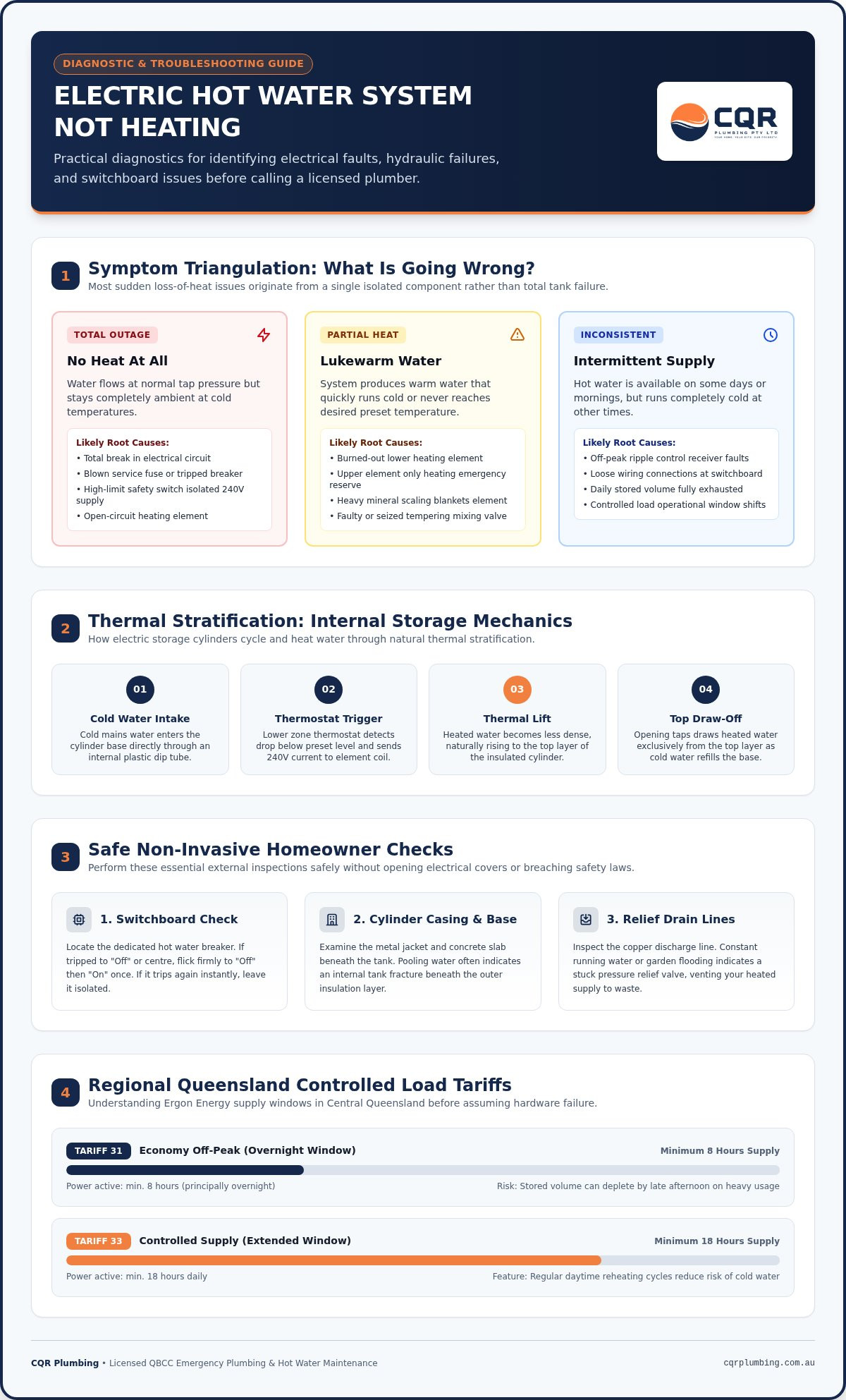
- No heat at all: Water flows at normal tap pressure but stays completely ambient. This points to a total break in the electrical circuit, a blown service fuse, or an open-circuit heating element.
- Lukewarm water: The cylinder produces warm water that quickly runs cold, or reaches only a fraction of its required heat. This typically indicates a burned-out bottom element, heavy mineral scaling, or a faulty mixing valve.
- Intermittent heating: Hot water is available on some days but missing on others, which usually points to off-peak ripple control receiver faults or loose wiring connections at the switchboard.
Total Loss of Heat Versus Lukewarm Water
A complete loss of heat points directly to an electrical supply failure. If the manual-reset high-limit switch trips on the thermostat, it isolates the incoming 240-volt supply to prevent boiling. Conversely, lukewarm water usually signals a partial mechanical issue. On twin-element cylinders, the top element heats the upper reserve while the lower element handles bulk storage. If the lower element burns out, you only get a tiny fraction of usable hot water. In older cylinders, heavy sediment accumulation around the base blankets the lower element, preventing clean heat transfer into the surrounding water column.
How Electric Storage Water Heaters Function
Understanding the internal cycle helps you recognise where the breakdown occurs. Cold mains water enters near the base of the cylinder through an internal plastic dip tube. The immersion thermostat monitors water temperature at that lower zone; when it drops below the preset dial level, it closes contacts to send electrical current through the resistive element coil. Because hot water is less dense, it naturally rises to the top of the cylinder through thermal stratification. As you open a tap, outgoing hot water draws directly from this top layer, while incoming cold water simultaneously refills the base to repeat the cycle. If any link in that process breaks, heating stops.
Safe Homeowner Troubleshooting Checks Before Calling a Plumber
Before assuming the worst, you can perform several practical, non-invasive inspections around your property. When faced with an electric hot water system not heating, basic visual checks help pinpoint whether the breakdown involves incoming electrical supply or an external plumbing fault, all without risking your personal safety.
Take five minutes to review these key checkpoints:
- Main switchboard: Look for circuit breakers or safety switches labeled "Hot Water" or "Water Heater" that have shifted position.
- Cylinder casing: Check the metal jacket for scorch marks, rusted seams, or water leaking around pipe connections.
- Relief drain line: Check whether copper discharge lines are flooding the garden or running water continuously into the drain.
Inspecting Your Switchboard and Meter Box
Open your electrical meter box and locate the dedicated circuit breaker. If the toggle sits in the "Off" or central tripped position, flick it firmly to "Off" and then back to "On" once. If it trips again instantly, leave it off. In regional Queensland, controlled load tariffs supply power during specific operational windows, such as Ergon Energy's Tariff 31 (supplying a minimum of 8 hours, mostly overnight) or Tariff 33 (providing at least 18 hours daily). If your cylinder heats only overnight, you may simply have exhausted your daily stored volume during high-demand periods. For broader energy efficiency advice, review the energy.gov.au hot water systems guide.
External Cylinder and Leak Inspections
Walk out to the tank and examine the concrete slab beneath it. Pooling water around the base usually indicates an internal cylinder fracture beneath the outer insulation. Inspect the brass isolating valve on the cold-water inlet line to confirm the handle is completely parallel with the pipework. If you notice pooling water near electrical conduits, isolate the circuit immediately and organise emergency plumbing support to avoid hazardous short circuits.
The Legal Danger of DIY Electrical Work
Under the Queensland Electrical Safety Act 2002, property owners must never unscrew the lower electrical access plate covering the element and thermostat terminals. That small metal plate houses 240-volt live terminals. Even if a circuit breaker is turned off at the meter board, older switchboards or dual-tariff setups can retain live residual current. Testing internal terminal resistance or pressing high-limit reset buttons requires a qualified tradesperson carrying a Restricted Electrical Licence. Sticking to external visual inspections keeps you safe and complies with state electrical laws.
Common Faults: Electrical Failures Versus Plumbing Issues
Diagnosing an electric hot water system not heating requires separating electrical supply faults from plumbing hardware failures. While property owners often assume a loss of heat means an electrical blackout inside the tank, failing plumbing valves can produce identical symptoms. Pinpointing the actual breakdown prevents unnecessary component replacement and gets your hot water back on faster.
Burnt-Out Heating Elements and Thermostat Malfunctions
Immersion elements operate under extreme thermal stress. Over years of service, mineral scale bakes onto the element sheath, forming an insulating crust that causes the internal resistor wire to overheat and fracture. Similarly, mechanical thermostats open and close contacts thousands of times over their operating life. Eventually, contact points pit, corrode, or weld open, preventing electrical current from reaching the heating element even when the circuit breaker remains engaged.
Pressure Relief Valves and Tempering Valve Faults
Plumbing valves frequently mimic electrical faults. In Australia, cylinders store water at a minimum of 60°C to control bacteria, which a tempering valve mixes with cold water to deliver safe 50°C water to bathrooms. If the internal thermostatic capsule inside the tempering valve seizes, it can draw excess cold water into the supply line, delivering lukewarm water while the cylinder itself sits at full temperature. Additionally, if the temperature pressure relief (TPR) valve sticks open, heated water dumps continuously down the drain line, emptying the tank faster than the element can recover.
Component Diagnostic Reference Table
Use this reference breakdown to match your system symptoms to the probable mechanical or electrical fault:
| Visible Symptom | Likely Culprit | Fault Type | Required Trade |
|---|---|---|---|
| Completely cold water; breaker stays on | Burned element or failed thermostat | Electrical | Electrician / Plumber with electrical licence |
| Water runs lukewarm across all taps | Seized tempering valve | Plumbing | Licensed plumber |
| Discharge pipe continuously runs hot water | Stuck or worn TPR valve | Plumbing | Licensed plumber |
| Breaker trips instantly upon resetting | Shorted heating element | Electrical | Electrician / Plumber with electrical licence |
Having a licensed plumber inspect the installation first ensures your relief valves, cylinder integrity, and hot water delivery lines are verified before committing to complex component replacements.
Repair or Replace: Making the Right Decision for Your Home
Finding your electric hot water system not heating brings an immediate concern: can it be repaired, or do you have to replace the entire cylinder? The answer comes down to tank condition, system age, and which specific component failed. An honest maintenance assessment focuses on repairing isolated parts whenever the storage vessel remains sound, protecting you from premature changeovers.
Age and Tank Integrity Considerations
Every water heater has a metal data plate attached to the outer casing stamped with the manufacture date. Vitreous enamel mild-steel tanks generally have an operational life of 8 to 12 years, whereas stainless steel models often last 12 to 15 years. Inside enamel tanks, a sacrificial anode rod protects the steel from aggressive water chemistry. Once that anode depletes completely, corrosion attacks the inner cylinder walls directly.
Watch for signs of structural failure that make replacement unavoidable:
- Rust-coloured hot water: Discoloured water flowing from hot taps while cold water runs clear points to severe internal tank decay.
- Weeping jacket seams: Moisture, rust trails, or blistered paint around the casing seams indicates the inner pressure vessel has fractured.
- Persistent base pooling: Water gathering beneath the tank when all external pipe fittings and relief valves are completely bone dry.
When Component Repair Is the Smarter Route
If your cylinder is under eight years old and the outer jacket shows zero corrosion, replacing an individual electrical or plumbing component is usually the most sensible path. Installing a new heating element, fitting a fresh thermostat, or replacing a stuck tempering valve restores the unit to peak working order without the expense of a new cylinder. If your tank has reached the end of its working life and structural failure has occurred, review our guide to hot water system installations to select an appropriately sized replacement for your household.
Professional Repairs in Rockhampton and the Capricorn Coast
Living in Central Queensland places unique environmental stresses on hot water infrastructure. When an electric hot water system not heating leaves your household stranded, resolving the issue quickly requires an understanding of local operating conditions. Beyond diagnosing faulty components, licensed hot water work in Queensland must comply strictly with the Queensland Building and Construction Commission (QBCC). Under the Plumbing and Drainage Regulation 2019, any water heater replacement is classified as Notifiable Work, requiring a licensed plumber to lodge a Form 4 notice with the QBCC.
Central Queensland Water Quality and Climate Factors
Water supplies across Rockhampton, Gracemere, and the Capricorn Coast carry distinct mineral profiles that directly affect cylinder hardware. Water sourced from the Fitzroy River basin and coastal ground reserves contains dissolved minerals that precipitate rapidly under sustained heating. This sediment settles around the base of the tank, encrusting heating elements and reducing thermal efficiency. Along the coast in Yeppoon and Emu Park, airborne salt and high seasonal humidity accelerate external corrosion on relief valve bodies, brass fittings, and terminal covers. Scheduling routine preventative maintenance to flush sediment and inspect the sacrificial anode protects the tank against these harsh regional conditions.
Why Homeowners Choose CQR Plumbing
CQR Plumbing takes a maintenance-first approach to hot water diagnostics. Instead of pushing for unnecessary system changeovers, we focus on pinpointing the exact failure point and restoring your existing unit whenever structurally sound. When you contact our team, you receive clear communication, an upfront clear scope of work, and dependable trade expertise backed by full QBCC licensing.
Our service benefits include:
- Local availability: Rapid response time across Rockhampton, Yeppoon, Gracemere, Emu Park, and the Capricorn Coast for urgent plumbing faults.
- Accurate fault finding: Experienced trade diagnostics covering electrical thermostats, heating elements, tempering valves, and cold-water relief lines.
- Transparent reporting: Clear written explanations of work required, making property maintenance straightforward for private homeowners and real estate managers alike.
Do not let cold showers disrupt your morning routine. Request a fast quote today to have a qualified local technician diagnose and repair your hot water system.
Restore Your Hot Water With Confident Local Diagnostics
Dealing with an electric hot water system not heating can quickly disrupt your household routine, but it rarely means you need to buy a brand new tank. Simple visual checks help you rule out switchboard trips and external leaks safely, without ever removing live electrical covers. Whether the issue stems from a burnt-out element, a failed thermostat, or an aged tempering valve restricting flow, accurate testing isolates the fault quickly.
CQR Plumbing delivers honest fault diagnosis focused on practical repairs over unnecessary replacements. As fully licensed QBCC plumbers and gas fitters, our team provides a rapid response time and a clear scope of work across Rockhampton, Yeppoon, and the Capricorn Coast.
Get your system assessed properly by an experienced maintenance plumber today so you can return to dependable, hot showers without delay.
Frequently Asked Questions
Why is my electric hot water system running cold suddenly?
Sudden cold water usually means your electrical supply was interrupted by a tripped circuit breaker, or the thermostat high-limit safety cut-out activated. On off-peak tariffs such as Ergon Energy's Tariff 31, a brief network ripple interruption can also leave your cylinder unheated by morning. Alternatively, the heating element may have suffered an immediate burnout. Checking your switchboard gives you an instant initial indication before calling a technician.
Can I press the reset button on my electric water heater myself?
No, homeowners are legally prohibited from removing the electrical cover plate to press the reset button under Queensland electrical safety regulations. The reset switch sits directly on the thermostat behind a screw-fixed access panel adjacent to 240-volt live wiring terminals. Even if the circuit breaker is turned off, residual hazards can remain. A technician holding a restricted electrical licence must test why the high-limit switch tripped before resetting it.
How do I know if the heating element has failed?
The definitive indicator of a failed heating element is zero heat output while electrical power continues reaching the thermostat without tripping the switchboard. If the internal resistor wire fractures, electrical current cannot complete the circuit to heat the water. A maintenance plumber diagnoses this safely by isolating power and taking an ohms resistance reading across element terminals with a multimeter. Heavy mineral scale can also trigger element failure.
Why does my hot water go cold after only a couple of minutes?
Running out of hot water in minutes typically points to a broken internal dip tube or a burned-out bottom element in twin-element tanks. When an internal cold-water dip tube fractures inside the cylinder, incoming cold water mixes directly with the hot layer at the top rather than filling from the base. Another common cause is a seized tempering valve that draws excess cold water into your household supply pipe.
Is an electric hot water system not heating a plumbing or electrical issue?
An electric hot water system not heating can stem from either trade discipline, depending on which component failed. Power issues, thermostats, and heating elements are electrical components, while relief valves, tempering valves, pipe leaks, and tank replacements fall strictly under plumbing. Engaging a licensed plumber who holds an Electrical Safety Office restricted water heater licence allows a single tradesperson to diagnose both sides of the fault efficiently.
How long does an electric hot water storage tank normally last?
Vitreous enamel mild-steel electric storage cylinders generally last between 8 and 12 years, while stainless steel tanks often achieve 12 to 15 years or longer. In coastal areas such as Yeppoon and Emu Park, airborne salt and mineral content from regional water supplies can accelerate corrosion. Replacing the sacrificial anode rod every five years neutralises aggressive water minerals and prevents internal corrosion from fracturing the steel cylinder prematurely.
What should I do if water is leaking from the bottom of my heater?
Turn off the electrical circuit breaker immediately at your main switchboard and isolate the cold-water inlet valve beside the tank. Water pooling around the base usually indicates the internal steel pressure vessel has rusted through beneath the outer insulation jacket. This fault cannot be patched safely and requires a complete cylinder changeover. Once isolated, contact a local licensed plumber to arrange a replacement compliant with QBCC standards.
Disclaimer
The information in this article is provided for general educational purposes only and should not be relied upon as professional plumbing, gasfitting, or legal advice. Every property and plumbing system is different, and the information may not be applicable to your specific circumstances. CQR Plumbing recommends that all plumbing and gasfitting work be inspected and carried out by a licensed professional in accordance with applicable Australian Standards and Queensland regulations. If you require advice specific to your property, please contact CQR Plumbing for an assessment.