
Emergency Hot Water Repair Rockhampton: The Professional Guide to Restoring Your Flow
Imagine stepping into the shower on a brisk Central Queensland morning only to be greeted by a blast of icy water. It's a frustrating way to start the day, and for many local families, the immediate worry isn't just the cold; it's the fear of a mounting repair bill or water damage spreading through the laundry. When you're facing a sudden breakdown and need an emergency hot water repair Rockhampton service, you want more than just a temporary patch; you need to know if your system is actually worth saving or if it's reached the end of its functional life.
I understand that a sudden lack of hot water feels like a major household crisis, especially when you're trying to figure out if it's a simple tripped circuit breaker or a catastrophic tank failure. This guide will walk you through exactly how to handle a hot water emergency and when it's time to call in a QBCC licensed plumber to get your system running safely again. We'll look at the differences between gas and electric fault finding, explain why certain components fail, and provide honest advice on how to get a steaming hot shower back by tonight.
Key Takeaways
- Learn how to safely isolate your water, gas, or electricity supplies to prevent further property damage while waiting for a professional to arrive.
- Understand the diagnostic steps involved in an emergency hot water repair Rockhampton to determine if you need a simple component fix or a full system replacement.
- Discover why Central Queensland’s specific water mineral levels lead to heating element failure and how to spot the early warning signs of a breakdown.
- Apply the "10-year rule" to help you decide if a repair is a sound investment or just a temporary band-aid on an ageing, inefficient unit.
- Master basic preventative maintenance, including the six-monthly PTR valve test, to protect your tank and significantly extend its operational life.
Immediate Steps: What to Do When Your Hot Water System Fails
When you realise your hot water has failed, the first thing to do is determine the severity of the situation. Is it a "cold shower" emergency or a "flooding laundry" emergency? A total loss of heat is frustrating, but a burst tank can cause thousands of dollars in structural damage to your Rockhampton home if not handled quickly. If you see water gushing from the unit, you need to act before calling for an emergency hot water repair Rockhampton. Taking these steps doesn't just protect your home; it also makes the repair process significantly faster for your plumber.
Isolating Your System Safely
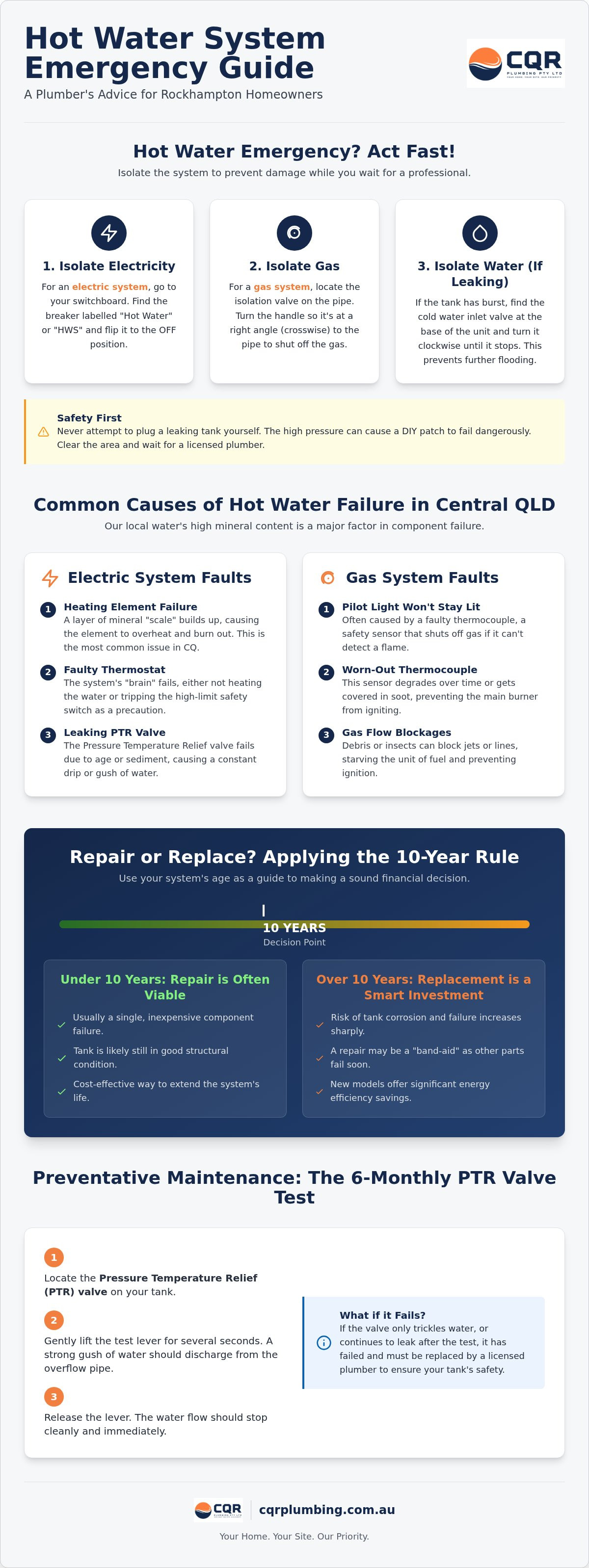
Before you touch the unit, you must isolate the energy source. For electric water heating systems, head straight to your main electrical switchboard. Look for a circuit breaker or fuse clearly labelled "Hot Water" or "HWS" and flip it to the "Off" position. This prevents the heating element from burning out if the tank is empty and eliminates the risk of electrical faults while water is present. It's a simple step that ensures the site is safe for both you and the attending plumber.
If you have a gas system, locate the gas isolation valve on the pipework leading into the heater. This is usually a small handle, often yellow or red. Turn the handle so it's at a right angle to the pipe. This "crosswise" position indicates the gas flow is shut off. Always perform a quick visual check at the base of the tank. If you smell gas or see scorched plastic around the burner cover, stay away from the unit and wait for a professional to arrive.
Managing a Burst Tank
A leaking tank requires you to stop the water flow immediately. Look for the cold water inlet pipe at the bottom of the unit. You should find a "duo valve" or a small green or black plastic handle. Turn this clockwise until it stops. If the valve is seized or too hot to touch, you might need to turn off the main water meter at the front of your property instead. This will stop the leak but will also cut off water to the entire house, so it's a last resort.
Never try to plug a hole in a leaking tank with putty or tape. These systems operate under significant pressure, and a temporary DIY patch will almost certainly fail, potentially making the split worse. While you wait for a technician to arrive, clear any furniture or boxes away from the area. If the tank is inside a cupboard, use old towels to soak up pooling water and prevent it from seeping under your floorboards or into adjacent rooms. When you call, try to have the brand name and approximate age of the unit ready. This helps us bring the right parts for a first-time fix.
Common Causes of Hot Water Emergencies in Central Queensland
Rockhampton's climate and water chemistry create a unique environment for hot water systems. Unlike some coastal areas with softer water, Central Queensland's supply often contains higher mineral levels. Over time, these minerals crystallise on the heating element, forming a thick layer of "scale." This scale acts as an insulator, forcing the element to work harder and eventually causing it to burn out or crack. Understanding these local factors is key to performing an effective emergency hot water repair Rockhampton families can rely on for long-term performance.
Electric System Faults: Why the Water is Cold
When an electric storage unit stops heating, the culprit is usually the heating element or the thermostat. As a plumber, I diagnose this by using a multimeter to check for electrical continuity. If there's no circuit, the element has snapped and needs replacement. The thermostat acts as the brain, regulating the temperature to prevent boiling; if it fails, the safety "high-limit" switch may trip, cutting all power to the unit as a precaution. The Pressure Temperature Relief (PTR) valve is a mandatory safety device designed to automatically release water to relieve excess pressure or temperature within the tank, preventing potential rupture. If you see this valve constantly dripping or gushing, it is a sign that the system is under stress or the valve itself has perished due to sediment buildup.
Gas System Emergencies: Pilot Lights and Blockages
Gas systems face different challenges, often related to ignition or gas flow. In older storage units, the most common emergency call involves a pilot light that won't stay lit. This is frequently caused by a faulty thermocouple, which is a small sensor that tells the gas valve it's safe to stay open. If the thermocouple is soot-covered or worn out, it will shut the gas supply off immediately to prevent a leak. According to the Australian Government guide to hot water systems, regular maintenance is vital for ensuring these technical components operate efficiently and safely.
Spiders or small insects can also crawl into the burner tubes, creating blockages that prevent a clean flame. While some ignition issues are simple fixes, others require a licensed gas fitter to strip the burner assembly and clear the path. If you've noticed a yellow flame or soot marks on the outside of your unit, it is best to arrange a professional inspection before the system fails entirely. Regular servicing doesn't just prevent cold showers; it ensures your gas unit remains compliant with current safety standards and operates at peak efficiency.
Repair or Replace? Making the Right Call for Your Property
Most homeowners face a tough choice when we arrive for an emergency hot water repair Rockhampton. Should you spend money on a new part or invest in a completely new unit? The decision usually hinges on the "10-Year Rule." Most vitreous enamel tanks have a design life of roughly 10 to 12 years. If your system is approaching double digits and starts showing signs of trouble, a repair often acts as a temporary band-aid rather than a long-term solution.
Evaluating the Tank Integrity
Structural failure is the most common reason we recommend a full replacement. Look for "weeping" around the base of the jacket or rust-coloured water coming from your hot taps. A small weep often precedes a major burst, so catching it early is vital. In Central Queensland, the sacrificial anode plays a massive role in protecting your tank from internal corrosion. This magnesium rod is designed to corrode so your steel tank doesn't; once it's spent, the tank is next. You can read more about identifying these warning signs in our guide on 5 Signs of a Failing Hot Water System.
Repair Scenarios vs. Replacement Scenarios
Deciding between a fix and a fresh start requires a clear cost-benefit analysis. If your unit is less than seven years old and has a failed heating element or a faulty thermostat, a repair is almost always the smartest financial move. These components are relatively inexpensive to swap out and can give you several more years of reliable service. However, if the tank itself is leaking from the cylinder, it cannot be safely repaired; it's a structural failure that requires a new installation.
Modern technology has also changed the equation. According to the Australian Government's guide to hot water systems, newer units are significantly more energy-efficient than those manufactured a decade ago. If you're running an old electric storage unit, the long-term energy savings of a new heat pump or high-efficiency system might offset the upfront cost much faster than you'd expect. When we assess an emergency hot water repair Rockhampton, we provide honest, transparent advice to ensure you aren't throwing money at a system that is destined to fail again shortly after we leave.
The Professional Emergency Repair Process: What to Expect
When we arrive for an emergency hot water repair Rockhampton, our first priority is a systematic diagnosis. We don't just start pulling covers off the tank. We begin by checking the energy source at the switchboard or gas meter to rule out external supply issues. High water pressure is another common culprit; if your mains pressure is too high, it can stress the tank and cause premature failure. By measuring these variables first, we ensure the repair addresses the root cause rather than just the symptom. This methodical approach prevents you from paying for parts you don't actually need.
Diagnosis and Compliance
Compliance with Australian Standard AS/NZS 3500.4 is non-negotiable for any licensed plumber. During any major repair or replacement, we are legally required to check your tempering valve. This device mixes hot and cold water to ensure it arrives at your bathroom taps at a safe maximum of 50°C. In a family home, this is a critical safety measure to prevent accidental scalding, especially for children and the elderly. Once the repair is finished, we perform a full commissioning process, testing for leaks under pressure and verifying temperature settings. For most hot water replacements, we also lodge a Form 4 with the QBCC, which provides you with a formal record of compliant, licensed work that protects your property insurance.
Transparency and Communication
At CQR Plumbing, we believe in total transparency. Before any work begins, we explain the diagnostic findings and provide clear options. If a simple component swap like a new heating element will get you through the night, we'll say so. If the system is a structural write-off, we'll explain why and show you the evidence. In cases where specific parts aren't available during an after-hours call, our goal is to secure the site and stop any leaks immediately. This might involve isolating the unit so you still have cold water to the rest of the house while we source the necessary components for a first-light fix. We'll then provide a clear timeframe for when the final repair can be completed, ensuring you're never left in the dark about the status of your hot water.
Preventing Future Cold Showers: Maintenance Tips for CQ Homeowners
The most effective way to avoid the stress of an emergency hot water repair Rockhampton is to treat your system like a car; it requires periodic check-ups to stay reliable. While some components are hidden away, there are several practical steps you can take to ensure your tank survives the full decade it was designed for. Neglecting these small tasks often leads to preventable failures that occur at the most inconvenient times, such as during a cold snap or when you have houseguests staying over.
The Homeowner Maintenance Checklist
Every six months, you should perform a manual test on the Pressure Temperature Relief (PTR) valve. This is the small valve with a silver lever located near the top of your tank. Gently lift the lever for about five seconds to allow a small amount of water to flow through the discharge pipe. This simple action clears out sediment and mineral deposits that can cause the valve to seize. If the water doesn't stop flowing once you release the lever, or if the valve feels stuck, it's a sign that the component has failed and needs a professional replacement.
You should also make a habit of checking the base of your unit once a month. Look for signs of dampness, pooling water, or rust stains on the jacket. If you catch a "weeping" tank early, it often gives you enough time to plan for a new Hot Water System Installation Rockhampton before the unit actually bursts. Additionally, keep an eye on your quarterly water bill. A sudden, unexplained spike in usage often points to a hidden hot water leak or a PTR valve that is constantly discharging into a drain where you can't see it.
Professional Preventative Care
In Central Queensland, our water mineral content is notably high, which makes the sacrificial anode the unsung hero of your plumbing system. This magnesium rod is designed to attract corrosive elements in the water, sacrificing itself so that your steel tank remains intact. In Rockhampton’s hard water environment, these anodes can be completely depleted within three to four years. Replacing the anode is the single best way to double the lifespan of your tank, yet it's the maintenance task most homeowners completely overlook.
We recommend scheduling a comprehensive professional service every three to five years. During this visit, a licensed plumber will check the gas burner health for efficient combustion or inspect electric elements for scale build-up. We also test the tempering valve to ensure it’s still delivering water at a safe temperature and check the electrical connections for any signs of heat stress. A proactive maintenance plan isn't just about avoiding a breakdown; it’s about ensuring your system runs as efficiently as possible, keeping your energy bills low and your morning showers reliably hot.
Restore Your Steaming Hot Water Today
Navigating a hot water crisis in Central Queensland doesn't have to be a stressful ordeal when you follow a methodical approach. By identifying whether you're facing a simple component failure or a structural tank leak, you can make an informed decision between a cost-effective repair and a necessary replacement. Remember that our unique local conditions, specifically the high mineral content in the water, require specialised maintenance like anode replacements to protect your investment over the long term.
As a locally owned and operated CQ business, we pride ourselves on providing transparent, reliable service. Our fully licensed QBCC plumbers and gas fitters possess extensive expertise in all major brands and models, ensuring every emergency hot water repair Rockhampton families require is performed to the highest Australian Standards. We focus on getting your flow restored safely and efficiently so you can get back to your routine without delay.
Don't let a cold shower ruin your week. With professional help just a phone call away, you can look forward to a steaming hot shower tonight and the peace of mind that comes with a job well done.
Frequently Asked Questions
How much does an emergency hot water repair cost in Rockhampton?
The total cost for an emergency hot water repair Rockhampton homeowners face depends on several factors, including the time of the call-out and the specific components required for the fix. A simple thermostat or heating element replacement is much more affordable than a full tank swap. We provide a clear breakdown of the required works after our initial diagnosis. Factors like gas versus electric systems and ease of access also influence the final invoice.
Can I fix a leaking hot water tank myself?
No, you shouldn't attempt to repair a leaking tank yourself. In Queensland, all hot water work is strictly regulated, and performing unlicensed plumbing can void your home insurance and manufacturer warranties. A leaking tank often involves electrical or gas components and high-pressure water, making it a significant safety risk. If your tank is leaking from the internal cylinder, it's a structural failure that requires a licensed professional to decommission and replace the unit safely.
Why is my electric hot water system taking so long to heat up?
If your system is struggling to reach temperature, it's often due to a scaled heating element. In Rockhampton, minerals in the water supply settle on the element, creating an insulating crust that prevents efficient heat transfer. This forces the system to run for much longer periods to heat the same volume of water. It could also indicate that one of the elements in a large twin-element tank has failed completely, leaving only half the heating power.
Is it normal for the hot water valve to drip occasionally?
It is perfectly normal for the Pressure Temperature Relief (PTR) valve to discharge a small amount of water during the heating cycle. This happens because water expands as it heats up, and the valve releases that excess pressure to protect the tank. However, if the valve is gushing water or dripping constantly even when the system isn't heating, it has likely perished or become blocked with sediment and requires a professional replacement to prevent water waste.
My gas hot water pilot light keeps going out; what should I do?
A pilot light that repeatedly fails usually points to a faulty thermocouple or a blockage in the pilot injector. The thermocouple is a safety device that shuts off the gas if it doesn't detect a flame. If it's worn or dirty, it will cut the gas even when the pilot is lit. You should stop trying to relight it and call a licensed gas fitter to inspect the burner assembly and ensure there are no dangerous gas leaks.
How long do hot water systems usually last in Central Queensland?
Most vitreous enamel storage systems in Central Queensland last between 10 and 12 years. Our local water conditions can be quite harsh on internal components, specifically the sacrificial anode. If you don't have the anode checked and replaced every few years, the tank can rust through much sooner. Stainless steel tanks generally offer a longer lifespan but still require regular valve checks to ensure they continue to operate safely and at peak efficiency.
What should I do if my hot water system is making a banging noise?
Banging or popping noises, often called kettling, are caused by a buildup of sediment and sludge at the bottom of the tank. When the heating element or gas burner activates, steam bubbles get trapped under this layer of debris and pop loudly. While it sounds alarming, it's a common sign that your system needs a professional flush or that the tank is reaching the end of its functional life and may soon fail.
Does a leaking hot water system always need to be replaced?
Not necessarily, but the source of the leak is the deciding factor. If the water is coming from a replaceable valve, a burst pipe, or a loose fitting, an emergency hot water repair Rockhampton service can usually fix the issue quickly. However, if the water is leaking directly from the internal cylinder jacket or the base of the tank, it indicates the steel has corroded through. In these cases, a full replacement is the only safe option.
Disclaimer
The information in this article is provided for general educational purposes only and should not be relied upon as professional plumbing, gasfitting, or legal advice. Every property and plumbing system is different, and the information may not be applicable to your specific circumstances. CQR Plumbing recommends that all plumbing and gasfitting work be inspected and carried out by a licensed professional in accordance with applicable Australian Standards and Queensland regulations. If you require advice specific to your property, please contact CQR Plumbing for an assessment.