
Expert Gutter Repairs Rockhampton: Protect Your Home from CQ Storms
A leaking gutter in Central Queensland isn't just a minor nuisance; it's a direct threat to the structural integrity of your home's foundations. When those heavy tropical summer storms hit, your guttering system has to move hundreds of litres of water away from your eaves every single minute. If that system fails, you'll likely be searching for urgent roof leak repairs Rockhampton before the next storm cell crosses the coast.
I know how frustrating it is to watch water overflow into your ceiling or down your internal walls, especially when you can't find a reliable trade who actually shows up when they say they will. You deserve the peace of mind that comes with knowing your home is watertight. In this guide, I'll explain how to identify common gutter faults, help you decide when a simple repair is better than a full replacement, and show you how to safeguard your property against our unique CQ downpours.
We will cover the technical warning signs of gutter failure, the legalities of QBCC licensing for roof work, and the practical maintenance checks you can perform to keep your stormwater flowing exactly where it should.
Key Takeaways
- Understand how Central Queensland's high-volume tropical rainfall and intense UV exposure impact the lifespan and performance of your home's guttering system.
- Identify the early warning signs of sagging brackets and leaking joins to avoid the high costs associated with emergency roof leak repairs Rockhampton.
- Use the 'Rust Ratio' to evaluate whether a localised repair provides genuine value or if a full Colorbond replacement is the more sustainable investment.
- Learn why maintaining your underground stormwater pipes is just as vital as clearing your gutters to prevent foundation damage and soil erosion.
- Ensure your property remains compliant and insured by understanding the QBCC licensing requirements for roof plumbing and the risks of using unlicensed labour.
Why Gutters Fail in Rockhampton: The Central Queensland Factor
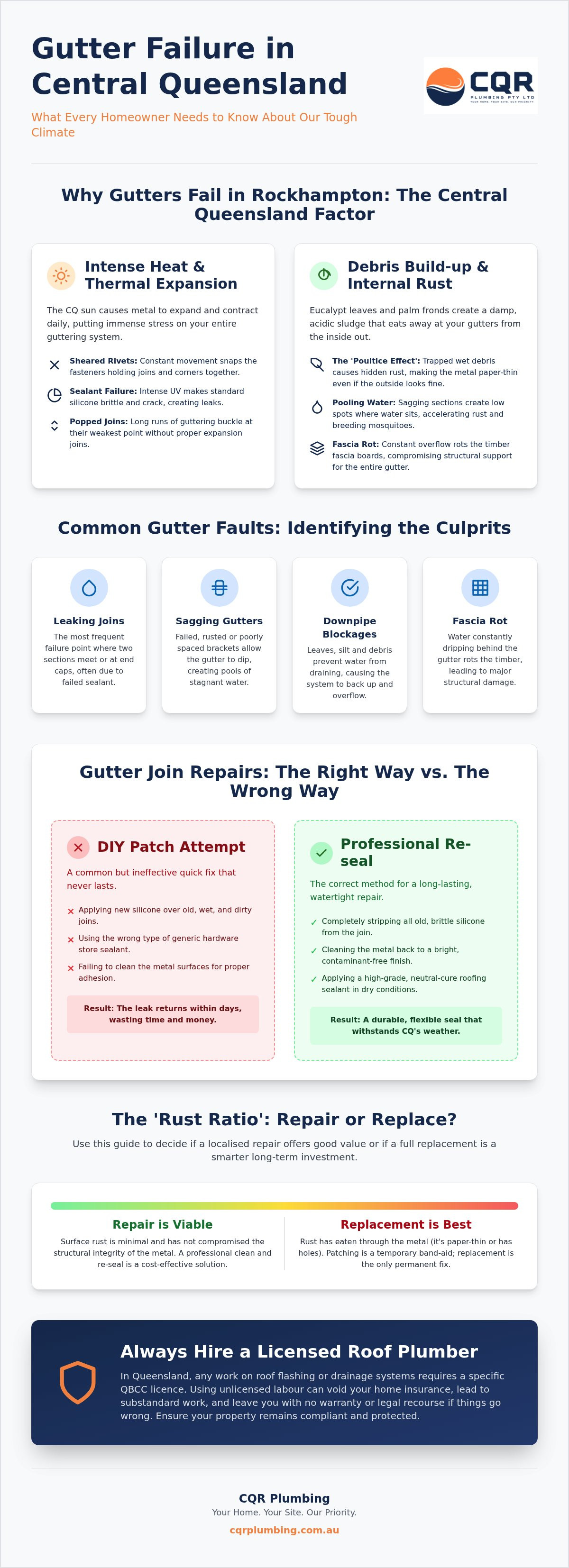
Rockhampton's climate is notoriously hard on external plumbing. While a guttering system in a southern capital might last decades, the combination of tropical humidity and intense UV exposure in Central Queensland often accelerates wear, particularly on sealants and expansion joins. If you're currently investigating roof leak repairs Rockhampton homeowners should first look at their guttering system, as the issue often starts with a gutter failure rather than a hole in the roof sheets themselves. Our summer storms can dump over 50mm of rain in under an hour; this is a massive volume of water that requires a perfectly pitched and clear system to manage, or it simply backs up into your eaves.
Intense Heat and Thermal Expansion
Metal gutters undergo significant physical stress in the CQ sun. On a 40-degree day, the surface temperature of your guttering can soar much higher, causing the metal to expand. At night, it cools and contracts. This daily cycle eventually causes several issues:
- Sheared Rivets: The constant tugging of expanding metal can snap the rivets holding your corners and joins together.
- Sealant Failure: Standard silicone can become brittle under intense UV. Once it loses its elasticity, it cracks, allowing water to bypass the join.
- Popped Joins: Long, continuous runs of guttering without expansion joins will eventually buckle or "pop" at the weakest point.
For larger homes in the region, installing professional-grade expansion joins is the only way to ensure the system remains watertight over the long term. These components allow the metal to move freely without compromising the integrity of the roof plumbing system.
Debris Build-up and Internal Rust
Local vegetation is a silent killer for metal guttering. Eucalypt leaves and palm fronds are oily and acidic, and when they accumulate, they trap moisture directly against the metal surface. This creates a 'poultice' effect that causes the metal to rust from the inside out. Even if the outside looks perfectly fine, the internal floor of the gutter could be paper-thin and ready to fail. This is why effective rainwater harvesting starts with maintaining clear, debris-free channels.
If water pools in 'low spots' due to sagging brackets, it doesn't just breed mosquitoes; it eventually rots out your timber fascia boards. Neglecting these small signs of decay usually leads to a full-scale call for roof leak repairs Rockhampton once the next tropical low crosses the coast. By the time you see water inside your home, the damage to your structural timber is often already significant.
Common Gutter Repairs: Identifying the Culprits
Most homeowners only notice a problem when they see water cascading over the side of the gutter like a waterfall. By the time you're searching for roof leak repairs Rockhampton, the issue is often a specific, identifiable fault that has been developing for months. Identifying these culprits early can save you thousands in structural repairs to your eaves and internal walls. If your gutters aren't performing, the water has to go somewhere, and unfortunately, that's usually straight into your fascia boards or ceiling cavity.
- Leaking Joins: The most frequent failure point where two sections of guttering meet or at the end caps.
- Sagging Gutters: Caused by failed, rusted, or poorly spaced brackets that allow the metal to dip under the weight of water.
- Downpipe Blockages: Often caused by leaf build-up, debris, or even silt that prevents the system from clearing.
- Fascia Rot: The direct result of water constantly dripping behind the gutter onto the timber support, eventually compromising the gutter's ability to stay attached.
Patching vs. Re-sealing Joins
I often see DIY attempts where a homeowner has tried to stop a leak by slapping a fresh bead of silicone over a wet, dirty join during a storm. This never works. The sealant cannot bond to a contaminated or damp surface, and the leak will return within days. The professional process requires stripping the old, brittle silicone, cleaning the metal back to a bright finish, and applying a high-grade neutral-cure roofing sealant in dry conditions. If the metal has actually rusted through at the join, re-sealing is just a band-aid. In those cases, you'll need a new section of guttering or a new 'pop' (the outlet leading to the downpipe) to ensure a permanent fix.
Correcting Gutter Fall and Alignment
A guttering system relies on 'fall' to function. This is the subtle slope, usually about 1:500, that uses gravity to move water toward your downpipes. In suburbs like Gracemere or Wandal, where reactive clay soils can cause minor house settling, this alignment is easily thrown out. When a gutter loses its fall, water pools in the middle of the run. This stagnant water accelerates 'inside-out' rusting and creates a heavy load that further stresses the brackets. Managing stormwater on your property effectively requires a system that is perfectly pitched to handle the volume of a CQ storm. If you've noticed water sitting in your gutters days after the rain has stopped, it's time to get a professional assessment of your roof's drainage alignment before the next tropical low arrives.
Gutter Repair vs. Replacement: Which Is Better Value?
Deciding between a quick fix and a total overhaul usually comes down to what I call the 'Rust Ratio'. If you're consistently paying for roof leak repairs Rockhampton every time a storm rolls through, you're likely just delaying the inevitable. While a localised repair might cost less today, modern Colorbond guttering offers a lifespan of 20 years or more, providing a much higher return on investment than a series of temporary patches on an ageing system.
Whether you're located inland at Rockhampton or along the coast at Yeppoon, the choice also affects your home insurance. Insurers are notoriously strict about maintenance; if they find that internal water damage was caused by a rusted gutter you knew about, they may deny your claim. A full replacement provides the documentation and security you need to show your home is storm-ready.
When to Choose Repair
I'll generally suggest a repair if the gutters are relatively young, typically under 10 years old, and the damage is isolated. This might include a single failed join, a bracket that has pulled away from the fascia, or physical damage from a fallen palm frond. If the rest of the run is free from corrosion and the pitch is still correct, there's no need to replace the entire system. It's a practical way to manage your budget while still ensuring your roof plumbing is functional before the peak of the storm season.
Signs You Need a Full Replacement
There are three major red flags that indicate your gutters have reached the end of their useful life. First is the presence of 'pinhole' rust. If you can see tiny dots of light through the floor of the gutter while standing on the ground, the metal is structurally compromised and will no longer hold a seal. Second is water leaking behind the gutter. This often indicates the back wall has rusted out, which will quickly rot your timber fascia and rafter tails if left alone.
Finally, many older homes in Central Queensland have undersized gutter profiles. If your gutters overflow even when they're perfectly clean, they simply don't have the cross-sectional area to handle our tropical rainfall intensity. In these cases, upgrading to a larger high-front profile is the only way to prevent water from entering your eaves and causing expensive internal damage. If you've noticed these signs, it's usually cheaper to replace the run now than to pay for recurring repairs and the eventual timber restoration.
Stormwater Management: Beyond the Gutters
A common mistake I see during roof leak repairs Rockhampton calls is focusing solely on the metal overhead while ignoring the PVC below. Your gutters are essentially the collection point for a much larger hydraulic system. If the underground pipes are restricted, water will back up the downpipes and overflow from the gutters, regardless of how clean or new they are. This is why a comprehensive approach to roof plumbing must include the entire path of the water, from the ridge cap to the legal point of discharge at the street.
The Gutter-to-Drain Connection
When a tropical storm hits, the volume of water is immense. If your downpipe is choked at the base by silt, debris, or tree roots, you'll experience what we call the 'waterfall effect'. This isn't always a gutter fault; it's often a symptom of blocked drains. In many older Rockhampton properties, earthenware pipes have cracked or shifted over time, allowing roots to enter and create a solid plug. We use professional CCTV drain cameras to navigate the bends of your underground lines. This technology allows us to see exactly where a blockage is occurring, whether it's a crushed pipe or a mass of palm roots. Identifying these issues early means we can often clear the line with a high-pressure jetter rather than having to excavate. If your gutters are overflowing despite being clear of leaves, the problem is almost certainly subterranean.
Protecting Your Home’s Foundations
Rockhampton's reactive clay soils are notoriously sensitive to moisture changes. When water pools near your foundations because of gutter overflow, the soil expands unevenly, which often leads to 'slab heave'. This manifests as jammed doors, cracked internal plaster, and eventually, structural failure. The goal of roof plumbing isn't just to keep your head dry; it's to maintain the stability of the ground your house sits on. Ensuring your stormwater is diverted effectively away from the building line is a critical standard we follow to protect your asset. To keep your system running correctly, I recommend these simple maintenance habits:
- Clear the pits: Regularly remove leaves and sediment from your yard sumps and downpipe outlets.
- Check the discharge: Ensure water is actually reaching the kerb and channel during heavy rain.
- Flush the lines: Use a garden hose to periodically flush the downpipes to ensure they aren't holding standing water.
By ensuring your underground lines are clear, you significantly reduce the stress on your gutters and brackets. This proactive approach is the best way to avoid the need for emergency roof leak repairs Rockhampton when the next tropical low crosses the coast and tests your home's drainage capacity.
Why Hire a Licensed Rockhampton Roof Plumber?
In Queensland, there's a strict legal distinction between someone who can paint a roof and someone who can actually touch your gutters. While a handyman might offer to patch a hole, any work involving the stormwater system is technically plumbing. Hiring unlicensed labour isn't just a risk to your home; it's often a breach of state regulations. For roof leak repairs Rockhampton homeowners can trust, a QBCC-licensed professional is the only way to ensure the work is both legal and effective. This license proves the contractor has the specific hydraulic training to manage the massive water volumes we see in Central Queensland.
A licensed plumber also provides a Compliance Certificate for significant work. This document is your safety net. If you ever list your home for sale, having a verified record of your roof plumbing in Rockhampton ensures there are no nasty surprises during the building and pest inspection. It's about protecting your asset's long-term value and ensuring the work is done right the first time.
Compliance and Insurance Peace of Mind
Insurance companies are experts at identifying non-compliant work. If a storm causes internal damage and the assessor finds that the gutters were installed with incorrect fall or undersized outlets by an unlicensed trade, they can deny your claim. We adhere strictly to Australian Standards AS/NZS 3500.3. This code governs the exact specifications for drainage and installation to prevent overflow into the building. Living on the Capricorn Coast also brings the challenge of salt-air corrosion. We select materials and fasteners specifically designed for coastal durability, ensuring your gutters don't rust out prematurely due to the salt environment.
The CQR Plumbing Difference
We focus on reactive maintenance. We know that when a leak starts, you don't want a sales pitch; you want a solution. Our team provides honest, transparent quoting. We'll tell you straight if a repair is viable or if you're throwing good money after bad on a system that's past its use-by date. We've seen too many Rockhampton homes suffer because of unreliable trades who disappear after a storm. We're here to provide the peace of mind that comes with professional, local expertise. Our goal is to ensure your home is watertight before the next tropical low crosses the coast.
Ready for the next storm? Request a quote from our local team today
Secure Your Home Before the Next Storm Season
Protecting your property from Central Queensland's intense tropical downpours requires more than just a quick patch on a rusted join. Effective stormwater management relies on a correctly pitched guttering system and clear underground drainage lines. By prioritising proactive maintenance and using high-quality materials like Colorbond, you avoid the stress and high costs of emergency roof leak repairs Rockhampton when the summer storms inevitably arrive.
CQR Plumbing is a locally owned and operated business in Central Queensland. Our team consists of licensed QBCC roof plumbers who understand the unique demands of our local climate. We provide authoritative, reliable service, including 24/7 emergency storm response for those critical moments when you need help immediately. Don't wait for the next tropical low to reveal a hidden fault in your roof plumbing or cause expensive damage to your timber fascia boards.
Take the first step toward a watertight home and gain the peace of mind that comes with genuine local expertise. We look forward to helping you safeguard your foundations and your home's structural integrity.
Frequently Asked Questions
How much do gutter repairs cost in Rockhampton?
The cost of guttering work depends on the extent of the damage and the materials required for a permanent fix. Minor tasks like re-sealing a join or replacing a few brackets are quite affordable, while replacing entire runs of guttering involves more labour and material. It is important to remember that in Queensland, any residential work exceeding $3,300 including GST requires a QBCC-licensed contractor and the payment of a Home Warranty Insurance premium.
Can I repair my own gutters with silicone?
Silicone is rarely a permanent solution because it requires a perfectly clean and dry surface to bond correctly. Most domestic silicones can't handle the extreme UV levels in Central Queensland or the constant expansion and contraction of metal gutters. We use industrial-grade, neutral-cure roofing sealants that remain flexible over time, ensuring the join doesn't pop again during the next heatwave.
Why do my gutters overflow even when they are not blocked?
Overflowing is often caused by a lack of 'fall' or because the gutter profile is too small for our tropical rainfall intensity. If the water isn't moving toward the downpipes quickly enough, it simply backs up and spills over the front. This can also be a sign of a blockage in the underground stormwater pipes, which creates back-pressure and prevents the downpipes from clearing. This is a common trigger for homeowners to seek roof leak repairs Rockhampton wide.
How often should I have my gutters inspected in Central Queensland?
You should have your gutters professionally inspected at least twice a year. The most critical time is just before the summer storm season begins in October to ensure the system is clear and structurally sound. A second check after the dry season helps remove accumulated leaf litter from local eucalypts and palms that can cause internal corrosion if left to rot over winter.
What is the difference between a roofer and a roof plumber?
In Queensland, a roof plumber is a licensed specialist specifically trained to manage the hydraulic components of a roof, including gutters, downpipes, and stormwater drainage. While a general roofer might focus on the installation of tiles or metal sheets, a roof plumber ensures the entire water collection system complies with Australian Standards AS/NZS 3500.3 for drainage and overflow prevention.
Does CQR Plumbing offer emergency roof and gutter repairs during storms?
Yes, we provide a 24/7 emergency response for storm-related damage across Rockhampton and Yeppoon. If a sudden failure occurs during a tropical low, our team can perform 'make-safe' repairs to prevent internal water damage to your ceilings and walls. We then return in dry conditions to implement a permanent, insurance-grade repair or replacement.
How long does a typical gutter repair take?
Most minor repairs, such as re-securing sagging brackets or fixing leaking joins, are completed within two to four hours. If a full gutter replacement is required for a standard family home, the job usually takes one full day to complete. We prioritise efficiency to ensure your home is watertight and protected before the next forecast rain event arrives.
What are the best gutter materials for homes near the coast in Yeppoon?
For homes along the Capricorn Coast, we recommend Colorbond Ultra or stainless steel. Standard metal finishes can struggle with the constant salt spray and high humidity of the Yeppoon area. Colorbond Ultra is specifically engineered for severe coastal environments, providing a much longer lifespan and better resistance to atmospheric corrosion than standard grade materials. This investment prevents the frequent need for roof leak repairs Rockhampton and coastal residents often face with inferior products.
Disclaimer
The information in this article is provided for general educational purposes only and should not be relied upon as professional plumbing, gasfitting, or legal advice. Every property and plumbing system is different, and the information may not be applicable to your specific circumstances. CQR Plumbing recommends that all plumbing and gasfitting work be inspected and carried out by a licensed professional in accordance with applicable Australian Standards and Queensland regulations. If you require advice specific to your property, please contact CQR Plumbing for an assessment.