
Gas Hot Water Not Working? Troubleshooting & Expert Repairs in Rockhampton & Yeppoon
Imagine stepping into the shower on a brisk morning in Yeppoon, only to be met with a freezing blast of water that just won't heat up. Finding your gas hot water not working is a stressful experience that usually happens at the worst possible time, leaving you stuck between the need for a quick fix and the fear of a dangerous gas leak or an expensive replacement bill.
It's a situation most homeowners dread, and it's easy to feel overwhelmed by the technical side of gas valves, pilot lights, and thermocouples. This comprehensive guide is designed to take the guesswork out of the process by providing a step-by-step diagnostic logic used by professional maintenance plumbers. You'll learn how to perform safe supply checks and recognise when a component has reached the end of its service life.
We'll cover everything from simple LPG bottle swaps to complex ignition failures, ensuring you have the knowledge to restore your hot water safely or make an informed decision about a professional repair. By understanding how these systems operate, you can avoid unnecessary costs and ensure your household remains compliant with current Australian plumbing standards.
Key Takeaways
- Learn how to distinguish between a simple empty LPG bottle and a potential gas leak by performing safe supply checks.
- Identify the most common mechanical causes for your gas hot water not working, including pilot light extinction and thermocouple failure.
- Understand the diagnostic differences between troubleshooting continuous flow systems and traditional gas storage tanks.
- Apply the "Rule of 10" to decide whether a component repair or a full system replacement is the most cost-effective path forward.
- Recognise the legal and safety requirements for hiring a QBCC licensed gasfitter to ensure your installation remains compliant.
Immediate Safety and Supply Checks: Is it the System or the Fuel?
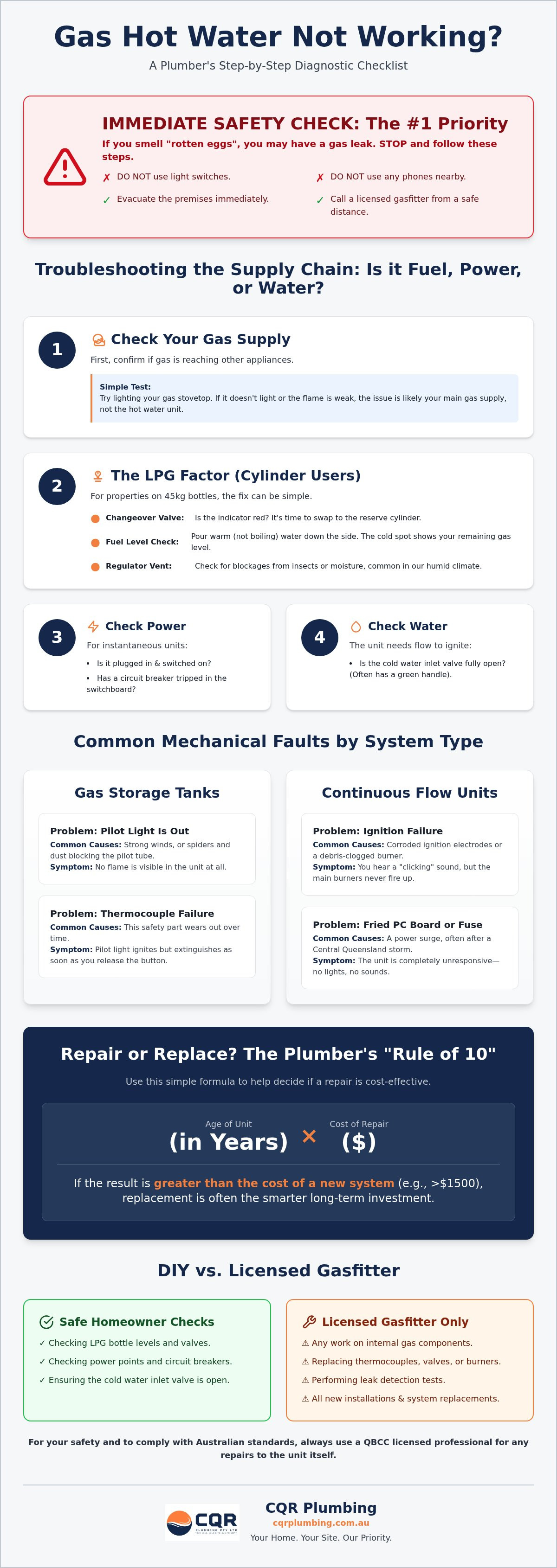
Before examining the internal components of your heater, you must address the most critical factor: safety. Gas suppliers add a chemical called mercaptan to natural gas and LPG, giving it a distinctive "rotten egg" odour. If you detect this smell, do not operate any light switches, use a telephone near the unit, or attempt to relight a pilot flame. Evacuate the premises immediately and contact a licensed professional to perform a leak detection test. Safety is the absolute priority when your gas hot water is not working.
If there is no smell of gas, the next step is a simple supply isolation test. It's common for homeowners to assume a major mechanical failure when the issue is actually a lack of fuel. If you have gas cooking appliances, try lighting a burner on the stovetop. If the flame is weak or won't light at all, the problem lies with your main gas supply or meter rather than the hot water unit itself. For those with continuous flow systems, remember that these modern units require a stable electricity supply to operate the digital controller and electronic ignition. A tripped circuit breaker in your switchboard is often the silent culprit behind a cold shower.
The LPG Factor in Central Queensland
Many properties across Yeppoon and the Capricorn Coast rely on 45kg LPG cylinders rather than reticulated natural gas. If your gas hot water is not working, check your bottles first. You can accurately verify the fuel level by pouring a jug of warm (not boiling) water down the side of the cylinder. Run your hand down the metal; the portion of the tank that feels cold to the touch indicates the remaining liquid level. Also, inspect the changeover valve located between the two bottles. If the indicator has turned red, it's time to swap to the reserve cylinder and order a refill. In our humid climate, insects or moisture can sometimes block the small vent on the gas regulator, which prevents the correct pressure from reaching your appliances.
Power and Water Supply Isolation
Modern instantaneous units are usually plugged into an external weatherproof power point (GPO). Check that the plug is pushed in firmly and the switch is in the 'on' position. If your area has recently experienced a heavy Central Queensland storm, a power surge may have tripped the internal safety fuse or fried the digital PC board. Additionally, verify that the cold water inlet valve, often a green-handled "duo valve" located at the base of the unit, is fully open. If the unit doesn't sense sufficient water flow, the gas burners will never engage. For urgent assistance with these electrical or supply faults, our team provides 24/7 emergency response to get your system back online safely.
Common Mechanical Faults: Why Your Gas System Won’t Ignite
Once you've ruled out an empty LPG bottle or a tripped circuit breaker, the focus shifts to the internal ignition sequence. If your gas hot water is not working despite having a clear fuel supply, a mechanical or electronic fault is likely preventing the burners from firing. In older storage units, the most frequent culprit is a simple pilot light extinction. This tiny flame must stay lit 24/7 to ignite the main burner when the thermostat calls for heat. While a strong gust of wind can blow it out, we often find that Central Queensland spiders or dust buildup in the pilot tube are the real causes. These obstructions disrupt the precise gas-to-air ratio required for a stable flame.
Modern continuous flow units face different challenges. You might hear the distinct "clicking" of the electronic igniter, but the system fails to transition to a full flame. This often happens because the burner assembly is clogged with debris or the ignition electrodes have become corroded. If the unit can't verify a successful ignition within a few seconds, it will shut down for safety. Identifying these faults early can prevent the need for a full system replacement. If your unit is struggling to fire up, you can request a quote for a professional diagnosis to pinpoint the exact failure point.
The Role of the Thermocouple
The thermocouple is a critical safety component found in nearly all gas storage heaters. It's a small copper probe that sits in the pilot flame, converting heat into a tiny electrical current. This current sends a signal to the gas valve, telling it that it's safe to stay open. If the thermocouple fails, the valve will snap shut to prevent unburnt gas from filling your home. A classic sign of failure is a pilot light that ignites but goes out immediately when you release the control knob. Because this involves the integrity of the gas valve and safety sensors, it's a task that must be handled by a licensed gasfitter to ensure the system remains compliant with Australian Standards.
Electronic Controllers and Error Codes
High-tech units from brands like Rinnai or Rheem use digital controllers to communicate specific faults. If you see a flashing number on your internal keypad or the unit's interface, it's providing a diagnostic map of the problem. Code 11 typically indicates an ignition failure, while Code 12 suggests the flame was lost during operation. If you see Code 14, the unit has detected an overheat condition and has shut down to protect the heat exchanger. Before booking a service, try a "soft reset" by switching the power point off for 30 seconds and then back on. This can sometimes clear minor sensor glitches caused by power fluctuations during local storms.
Troubleshooting by System Type: Storage vs. Continuous Flow
Identifying why your gas hot water is not working requires a different diagnostic approach depending on whether you have a storage tank or a continuous flow unit. Storage systems rely on a large volume of water being kept at temperature, while continuous flow models heat water instantly as it passes through a heat exchanger. One common frustration with instantaneous units is the "cold water sandwich." This occurs when you turn the tap off and back on quickly; you get the hot water left in the pipes, followed by a burst of cold water that entered the system before the burners could reignite, then hot water again. It's a normal characteristic of the technology, but if the cold gap lasts longer than a few seconds, your sensors may be struggling.
Water pressure also plays a significant role, particularly in elevated parts of Yeppoon. Continuous flow units require a minimum "start-up" flow rate to engage the gas burners. If your household water pressure is low or you've installed highly restrictive water-saving showerheads, the unit might not "sense" the demand. This leaves you with a system that appears functional but fails to provide heat because the internal flow switch never activates.
Gas Storage Unit Faults
If you own a storage tank, keep an eye out for "rusty water" or puddles around the base. These are often signs of a failing cylinder. Inside every tank is a sacrificial anode (SAC), a metal rod designed to corrode so the steel tank doesn't. If this isn't replaced every few years, the tank will eventually rust through, leading to a non-repairable leak. You might also notice your Pressure Temperature Relief (PTR) valve dripping. While a small amount of discharge is normal during the heating cycle, a constant stream indicates a faulty valve or high mains pressure. Furthermore, a "rumbling" or "knocking" sound during heating usually points to sediment build-up at the bottom of the tank, which reduces efficiency and can eventually lead to hot spots that damage the lining.
Continuous Flow Performance Issues
For those with instantaneous systems, Rockhampton's water mineral content can lead to scaling within the heat exchanger. Over time, calcium deposits restrict water flow and insulate the copper pipes, forcing the unit to work harder and eventually causing it to shut down. Regular maintenance involves cleaning the cold water inlet strainer, which often becomes clogged with fine grit or debris from the mains. If this filter is blocked, it reduces the flow rate below the unit's activation threshold, resulting in your gas hot water not working when you need it most. Ensuring these filters are clear is a simple way to maintain hot water reliability without needing complex repairs.
Repair or Replace? Assessing Your Hot Water System’s Future
When you find your gas hot water not working for the third time in a year, you have to ask if you're throwing good money after bad. In the plumbing trade, we generally apply the "Rule of 10" as a benchmark for decision-making. If your system is over 10 years old, the cost of a major repair often represents a significant percentage of a brand new, warrantied unit. While a component replacement might get you through the week, it doesn't fix a thinning tank or a scaled-up heat exchanger that is nearing the end of its functional life.
In Central Queensland, our specific environment plays a massive role in these decisions. The mineral content in Rockhampton’s water supply and the coastal salt air in Yeppoon accelerate both internal corrosion and external cabinet rust. If your current unit is a traditional storage tank, this is the ideal time to consider an upgrade to a continuous flow system. These units only heat water on demand. You aren't paying to keep a large volume of water hot while the house is empty, which can lead to noticeable savings on your gas bill.
Warning Signs of Imminent Failure
Keep a close eye on the physical condition of your heater. Visible rust bubbling under the paint of the outer casing or a constant puddle in the base tray are clear indicators that the internal cylinder is compromised. You should also take note if your pilot light requires manual relighting every week; this usually suggests a warped burner or a failing gas control valve. Perhaps the most telling sign is discoloured, brown, or milky water appearing at your hot taps. This confirms that the internal sacrificial anode has been depleted and the steel tank is now rusting from the inside out.
Energy Efficiency and Compliance
Modern gas technology has advanced significantly, with current 6-star rated units offering much lower running costs than the "gas guzzlers" from a decade ago. Beyond efficiency, a new installation brings your home up to current Australian Standards. This includes the mandatory installation of a tempering valve. These valves mix hot and cold water to ensure a maximum of 50°C at the bathroom taps, which is essential for preventing accidental scalding in children. In Queensland, any major hot water work must be performed by a licensed gasfitter and lodged with the QBCC via a Form 4. This protects your manufacturer's warranty and ensures your household insurance remains valid.
Professional Gas Hot Water Services in Rockhampton and Yeppoon
Gas fitting is a highly restricted trade in Queensland for a very good reason. Attempting to fix a system where you find the gas hot water not working involves more than just turning a wrench; it requires a deep understanding of gas pressures, ventilation requirements, and combustion safety. The QBCC strictly regulates who can perform this work to prevent the catastrophic risks of fire, explosion, or carbon monoxide poisoning. When you engage a licensed professional, you aren't just paying for a quick fix. You're investing in the safety of your family and the long-term reliability of your appliance.
Our approach at CQR Plumbing is built on quiet competence and transparency. We don't guess; we measure. This systematic diagnosis is crucial for avoiding unnecessary "part-swapping" costs that occur when a plumber simply replaces components until the unit starts working again. We understand the specific plumbing layouts common in our region, such as the older high-set Queenslanders in Rockhampton that often require unique pipework considerations or the modern builds in Gracemere. By knowing the local infrastructure, we can quickly identify if a pressure drop is a street-side supply issue or an internal fault. We provide a 24/7 response because we know that a cold shower is an urgent problem that needs a resolution today.
Why Choose a Licensed Gasfitter?
Hiring a tradesperson with a current QBCC gasfitting licence is the only way to ensure your work is compliant with Australian Standard AS/NZS 5601.1. This isn't just about safety; it's about protecting your property value and your home insurance. If an unlicensed repair leads to property damage, your insurer will likely reject the claim. Our team arrives with specialised diagnostic tools, including digital manometers for precise pressure testing and electronic leak detectors to find faults that the naked eye would miss. This professional equipment allows us to verify that your system is operating at peak efficiency and safety. You can Request a Quote for Hot Water Repairs to see how we can assist with your specific system.
Our Service Area
We have deep roots in the local community and understand the specific plumbing challenges of the Capricorn Coast region. From the reticulated natural gas networks in the Rockhampton CBD to the LPG-dependent coastal homes in Yeppoon, we have the experience to handle any gas hot water not working scenario. We take pride in being a dependable neighbour who possesses high-level technical skills. We proudly serve:
- Rockhampton and surrounding suburbs like Gracemere and Parkhurst.
- Yeppoon, Emu Park, and the wider Capricorn Coast region.
For immediate help and expert advice, visit our Emergency Plumbing Services Rockhampton or Hot Water System Experts Yeppoon pages.
Restoring Your Household Reliability
Dealing with your gas hot water not working is a significant disruption to your daily routine, but a systematic approach ensures you aren't caught off guard by hidden costs. By distinguishing between simple supply issues like empty LPG cylinders and complex mechanical failures like thermocouple or ignition faults, you can take control of the situation. Remember that while basic checks are safe for homeowners, any work involving the gas train or internal valves must be handled by a qualified professional to maintain your home's safety and insurance validity.
Our team of licensed gasfitters and hot water specialists is committed to providing honest, practical advice that prioritises your long-term benefit over a quick sale. Whether you need a 24/7 emergency repair in Rockhampton or a compliant system upgrade in Yeppoon, we ensure all workmanship meets strict QBCC standards. We use specialised diagnostic tools to pinpoint the exact cause of failure, giving you peace of mind that your hot water will remain consistent and efficient for years to come.
Don't settle for another cold morning or an unreliable heater. Reach out to your local experts to get your system back to peak performance safely and efficiently.
Common Questions About Gas Hot Water Repairs
Can I relight the pilot light on my gas hot water system myself?
Yes, you can usually relight the pilot light yourself by following the specific instructions printed on the inside of the unit's access cover. However, if the flame refuses to stay lit after you release the control knob, it typically points to a failed thermocouple or a blocked pilot injector. You should never attempt to force the gas valve or use an external flame if you detect any scent of gas around the system.
Why does my gas hot water system run out of hot water so quickly?
Running out of hot water prematurely is often a sign of a broken internal dip tube or significant sediment build-up at the base of the tank. In Rockhampton, minerals in the water supply can settle over time, effectively reducing the storage capacity of your heater. If you find your gas hot water not working as effectively as it used to, a professional flush or a component check is usually required to restore its original capacity.
What should I do if I smell gas near my hot water unit?
You must evacuate the immediate area and turn off the gas supply at the meter or cylinder valves if it is safe to do so. Avoid using light switches, mobile phones, or any electronic devices near the unit, as these can act as ignition sources. Once you are at a safe distance, contact a licensed gasfitter immediately. Detecting a leak is a high-priority safety task that requires specialised equipment like electronic manometers.
How long does a typical gas hot water system last in Central Queensland?
In the Central Queensland climate, a well-maintained gas hot water system typically lasts between 8 and 12 years. Properties in Yeppoon may see slightly shorter lifespans due to salt air corrosion, while Rockhampton homes deal with mineral scaling. Replacing the sacrificial anode every few years is the most effective way to protect the tank from internal rust and ensure you get the maximum possible service life from your investment before a replacement is needed.
Why is my continuous flow hot water system showing an error code?
Continuous flow units use error codes to identify specific faults like ignition failure or flame sensing issues. These codes are designed to protect the unit from damage and ensure user safety. While you can try a "soft reset" by switching the power off at the wall for 30 seconds, persistent codes mean a sensor or component has failed. These technical repairs must be performed by a licensed professional to maintain compliance and ensure safe operation.
Does a gas hot water system still work during a power outage?
Whether your system works during a blackout depends entirely on the model. Traditional storage units with a standing pilot light operate without electricity, making them very reliable during Central Queensland storms. Conversely, modern continuous flow systems require a 240v power supply to operate the electronic ignition and digital controllers. If the power is out, these units cannot heat water. Some homeowners choose to install a small Uninterruptible Power Supply (UPS) to keep these systems running.
Is it normal for my hot water system to leak or drip from the valve?
It is normal for the Pressure Temperature Relief (PTR) valve to drip slightly while the water is heating up, as this manages thermal expansion. However, a continuous leak or a heavy stream of water is a sign of a faulty valve or high water pressure. If you notice excessive discharge, it’s important to have the valve replaced. Ignoring a leaking valve can lead to high water bills and unnecessary stress on the tank’s internal lining.
How often should I have my gas hot water system serviced?
We recommend a professional service every two years to maintain the safety and efficiency of your unit. During a service, we check the burner pressure, clean the pilot assembly, and inspect the sacrificial anode. This preventative maintenance is the best way to avoid finding your gas hot water not working on a cold morning. Regular checks also ensure your system remains compliant with current Australian Standards and manufacturer warranty requirements for long-term reliability.
Disclaimer
The information in this article is provided for general educational purposes only and should not be relied upon as professional plumbing, gasfitting, or legal advice. Every property and plumbing system is different, and the information may not be applicable to your specific circumstances. CQR Plumbing recommends that all plumbing and gasfitting work be inspected and carried out by a licensed professional in accordance with applicable Australian Standards and Queensland regulations. If you require advice specific to your property, please contact CQR Plumbing for an assessment.