
Heat pump hot water system cost in Australia: what shapes your 2026 quote?
Heat pump hot water system cost Australia homeowners are quoted can vary because two similar homes may need different installation work. Household hot-water use, existing plumbing and available space all affect which system may suit and how it can be installed.
Before choosing a system, consider how your household uses hot water, where the equipment could go and what changes the installation may involve. This guide explains how heat pumps work, what can affect their operation and how they compare with other hot-water options.
CQR Plumbing installs hot water systems for homes and businesses across Rockhampton, Yeppoon, the Capricorn Coast, Gracemere and Emu Park. We explain the proposed work before it starts, so you can understand what the installation involves.
Key Takeaways
- Understand why the heat pump hot water system cost Australia homeowners are quoted depends on household demand, equipment and site conditions.
- Learn how a heat pump draws warmth from surrounding air to heat stored water, and what the outdoor unit needs for suitable placement.
- Compare heat pump, electric, gas and solar systems by energy source, installation needs and household suitability.
- Use a practical checklist to review equipment selection, removal, connections, commissioning and any other trade work in the installation scope.
- See how a site assessment and project-specific scope help set expectations for installation across Central Queensland.
Heat pump hot water system cost in Australia: what determines the quote?
A heat pump water heater draws heat from the surrounding air and transfers it to water in a storage tank. Selecting and installing one involves more than choosing equipment. Your household’s hot-water habits, the existing unit and connections, and the property layout all affect the work needed to get the system ready to use.
There isn’t one installation plan for every home. Even houses with similar hot-water use can have different access, connection and placement requirements. A site assessment identifies these practical details before work begins. An assessment at your property gives a clearer picture of the installation than a general estimate because it accounts for the existing setup and available space.
What a heat pump installation needs to account for
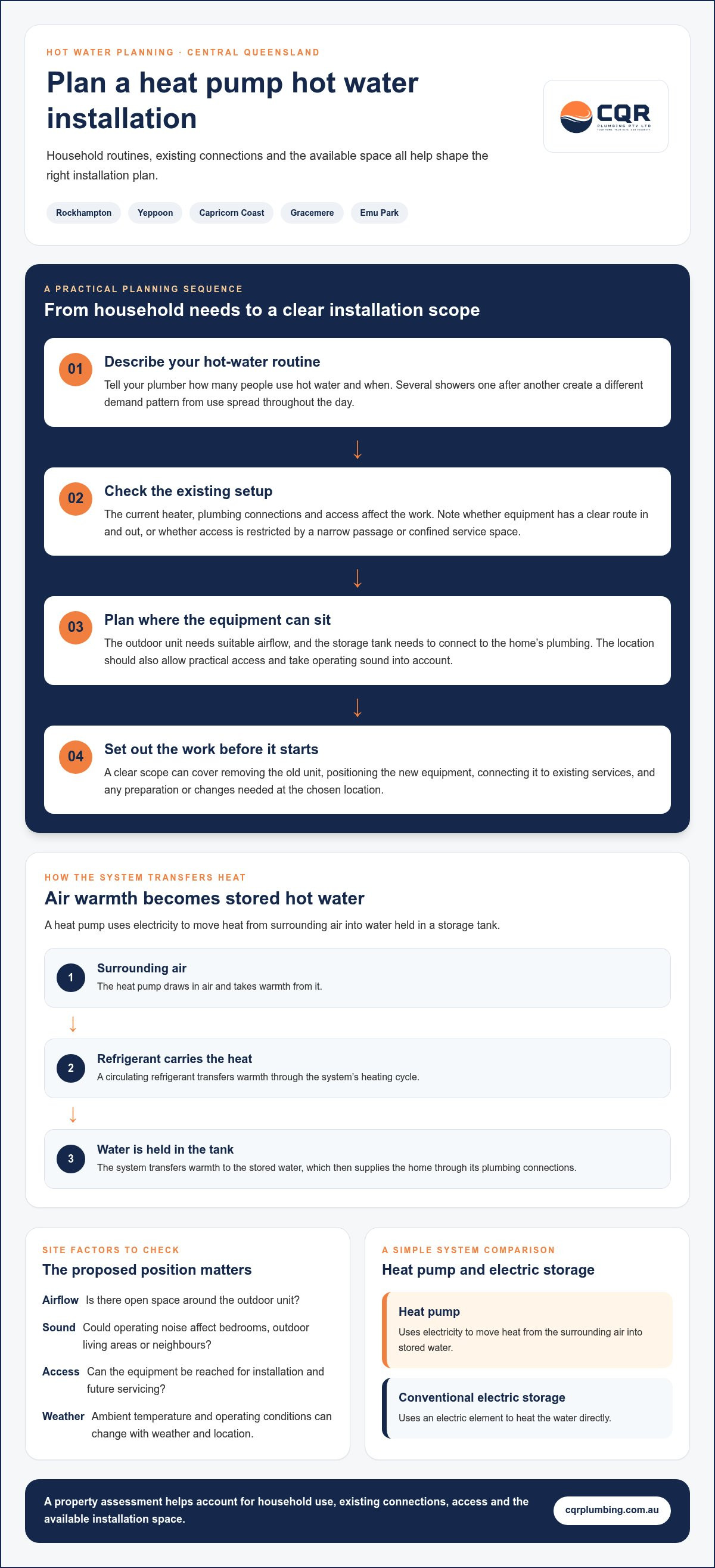
System selection should reflect how your household uses hot water. The number of people in the home matters, but so does the timing of use. Several people showering one after another create a different demand pattern from hot-water use spread throughout the day. Share these routines when discussing system options.
The existing heater and plumbing connections help determine what work is involved. The old unit may need to be removed, and the position of existing connections can affect where the replacement can go. Access matters too: bringing equipment through a clear path beside the house is different from moving it through a narrow side passage or confined service space.
Placement needs careful thought. The heat pump’s outdoor unit requires a suitable position, while the storage tank needs to connect to the home’s plumbing. If the preferred location requires changes to existing services or preparation of the area, include that work in the scope. CQR Plumbing carries out hot water plumbing in Rockhampton, with the proposed work explained before it starts.
Why two Australian homes can need different installation work
One home may have an accessible existing heater and a practical position nearby for the replacement. The work may then centre on removing the old unit, positioning the new equipment and connecting it to the home’s services.
Another property may need more preparation. Access could be restricted, the preferred location may be further from existing connections, or the available space may limit where the equipment can sit. These details affect the installation even when household routines are similar. The chosen location also needs to allow practical access to the equipment and meet its installation requirements.
Heat pumps transfer warmth from air through a refrigeration cycle. Wikipedia provides a general explanation of heat pump operation and efficiency. For your installation, focus on the proposed system, removal of the existing heater, equipment placement, connections and any changes to services. A clear scope sets out what the work involves before it begins.
How a heat pump hot water system works and what affects its performance
A heat pump water heater takes warmth from the surrounding air and transfers it into water held in a storage tank. Electricity powers the system’s components, but it doesn’t heat water in the same way as a conventional electric storage heater, which uses an element to heat the water directly. A heat pump moves heat from the air into the tank; a conventional electric storage unit heats the water with an element.
The main parts of a heat pump water heater
The system usually includes a heat pump unit, a storage tank and controls. The unit draws in surrounding air and passes heat to a refrigerant, a fluid that circulates through the system. As the refrigerant moves through the heating cycle, it transfers warmth to the stored water. The tank then supplies hot water to the home through its plumbing connections. System layouts vary, so components may be arranged differently.
Controls manage the heating cycle and let the system respond to household use. For a broader explanation of heat pumps in Australian homes, the Australian Government guide to hot water systems outlines different options. The basic principle is that a heat pump uses electricity to move heat, rather than relying only on an electric element to generate heat in the water.
Household demand, placement and day-to-day operation
Performance is affected by the air around the unit. Ambient temperature influences how readily the system can draw in heat, and operating conditions can change with the weather and installation location. The unit also needs adequate airflow. A tight, enclosed area can restrict air movement or allow cooled air to circulate back through the system, so consider the proposed position carefully.
Household routines matter too. A home where several people shower in quick succession has a different demand pattern from one where hot-water use is spread across the day. Choose a system to suit both typical household use and the available installation space. In Rockhampton, Yeppoon and nearby Central Queensland communities, a hot water system installation needs to account for the property layout and how occupants use hot water.
- Airflow: Is there open space around the outdoor unit, rather than a confined corner?
- Sound: Could operating noise affect bedrooms, outdoor living areas or neighbouring properties?
- Access: Can the unit and tank be reached for installation and future servicing?
- Controls: Can the settings be adjusted to suit your household’s usual hot-water routine?
These are useful points to consider when planning a location. Check the manufacturer’s guidance for the specific system and discuss any concerns about sound, airflow or access during planning. To discuss an installation for your property, get in touch about your hot water system.
Heat pump vs electric, gas and solar hot water: compare the practical trade-offs
No hot-water system suits every home. Compare how each option heats water, what the property needs for installation and how well its operation matches your household. The heat pump hot water system cost Australia homeowners are quoted is only one part of the decision; equipment choice and site requirements also shape the work involved.
Heat pump: Uses heat from surrounding air to warm water in a storage tank. It needs a suitable outdoor position with airflow, plus connections to the home’s plumbing and electrical supply. It may suit households that can plan for the equipment’s location and match the system to their hot-water routines.
Electric storage: Uses an electric element to heat water held in a tank. It needs space for the unit and suitable electrical and plumbing connections. It may be practical where an existing electric system and its location suit the household’s needs.
Gas: Uses gas to heat water. Installation depends on the system type and the property’s existing services and layout. It may suit a property with gas available where the household prefers to retain a gas hot-water system.
Solar: Uses roof-mounted collectors to capture sunlight and heat water. The roof, collector position, pipework and available space all affect suitability. It may suit a property with an appropriate roof layout and a household prepared to consider how solar heating fits its needs.
When a heat pump may suit a household
A heat pump may be worth considering if its operating approach fits your household and there’s a practical place for the outdoor unit. Think about when hot water is used, how much space is available and whether the location allows suitable airflow. Existing plumbing and electrical services also affect the installation. These are general considerations, not a guarantee of performance or suitability for a particular property.
For example, a household with a clear outdoor area may have more placement options than one with limited service space. Daily demand matters too. Select a system with your household’s use in mind, rather than choosing one simply because the technology is familiar or popular.
When another hot-water system may be a better fit
An existing system type may make sense if its connections and location already suit the property and household. Electric storage may fit a home set up for that arrangement; gas may suit a property with appropriate gas services; solar may be an option where roof conditions and the installation layout work. Each choice has its own site requirements, so don’t decide on one feature alone.
Compare the energy source, installation changes, available space, household routines and practical requirements of living with the system. CQR Plumbing’s hot water system service includes system installation, with the proposed work considered for the property rather than assumed from a one-size-fits-all comparison.
What to check before accepting a heat pump hot water installation quote
A clear quote should describe the work at your property, not just name a system. Before accepting, check that it accounts for your household’s hot-water needs, the existing installation and the practical conditions on site. The heat pump hot water system cost Australia homeowners are quoted can’t be assessed properly without understanding what the work includes.
Questions a clear installation scope should answer
Check that the proposed system suits your household’s use and that the quote explains the work from removal through to commissioning. It should identify the installation location, plumbing connections and any electrical or other trade work. A clear scope also states what is excluded, so responsibilities and additional work aren’t left unclear once installation is under way.
- System choice: Is the proposed system suited to the number of people in your household and how you use hot water?
- Existing unit: Does the scope cover disconnecting and removing the old heater, including any access issues?
- Placement: Is the intended position identified, with enough room to install the unit and allow access around it?
- Connections: Does the quote describe the plumbing work and identify any changes needed to existing services?
- Other trades: If electrical or other trade work is required, does the scope say what work is needed and who is responsible for arranging it?
- Commissioning: Does the work include starting and checking the installed system, and explaining its controls?
- Inclusions and exclusions: Can you see what the quoted scope covers and what sits outside it?
Commissioning matters because installation involves more than positioning equipment and connecting pipes. Understand what will be checked before the system is handed over and how to use its controls. If any item is unclear, resolve it in the written scope before work begins.
Preparing the site in Rockhampton and nearby areas
Before the assessment, note where the existing heater sits, how it can be reached and where a replacement might fit. Mention gates, narrow paths, steps, nearby windows and areas where people spend time. Describe your usual hot-water routine too. These details help establish the site and household requirements, while an on-site assessment confirms the installation conditions.
A property in Rockhampton may have different access and placement constraints from one in Yeppoon, Gracemere or Emu Park. A site assessment accounts for the actual installation environment and existing services, unlike a generic online estimate. CQR Plumbing provides hot water installation support in Rockhampton and explains the proposed work before starting.
Heat pump hot water installation in Central Queensland: what happens next
A well-managed installation starts by understanding your household and property, then agreeing on the work before it begins. CQR Plumbing installs hot water systems for homes and businesses in Rockhampton, Yeppoon, the Capricorn Coast, Gracemere and Emu Park. The process gives you a clear view of what’s proposed and how the installation will proceed.
- Discuss household needs: Explain how many people use hot water, when demand is highest and any issues with the current system.
- Assess the site: Review the existing unit, access, possible installation positions and relevant plumbing connections.
- Define the work: Set out the proposed system, removal and installation tasks, connections and any other work required.
- Complete the installation: Carry out the agreed work and check the system as part of commissioning.
From site assessment to an agreed scope
Your household’s hot-water use helps guide system selection, while the site assessment identifies practical installation requirements. Existing services, the access route and the intended location all inform the work. A clear scope records what will be done, what other trade work is needed and who is responsible, so you understand the plan before work starts.
If site conditions change what’s required, those details should be explained rather than left as a surprise. This is particularly useful where access is restricted or the new location differs from the existing one. For wider background on the installation process, see this hot water installation guide.
Installation handover and ongoing care
After installation, commissioning involves checking that the system has been connected and is operating as intended. The handover should include basic guidance on the controls and operating points you need to know. Take time to understand the settings and where to find the manufacturer’s instructions, rather than relying on assumptions based on your previous heater.
- Keep the manufacturer’s operating and care instructions somewhere accessible.
- Follow the maintenance advice provided for your particular system.
- Arrange qualified servicing if the system develops a fault or needs attention.
Maintenance needs vary by system, so don’t apply generic instructions to unfamiliar components. If you notice a change in operation, record what you’ve observed and refer to the manufacturer’s guidance. A qualified professional can assess work that needs technical attention.
Central Queensland properties vary in layout, access and existing services. A project-specific assessment accounts for those conditions and gives you a clearer understanding of the work than a generic online estimate. CQR Plumbing explains the installation requirements before starting and provides a clear scope, so you know what’s planned.
Make your next hot-water decision with confidence
Choosing a replacement is a chance to think beyond the day the old system comes out. Consider how your household may use hot water in the years ahead, whether your needs are likely to change and which practical trade-offs suit your home. This can help you avoid choosing a system based only on its headline features.
Use the phrase heat pump hot water system cost Australia as a prompt to look closely at the installation scope, not as a reason to assume every quote covers the same work. A useful proposal explains what’s planned for your home and helps you make a considered decision.
With the right information, you can understand why a system has been selected and what the installation involves. CQR Plumbing installs hot water systems across Rockhampton, Yeppoon, the Capricorn Coast, Gracemere and Emu Park, with the work explained before it starts.
Frequently Asked Questions
Is a heat pump hot water system suitable for every home?
No. It may not suit a property with very limited space for the unit, restricted access or services that need substantial changes. Consider how your household’s hot-water use may change too, such as with a growing family or a new bathroom. The heat pump hot water system cost Australia homeowners are quoted won’t tell you on its own whether the system is a good fit; the property and household need to be assessed together.
Can a heat pump hot water system work with rooftop solar?
Yes, a heat pump can work in a home with rooftop solar, but how the systems interact depends on the heat pump’s controls and the home’s electrical setup. Ask how the unit can be scheduled to make use of solar generation and whether electrical changes are needed. A qualified professional can explain the system’s settings and any limitations before installation.
Does a heat pump hot water system need outdoor space?
Yes, an air-source heat pump needs a suitable location for the unit to draw in and discharge air. A narrow alcove or enclosed area may restrict airflow, so don’t assume an existing heater’s position will automatically work. The installation spot should also allow service access. Check the proposed location against the manufacturer’s instructions and have the site assessed before settling on it.
Are heat pump hot water systems noisy?
They make operating noise, and the level can vary between systems and installation conditions. Before choosing a location, consider nearby bedroom windows, outdoor seating areas and neighbouring properties. Check the manufacturer’s sound information for the specific system rather than relying on a general comparison. If the unit may sit close to a quiet area, raise that early so placement can be considered in the installation plan.
Will a heat pump hot water system work in Central Queensland conditions?
Central Queensland’s warm conditions are generally suitable for air-source heat pump operation, but performance still depends on the system, weather and household use. Check the manufacturer’s stated operating conditions and have the proposed unit matched to the property. Choose a system for the conditions it will face, rather than assuming every heat pump will perform the same way.
What maintenance does a heat pump hot water system need?
Follow the maintenance schedule and care instructions supplied by the manufacturer, as requirements vary between systems. As a simple visual check, keep the area around the unit clear of leaves or stored items that could obstruct airflow. Don’t remove covers or attempt electrical or refrigerant work yourself. If you notice unusual operation, a fault message or a change in hot-water supply, arrange a qualified assessment.
How long does heat pump hot water installation take?
There isn’t one reliable timeframe for every installation. A direct replacement with clear access may involve different work from a job that requires moving the unit, changing connections or coordinating electrical work. Removal and commissioning are also part of the process. After assessing the site and existing services, the installer should explain the expected work sequence and any factors that could affect timing.
Disclaimer
The information in this article is provided for general educational purposes only and should not be relied upon as professional plumbing, gasfitting, or legal advice. Every property and plumbing system is different, and the information may not be applicable to your specific circumstances. CQR Plumbing recommends that all plumbing and gasfitting work be inspected and carried out by a licensed professional in accordance with applicable Australian Standards and Queensland regulations. If you require advice specific to your property, please contact CQR Plumbing for an assessment.