Hot water running out fast? Check tank size and system faults
If your hot water is running out fast, a larger tank may help when household demand has increased and the system is working properly. But a faulty element, thermostat or other component can cause the same problem, so replacing the tank isn’t always the answer. Recovery also depends on system type: some electric storage systems reheat straight away, while controlled-load systems may wait until power returns to their circuit.
Running out of hot water during a shower is frustrating, especially when the system used to meet your household’s needs. The key is to distinguish a capacity issue from a fault before deciding whether to repair, replace or upgrade.
This guide explains how to assess tank size, recognise common faults and understand recovery times for electric, gas and solar systems. You’ll also learn which observations can help narrow down the cause and when a licensed plumber should inspect the system.
Key Takeaways
- Separate a system fault from a tank that’s too small: a household’s hot-water demand may have changed even when the system still works properly.
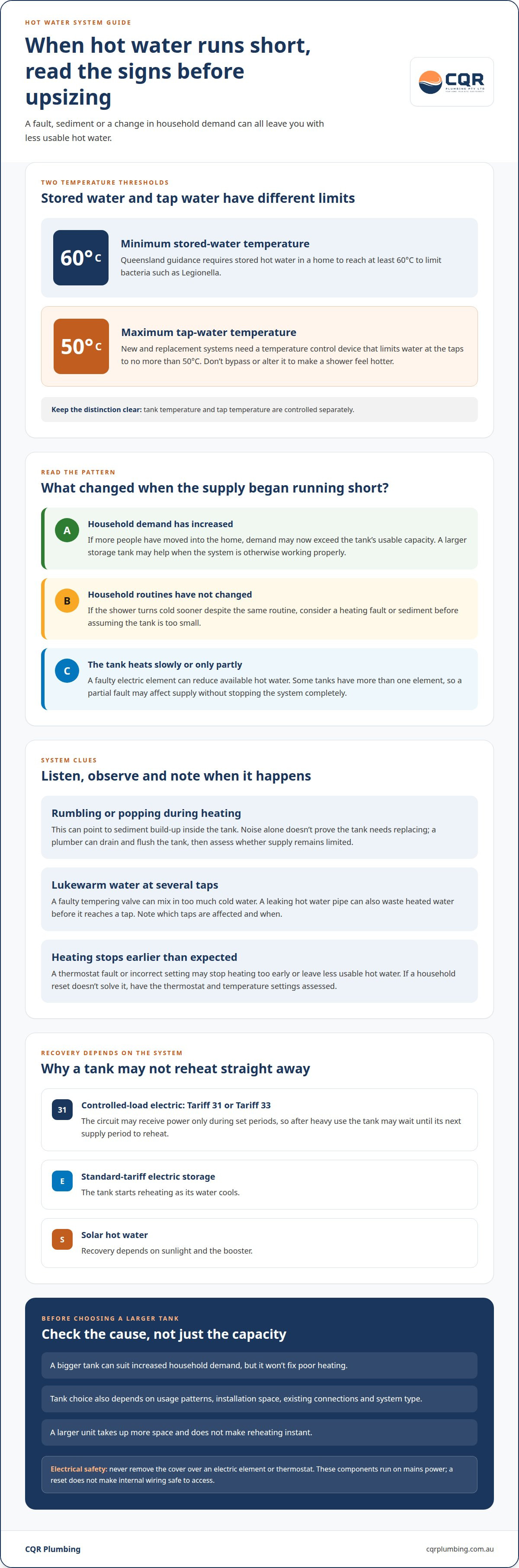
- Stored hot water must reach at least 60°C, while new and replacement systems need temperature control to limit water at the taps to no more than 50°C.
- Rumbling or popping during heating can point to sediment build-up; a plumber can drain and flush the tank.
- Small plastic pieces in shower heads, strainers or appliance filters can be a sign of a broken dip tube.
- Reheating depends on the system: controlled-load electric tanks may wait for their next power period, while solar recovery depends on sunlight and the booster.
Failing electric heating elements and thermostats
A faulty element or thermostat can leave an electric storage tank with less usable hot water, even when its capacity suits your household. In Queensland, stored hot water must reach at least 60°C, while new and replacement systems need temperature control limiting water at taps to no more than 50°C.
Electric heating element faults
An electric heating element warms the water in a storage tank. If it fails, the tank may heat slowly or only partly. You might notice the shower turns cold sooner, even though your household routine hasn’t changed. Some tanks have more than one element, so a partial fault can reduce available hot water without stopping the system completely. If the problem persists, professional assessment can help identify the cause and suitable next steps.
Water heater thermostat problems
A thermostat controls when an electric water heater heats and how hot the stored water becomes. If it fails or is set incorrectly, the tank may stop heating too early or deliver less usable hot water. A reset may help, but follow the manufacturer’s instructions and use only controls intended for household operation. If resetting doesn’t solve the problem, have a plumber assess the thermostat and temperature settings.
Never remove the cover over an electric system’s element or thermostat. These components run on mains power, so opening the panel creates an electric shock risk. A reset or temperature adjustment does not make it safe to access internal wiring.
Keep the two temperature controls clear in your mind: the tank’s stored water and the water delivered at the tap are not the same setting. Queensland guidance requires stored water in a home to be heated to at least 60°C to limit bacteria such as Legionella. New and replacement systems must have a temperature control device so tap water reaches no more than 50°C. Don’t bypass or alter that device to make a shower feel hotter.
Could a leaking hot water pipe or tempering valve reduce supply? Yes. A leak can waste heated water before it reaches a tap, while a faulty tempering valve can mix in too much cold water and make the supply feel lukewarm. If several taps are affected, note where and when it happens. That pattern can help distinguish a local issue from a tank fault.
Electric systems can also appear slow to recover because of their power supply. In Queensland, controlled-load tariffs may be identified as Tariff 31 or Tariff 33, and the circuit may receive power only during set periods. If the tank runs out after heavy use, it may not reheat until its next supply period. A standard-tariff electric storage tank starts reheating as its water cools.
Don’t keep changing settings when a reset has failed. A hot water system repair assessment can identify whether the cause is an element, thermostat, tempering valve or supply schedule, and whether repair is the appropriate next step.
Can I increase the size of my hot water tank?
Yes, a larger storage tank can provide more hot water when household demand has outgrown the existing system. First, distinguish a genuine capacity issue from sediment build-up or a fault. A bigger tank won’t fix poor heating, and replacing a sound system may be unnecessary.
Consider when the supply runs short. If the problem started after more people moved into the home, demand may now exceed the tank’s usable capacity. If household routines haven’t changed, check whether the water takes longer to heat or the tank has started making unfamiliar noises. These clues can point to a fault or sediment rather than tank size.
Tank selection should suit the household’s usage pattern, available installation space and existing system. For example, a household that takes showers one after another places a different demand on stored hot water from one that spreads showers throughout the day. A plumber can assess these patterns and the current system before recommending a larger tank. More capacity may help during peak use, but it won’t make reheating instant.
Sediment is another reason a tank may seem to hold less hot water. Minerals and other material can settle inside the storage tank over time. Rumbling or popping sounds while the tank heats can be a sign of sediment build-up. A tank that used to meet normal household demand may then seem less effective, even though its physical size hasn’t changed.
Listen for these sounds during a heating cycle and note whether they’re new or becoming more noticeable. Noise alone doesn’t prove the tank needs replacing. Sediment is one possible cause, but a heating fault or another issue may produce similar symptoms. When the noise occurs, changes in supply and the system’s general condition can help narrow down the cause.
A professional can drain a water heater tank and flush out sediment. This removes accumulated material rather than adding storage capacity. If the tank works properly afterwards, a larger replacement may not be needed. If supply remains limited, an assessment can distinguish between household demand, a system fault and a tank that no longer suits the home.
Consider a larger tank only after these checks. A bigger unit takes up more space, so the installation area matters. Existing connections and system type also affect what can be installed. If the tank is damaged or showing other signs of deterioration, increasing its size may not address the underlying problem.
If sediment or a capacity concern is affecting your supply, describe the symptoms and household usage when arranging an assessment of your hot water system. That gives the plumber a practical starting point for deciding whether flushing, repair or a larger tank fits the problem.
How do I know if I need a bigger hot water system or a new one?
Distinguish a lasting increase in household demand from a change in system performance. A bigger system may suit a continuing capacity mismatch, but a new system isn’t automatically the answer when a repair can address the fault.
Simultaneous household hot water use
Look beyond the number of people at home and consider when they need hot water. Staggered work or school schedules may spread demand, while weekend visitors can create a short-lived peak. If shortages happen mainly on busy days, record the pattern before deciding the tank is undersized.
Compare a typical weekday with a weekend or guest visit. Note when hot water is needed, how often the shortage occurs and whether the pattern settles when routines return to normal. This helps distinguish a temporary demand spike from a regular mismatch that a system change may address.
Household demand and tank capacity
Tank capacity should match the household’s regular pattern of use, not just its headcount. Consider how often the home has extra occupants, whether showers are spread across the day and whether demand has changed permanently. For example, regular visits from family create a different ongoing need from an occasional gathering.
Keep a brief usage record on ordinary days, including when supply becomes inadequate and whether the issue recurs. A single busy morning offers less useful evidence than a pattern across normal routines. Use the record to explain your household’s needs during an assessment, rather than choosing a larger tank based on one unusual day.
Choosing repair or replacement
Repair is worth considering when an inspection identifies a specific fault and the system otherwise meets your household’s needs. Replacement may suit a system that no longer matches regular demand or can’t be returned to reliable operation through repair. The decision should follow diagnosis, not the assumption that an older-looking unit needs replacing.
For a useful assessment, have the system’s make and model available if its external label is readable. Describe when the shortage started, how often it happens and whether household routines have changed. This gives the plumber context to compare the likely fault with the capacity your home actually needs.
Quick run-out in storage systems
Hot water running out fast can mean demand exceeds the usable supply, but a storage system may also be underperforming. Compare the current pattern with previous normal use. If the same routine now produces a shorter supply, investigate system performance before settling on a larger tank.
Also note whether the problem happens after every period of use or only under particular conditions. A repeatable pattern gives a clearer basis for deciding between investigation, repair and replacement. If hot water is running out fast despite steady household routines, share those observations when arranging an assessment through a hot water system assessment.
Broken dip tubes and cold-water mixing
A dip tube carries incoming cold water towards the bottom of a storage hot water tank. This helps keep colder incoming water away from the hot water collected near the top. If the tube breaks, cold water can enter higher in the tank and mix with heated water. The result may feel like reduced capacity, even if the tank is still heating.
A change in shower temperature can be a clue. For example, a shower that turns lukewarm sooner despite unchanged household routines may point to a fault inside the tank. The water heater might still run, making the problem look like an undersized tank. Compare the timing and temperature with your usual hot-water use.
Look for small plastic pieces at household water outlets. Fragments in a shower head, tap strainer or appliance filter screen may indicate a broken dip tube that needs replacement. Note where you find the pieces and whether they reappear after cleaning the outlet. Don’t assume every fragment came from the hot water tank; tell the plumber which outlet was affected.
Make a few simple observations before arranging an inspection. Record whether the temperature drops at several hot taps or only one, and whether plastic debris appears in more than one place. For instance, fragments in a shower head and a washing machine filter provide a different clue from a single blocked shower head. These details can help narrow down where the fault may be.
Cold-water mixing can also happen outside the tank. A tempering valve blends hot and cold water before it reaches taps, and a fault there can affect the delivered temperature. If one outlet is affected while other hot taps remain normal, the issue may be local to that fixture. If several outlets lose heat together, the tank or a shared component deserves closer inspection.
A broken dip tube needs proper diagnosis and replacement, not a larger tank. A plumber can inspect the system, check the debris and determine whether the tube has failed. The work involves the storage unit, so don’t open covers or attempt to remove internal parts yourself. Note the system’s make and model if it’s visible on the external label.
Keep useful notes: when the temperature changes, which taps are affected and where plastic pieces appear. If you’ve cleaned a shower head or appliance screen, check whether debris returns during normal use. A clear pattern helps distinguish a tank problem from an outlet issue and supports a repair decision based on the fault, not guesswork.
Hot water recovery times by system type
Recovery time is how long a system takes to restore hot-water supply after use. It varies with system type, power supply, sunlight, booster operation and how much water the household has used. That difference matters: a storage tank may need to reheat, while continuous-flow gas has no tank to empty.
An instant gas system can avoid shortages caused by using up a fixed tank of stored hot water. It heats water as it flows, so a cold-water problem may instead point to a fault, gas supply issue or flow problem. A heat pump uses stored water, so available hot water depends on its heating cycle and household demand. Neither system suits every property or usage pattern equally.
For an electric storage system on a standard tariff, reheating starts as the water cools. A Queensland system on an off-peak controlled-load tariff may wait until the electricity network supplies power to its circuit again. Some circuits use Tariff 31 or Tariff 33. Energy Made Easy describes controlled load as power for a large appliance, such as a hot water system, restricted to set periods, generally overnight and on weekends.
Gas storage tanks start reheating when the water cools, as the burner lights automatically. Solar hot water recovery depends on sunlight and the system’s booster. For example, after heavy use on a cloudy day, the booster’s operation can affect how quickly usable hot water returns. These systems don’t share a single recovery time.
Check whether your system is recovering by noting when hot water runs short and whether supply returns later. Check the external display or indicator for a fault message, and note whether the system has power. For controlled-load electric systems, compare recovery with the circuit’s supply period. With solar, record sunlight conditions and whether the booster is operating.
Test more than one hot tap after the system has had time to heat. If every outlet remains cool, the issue may involve the system or its supply. If one tap stays cool while another is hot, the fault may be local to that outlet. Don’t remove covers or handle electrical components; a licensed professional should inspect internal faults.
Recovery patterns help explain whether a shortage is expected or unusual. A controlled-load tank that reheats later follows a different schedule from standard-tariff electric storage. A continuous-flow gas unit shouldn’t run out of stored water, while solar output changes with sunlight and booster use. Track system type, household demand and supply patterns before deciding whether a fault needs attention.
CQR Plumbing: Hot water system installations
CQR Plumbing provides Hot Water System Repairs and hot water system installations when a fault needs attention or household demand has changed. An assessment can help distinguish a repairable component issue from an undersized or ageing system, so replacement isn’t treated as the automatic answer. If a new system is appropriate, household usage, recovery expectations and installation requirements all inform the choice. CQR Plumbing serves homes across Rockhampton, Yeppoon, Gracemere, Emu Park and the Capricorn Coast. Contact CQR Plumbing to discuss your hot water system and the symptoms you’ve noticed.
Take the next step towards dependable hot water
If hot water is running out fast, use your observations to guide the next decision. Note when the temperature drops, which outlets are affected and whether the issue followed a change in household use. These details give a plumber a clearer starting point and help focus attention on the cause, rather than assuming a larger tank is needed.
Before arranging an assessment, write down the system type and any visible warning signs, such as a leak, unusual noise or fault display. Don’t open electrical covers or attempt internal repairs. A clear description of the symptoms can help keep the conversation practical and focused on the right remedy.
A suitable repair or replacement starts with understanding how your system behaves at home. Take the next step with the details you’ve gathered and work towards a more reliable hot-water routine.
Frequently Asked Questions
How Long Should You Wait for Hot Water to Come Back After It Runs Out?
There’s no single wait time that applies to every system. A standard-tariff electric storage tank reheats as its water cools, while a controlled-load unit may wait for its next power period. A gas storage system reheats automatically; solar recovery depends on sunlight and its booster. Continuous-flow gas doesn’t store hot water, so a cold supply needs investigation rather than waiting for a tank to recover.
How do tank size and household size affect hot water supply?
A tank needs to match how many people use hot water and how closely their use overlaps. A household with separate shower times may manage with less stored capacity than the same number of people showering consecutively. Think about your busiest morning: note showers, laundry and dishes happening together. If supply is reliable outside that peak, timing may be a factor; if demand has grown overall, capacity may need review.
Could a faulty thermostat or heating element cause hot water to run out quickly?
Yes. A faulty thermostat can stop heating at the wrong point, while a failing element may heat the tank slowly or incompletely. Note whether the water is consistently lukewarm or starts hot before cooling sooner than usual. That pattern can help distinguish a heating problem from a change in usage. Don’t remove the electric system’s cover or touch internal components; arrange a professional assessment if the fault continues.
When should you call a licensed plumber or electrician for hot water problems in Australia?
Call a licensed plumber if hot water remains unreliable, a pipe or tank is leaking, or several taps are affected. For suspected electrical supply or wiring problems, contact an electrician; don’t open the heater cover or handle internal components. If you’re in Rockhampton, Yeppoon or the Capricorn Coast, describe the system type, symptoms and when they occur. This information helps direct the fault to the right trade.
Disclaimer
The information in this article is provided for general educational purposes only and should not be relied upon as professional plumbing, gasfitting, or legal advice. Every property and plumbing system is different, and the information may not be applicable to your specific circumstances. CQR Plumbing recommends that all plumbing and gasfitting work be inspected and carried out by a licensed professional in accordance with applicable Australian Standards and Queensland regulations. If you require advice specific to your property, please contact CQR Plumbing for an assessment.
