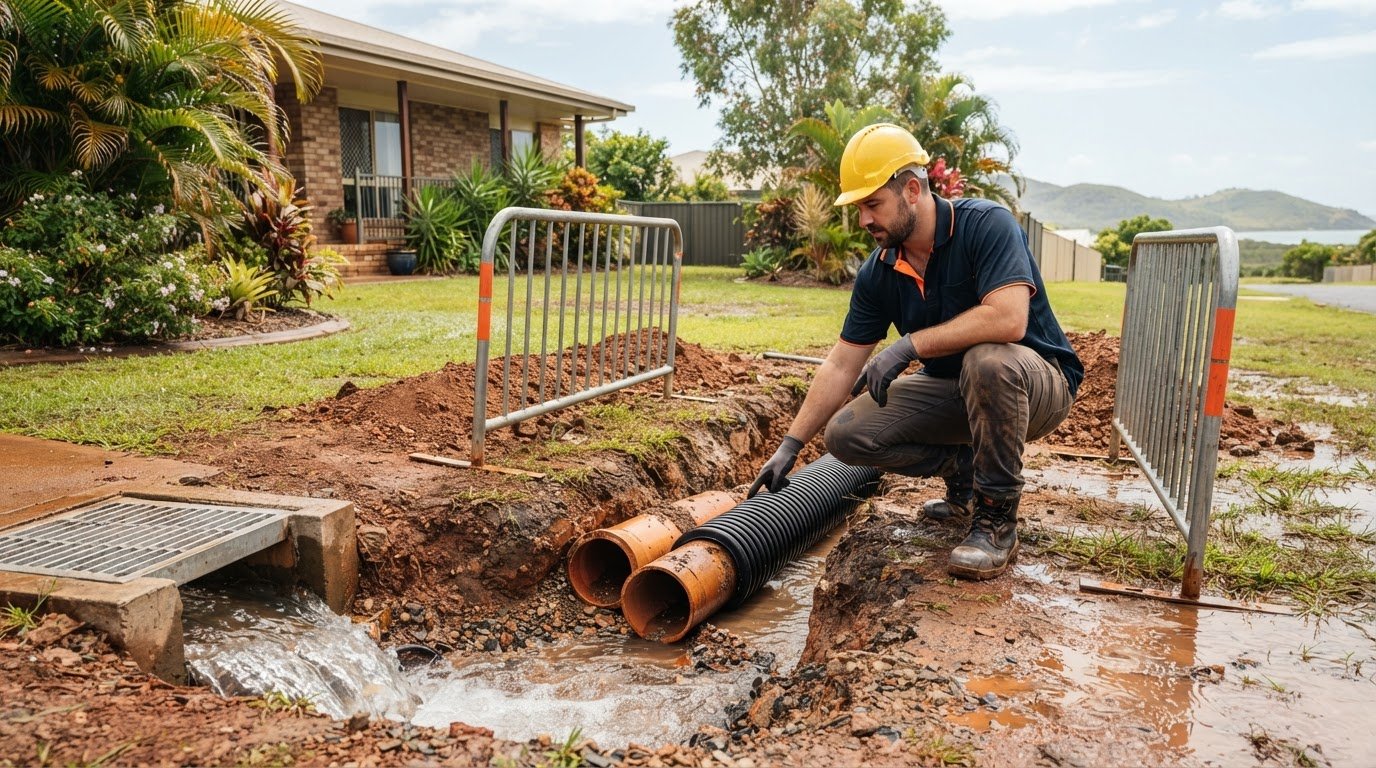
Stormwater drainage repairs and pipe replacement in Rockhampton
Blocked drains and damaged pipes can prevent stormwater from flowing away, leaving water to pool around downpipes, yards or foundations. Stormwater drainage in Rockhampton may require clearing an obstruction, repairing a leaking section or replacing a badly damaged pipe. Heavy rain can put extra demand on the system, so the first step is to identify where the flow is restricted.
A blockage may not be the whole problem. Recurring pooling can also point to damaged pipework, poor drainage, or gutters and downpipes that are not carrying water away effectively. The right repair depends on the cause and on how the property’s stormwater system is designed to discharge.
This guide explains how to assess blocked or damaged drains, when pipe replacement or pipelaying may be needed, and how stormwater differs from sewer drainage. It also covers practical maintenance, local drainage considerations and professional services across Rockhampton, Yeppoon, the Capricorn Coast, Gracemere and Emu Park.
Key Takeaways
- Recurring pooling or slow drainage can signal pipe damage as well as a blockage; finding the cause helps determine whether clearing, repair or replacement is appropriate.
- Stormwater and sewer systems serve different purposes, so identify which system is affected before deciding what work is needed.
- Keep gutters, downpipes, collection pits and drains clear, and watch for standing water near downpipes or walls.
- Drainage design depends on the property’s fall, soil and approved discharge point; poor infiltration can make surface runoff a key consideration in Rockhampton.
- Responsibility can depend on where the drainage structure sits: property owners must keep drainage easements clear, while Council maintains certain built drainage structures on them.
Repairing or replacing damaged drains and pipes
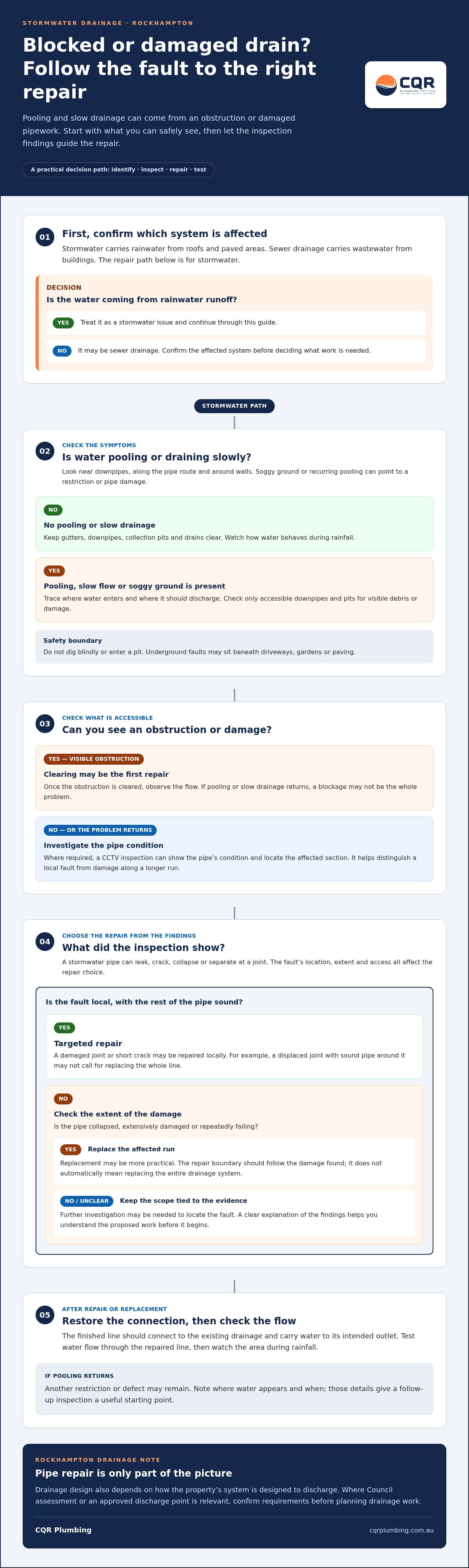
A stormwater pipe can leak, crack, collapse or separate at a joint. In Rockhampton, heavy rain may reveal a fault that went unnoticed in dry weather. Pooling near a downpipe, soggy ground along a pipe route or repeated drainage problems can help narrow down the cause. These signs call for investigation, but do not automatically mean the whole pipe needs replacing.
Start by tracing where water enters the system and where it should discharge. Check accessible downpipes and pits for visible damage or debris, but do not dig blindly or enter a pit. Underground faults can lie beneath driveways, gardens or paving. Where required, a CCTV inspection can show the pipe’s condition and help locate the affected section, distinguishing a local defect from damage along a longer run.
The right repair depends on the fault’s location and extent, as well as access. A damaged joint or short crack may allow a targeted repair. If the pipe has collapsed, is extensively damaged or keeps failing, replacing the affected run may be more practical. The repair should also account for how the pipe connects to the existing drainage and whether the finished installation can carry water to its intended outlet.
- Locate: identify the inlet, affected section and intended outlet.
- Inspect: check the pipe internally where access allows, and assess surrounding ground for signs of leakage.
- Choose: compare a local repair with replacement of a damaged run.
- Restore: reinstate the connection and test water flow through the repaired line.
For example, if an inspection shows one displaced joint and the rest of the pipe is sound, a focused repair may avoid unnecessary excavation. If it reveals a crushed section beneath a path, replacement may require access work and reinstatement. A clear explanation of the findings helps you understand the proposed work before it begins.
Rockhampton’s Oakley Street drainage replacement project was reported as halfway completed, illustrating that replacement work can involve a defined section rather than an entire network. For a property, the repair boundary should likewise follow the observed damage. Rockhampton Regional Council may issue a property owner a written notice for a breach of the Local Government Act 2009 provisions on stormwater control, including section 77(1). Council assesses plumbing and drainage work classified as permit work. Property owners can find local service information on the Rockhampton plumbing page.
After the repair, keep the route clear and observe how water behaves during rainfall. If pooling returns in the same place, another restriction or defect may remain. Note where water appears and when; those details give a follow-up inspection a useful starting point.
Stormwater and sewer drainage services in Rockhampton
Stormwater carries rainwater from roofs and paved areas, while sewer drainage carries wastewater from buildings. In Rockhampton, the right next step depends on which system is affected and where it discharges.
Council connection requirements
Rockhampton Regional Council may direct an owner to connect a property’s stormwater installation to its drainage system when a connection is available and practical. According to Rockhampton Regional Council, only plumbing and drainage work classified as permit work requires an application for Council assessment. A new driveway doesn’t automatically establish whether the associated drainage work is permit work.
Developments that increase runoff beyond existing conditions or Council infrastructure capacity need approved discharge points and on-site detention. Detention temporarily stores stormwater, then releases it gradually into Council’s system. If neither of the other legal discharge points is available, an absorption or dispersion trench may be installed with Council approval, 3 metres from any downstream boundary.
For stormwater discharge between neighbouring properties, avoid directing water in a way that creates a flow problem next door. Rockhampton Regional Council may issue an owner written notice for a breach of Local Government Act 2009 stormwater-control provisions, including section 77(1). For neighbour disputes about overland flow, residents can contact the Dispute Resolution Centre on (07) 3239 6007 about mediation.
Stormwater charges vary according to development circumstances, so there is no universal fee amount. Rockhampton Regional Council encourages rainwater harvesting through rebate programs and reduced stormwater charges for developments that demonstrate water-sensitive design. Check the relevant Council information for the specific development before planning drainage work.
To review flood and stormwater mapping, search Rockhampton Regional Council’s mapping by property address and check the relevant flood information and drainage features. For plans or easements, compare the property survey or title information with Council drainage records. This can help identify drainage corridors and easements before landscaping, excavation or building work begins.
Drain responsibility and reporting
Responsibility depends on the location and type of structure. Rockhampton Regional Council maintains built drainage structures on drainage easements, including underground pipes, inlets, open concrete channels and concrete inverts. Property owners must keep drainage easements clear of debris and obstructions so stormwater can flow naturally.
For a blocked or damaged drain on public land or a road, direct the enquiry to Rockhampton Regional Council’s Customer Service Centre on 1300 22 55 77. Note the location and describe what you can see, such as a blocked inlet or damaged channel. For a blockage within a property, a request for plumbing assistance is a practical next step.
Clearing blocked downpipes and drains
In Rockhampton, leaves, roof debris and sediment can restrict gutters, downpipes, collection pits and stormwater drains. Signs include water spilling over a gutter, a downpipe stopping during rain or water sitting around a pit. Check for visible issues from ground level, especially after heavy rain. Do not climb onto a wet roof to investigate.
Start at an accessible inlet. Remove loose leaves from ground-level grates and pit covers, then check whether water can enter freely. Keep your hands clear of moving water and do not reach into a pit if you cannot see the bottom. If the grate is damaged, the blockage is underground or water remains after surface debris is removed, arrange a closer inspection.
If stormwater is flooding your Rockhampton property, move people and belongings away from rising water and avoid electrical equipment in wet areas. If the flow appears to come from a public road or public land, report it to Rockhampton Regional Council’s Customer Service Centre on 1300 22 55 77. Note where water enters and whether it coincides with rainfall.
Water standing beside downpipes or at the base of walls can contribute to dampness around a home. A blocked downpipe may also send roof runoff over the gutter edge instead of into the drainage system. Leaking, rusted or damaged gutters and downpipes can put the roof and property at risk, so clearing debris alone will not fix a damaged section.
- Gutters: Look for visible leaf build-up, overflow marks and sections that hold water.
- Downpipes: Check ground-level outlets for leaves or sediment, and observe whether water drains during rainfall.
- Collection pits: Clear loose surface debris and check for water that remains after rain.
- Yard drains: Look for silt, leaves or mulch covering the grate or collecting around its edges.
Regularly clean Rockhampton’s stormwater pits, gutters and drains to help prevent blockages. Inspect them before the wet season and after major storms, when wind-blown leaves or washed-in sediment can restrict flow. Keep notes on recurring trouble spots. The same downpipe overflowing during separate storms may indicate an obstruction farther along the line.
For an underground restriction, a drainage professional can assess the line and clear the blockage with high-pressure jetting where appropriate. CCTV inspections can help locate an obstruction or show pipe damage. The right method depends on the blockage and pipe condition. Avoid pushing improvised rods into a drain, as they can get stuck or damage the pipe.
After clearing the drain, watch the outlet during the next rainfall. If water still pools or backs up, the cause may be a damaged pipe, poor connection or restricted outlet rather than loose debris alone.
Drainage and pipelaying
Roof and surface water should be collected, carried through drainage pipes and discharged at an approved point. In Rockhampton, downpipes may connect to underground pipework leading towards the street or another approved outlet. Red clay soils absorb water poorly, so runoff often needs to be collected and directed away from buildings.
Start by observing where rainwater travels across the property. Note low spots, water running towards doors and downpipes that discharge beside walls. A drainage plan needs to account for roof catchments, paved areas, ground levels and the intended outlet. If a new pipe changes the flow, consider its effect on nearby surfaces and existing drainage.
Rockhampton’s stormwater systems are usually designed for flows from a one (1) in two (2) year to a one (1) in ten (10) year storm event. Higher-intensity runoff or a blockage can instead flow overland. This is why a design needs to consider both the piped route and the path water could take when the system cannot carry all incoming flow.
- Downpipes: Connect roof outlets to a suitable stormwater route, rather than letting water discharge against the building.
- Yard drains: Place pits or channels where runoff collects, such as a low section beside a driveway.
- Pipe route: Set the line to carry water towards its approved discharge point without creating new pooling areas.
- Overland flow: Keep a path for excess water that may exceed pipe capacity or encounter a blockage.
For example, a North Rockhampton homeowner sought underground downpipe connections and yard drains to move excess water away. This type of layout can collect roof runoff and surface flow, but the outlet and site levels determine whether water drains as intended. Stormwater pits and channels can also collect runoff in low-lying areas.
Rockhampton Regional Council requires stormwater management plans for new homes, renovations that add impervious surfaces, subdivisions and commercial developments. A plan should account for extra runoff when gardens or permeable ground are replaced with roofs, paving or concrete. Developments that increase runoff beyond existing conditions or Council infrastructure capacity need approved discharge points and on-site detention.
During pipelaying, the route, connection points and outlet should match the approved design. After installation, check that pits remain accessible and surface grading directs water towards collection points. Do not cover an inlet with soil, mulch or landscaping. Before the wet season and after major storms, inspect visible outlets and low spots. Repeated pooling can signal an obstruction, poor fall or a drainage layout that needs assessment.
Who is responsible for stormwater drainage in Rockhampton Regional Council?
To establish responsibility, first identify the exact asset causing the problem. Water appearing beside a property does not, by itself, show whether the fault is in a private pipe, a surface inlet or another part of the drainage network. Record the location and visible symptoms before arranging work or lodging an enquiry.
Keep a simple record of the issue. Note where water first appears, which direction it travels, whether it follows rainfall and which nearby inlet or pipe may be affected. Photos taken from a safe position can help distinguish a local yard problem from runoff arriving from beyond the property. Do not enter pits or approach fast-moving water.
For a rental, strata or commercial property, tell the property manager or responsible maintenance contact what you observed. Include the affected area, any changes since the last inspection and whether the issue has happened before. A clear report helps them decide whether to inspect the property’s drainage layout or raise the matter with the relevant asset manager.
Before excavation or landscaping, gather the available drainage information for the property and mark the area of concern. A plan can help guide an investigation, but visible conditions matter too: planting may hide an outlet, or surface water may flow away from its underground pipe. Keep proposed work clear of drainage routes until the affected section is identified.
If the source is unclear, describe the symptoms rather than guessing who owns the pipe. For example, report that a particular inlet overflows during rain or that water appears along a specific part of the yard. This gives the person assessing the issue useful observations without assuming the nearest visible structure is responsible.
Once the affected asset is identified, keep the inspection findings and any repair records with the property documents. If the same spot causes trouble again, those notes can show whether the location or symptoms have changed. For a private-property drainage concern, a drainage inspection request can help establish the issue and an appropriate repair scope.
Rockhampton Regional Council committed to a ten-year stormwater drainage program with an allocation of $3 million per year. Its 2015/16 stormwater drainage project list included debris deflectors on Beasley Street and Rockonia Road in Rockhampton. These examples indicate that Council plans and funds work on parts of the public drainage network, while the responsible party for a particular fault still depends on which asset is affected. A visible inlet or outlet can help locate the issue, but it does not alone establish who owns or maintains the connected pipe.
Rockhampton’s red clay soils have poor infiltration rates, so most stormwater becomes surface runoff that needs to be collected and discharged to Council systems. An engineer's certificate is required for a Council-approved stormwater absorption or dispersion trench in Rockhampton. Rockhampton on-site detention systems require annual inspections by Council. These requirements distinguish private drainage arrangements from Council’s wider network responsibilities. Property owners and maintenance contacts may need to provide information about on-site systems, while Council manages the relevant Council systems and inspections. Identifying the asset and its approval or maintenance arrangements can help direct an enquiry to the appropriate party.
CQR Plumbing: Hot water system installations
CQR Plumbing provides blocked drain repairs when a blockage or drainage fault affects your property. If water keeps backing up after surface debris is cleared, a CCTV inspection can help locate the obstruction and show the pipe’s condition. This gives you clearer information about whether clearing or repair is the practical next step.
For a drain on public land or a Council-maintained structure, report the issue to Rockhampton Regional Council. For a blockage on your property, CQR Plumbing can assess the drainage issue, explain the findings and outline a clear scope of work before repairs begin. CQR Plumbing also installs hot water systems, a separate service for properties planning a new system.
Contact CQR Plumbing to discuss a property drainage issue.
Plan ahead for the next change to your property
Think about drainage before making changes to your yard. New paving, garden beds, sheds or extensions can alter how water moves across a block. For stormwater drainage in Rockhampton, consider the planned layout alongside existing ground levels and the discharge route before work starts. This can help prevent runoff from being directed towards your home or neighbouring land.
Keep a simple record of property changes, including where new surfaces are and how downpipes connect. If drainage behaviour changes after landscaping or building work, these details can help narrow down what needs attention. A practical plan makes it easier to discuss the issue, understand the proposed work and decide what to do next.
When you’re ready, take the next step. Understanding the site helps you move forward with confidence.
Frequently Asked Questions
How have stormwater and sewer drains been affected in Rockhampton?
Stormwater issues often become visible during rainfall, while sewer problems can show through slow or backing-up wastewater fixtures. The symptoms help distinguish which system needs attention. Rockhampton’s creek and waterway debris-removal project was reported as about 98% complete. If you notice a problem, record whether it follows rain and which fixtures or outdoor drainage points are affected; that detail helps narrow down the source.
How does Rockhampton’s stormwater system handle heavy rain and flooding?
Rainwater tanks can capture roof runoff before it enters the drainage network. Rockhampton rainwater tank systems typically range from several thousand to tens of thousands of litres. A tank’s capacity and available storage affect how much roof water it can hold during rainfall. Tanks are one part of a property’s water management, so keep their inlets and overflow routes clear to let water flow as intended.
What are the rules for stormwater discharge between neighbouring properties in Queensland?
Avoid directing stormwater onto a neighbouring property in a way that creates a flow problem. For disputes about overland flow, residents can contact the Dispute Resolution Centre about mediation. Council may issue a written notice for a stormwater-control breach.
What stormwater drainage fees or charges apply in Rockhampton?
Stormwater charges vary according to development circumstances, so there is no universal fee amount. Council encourages rainwater harvesting through rebate programs and reduced stormwater charges for developments that demonstrate water-sensitive design.
Disclaimer
The information in this article is provided for general educational purposes only and should not be relied upon as professional plumbing, gasfitting, or legal advice. Every property and plumbing system is different, and the information may not be applicable to your specific circumstances. CQR Plumbing recommends that all plumbing and gasfitting work be inspected and carried out by a licensed professional in accordance with applicable Australian Standards and Queensland regulations. If you require advice specific to your property, please contact CQR Plumbing for an assessment.