TMV Testing Rockhampton: Your Essential Compliance and Safety Checklist
If you’re managing a childcare centre or an aged care facility in Central Queensland, a single degree of temperature deviation isn't just a minor maintenance oversight; it’s a significant safety breach that can lead to life-altering injuries. Most facility managers we speak with feel a fair bit of pressure trying to keep up with the maze of QBCC requirements and the logistical headache of managing maintenance schedules for dozens of different valves. It's a lot to handle when you're already juggling daily operations and resident care.
The good news is that staying on top of your TMV testing Rockhampton doesn't have to be a source of stress. We've put together this expert guide to help you navigate your legal obligations under the current AS 4032.3:2022 standards. You’ll learn exactly what's required for your mandatory 12-month testing cycle, how to ensure your hot water delivery stays at the required 45°C or 50°C limits, and why detailed documentation is your best friend during a compliance audit. We’ll also cover the specific endorsements a plumber needs to work on these specialised devices, so you can be certain your facility is in safe, licensed hands.
Key Takeaways
- Understand the critical balance between storing water at high temperatures to kill Legionella and using TMVs to prevent third-degree burns.
- Ensure your facility meets AS 3500.4 standards by scheduling professional TMV testing Rockhampton at least every 12 months.
- Learn how to maintain a comprehensive valve register and identify all device locations to streamline your next compliance audit.
- Discover why detailed reporting is essential for meeting QBCC requirements and protecting your organisation from legal liability.
- Recognise the specific plumbing endorsements required in Queensland to legally service and commission temperature control devices.
What is TMV Testing and Why is it Critical in Rockhampton?
You might've seen these devices tucked away under a basin or behind a stainless steel wall panel in a hospital corridor. What is a Thermostatic Mixing Valve (TMV)? At its core, it's a precision-engineered safety device designed to protect people from severe scalding. In Rockhampton, where we have a high concentration of aged care facilities, childcare centres, and hospitals, these valves are the frontline of defence. They work by blending hot and cold water to a pre-set, constant temperature, ensuring the water coming out of the tap is safe for human skin.
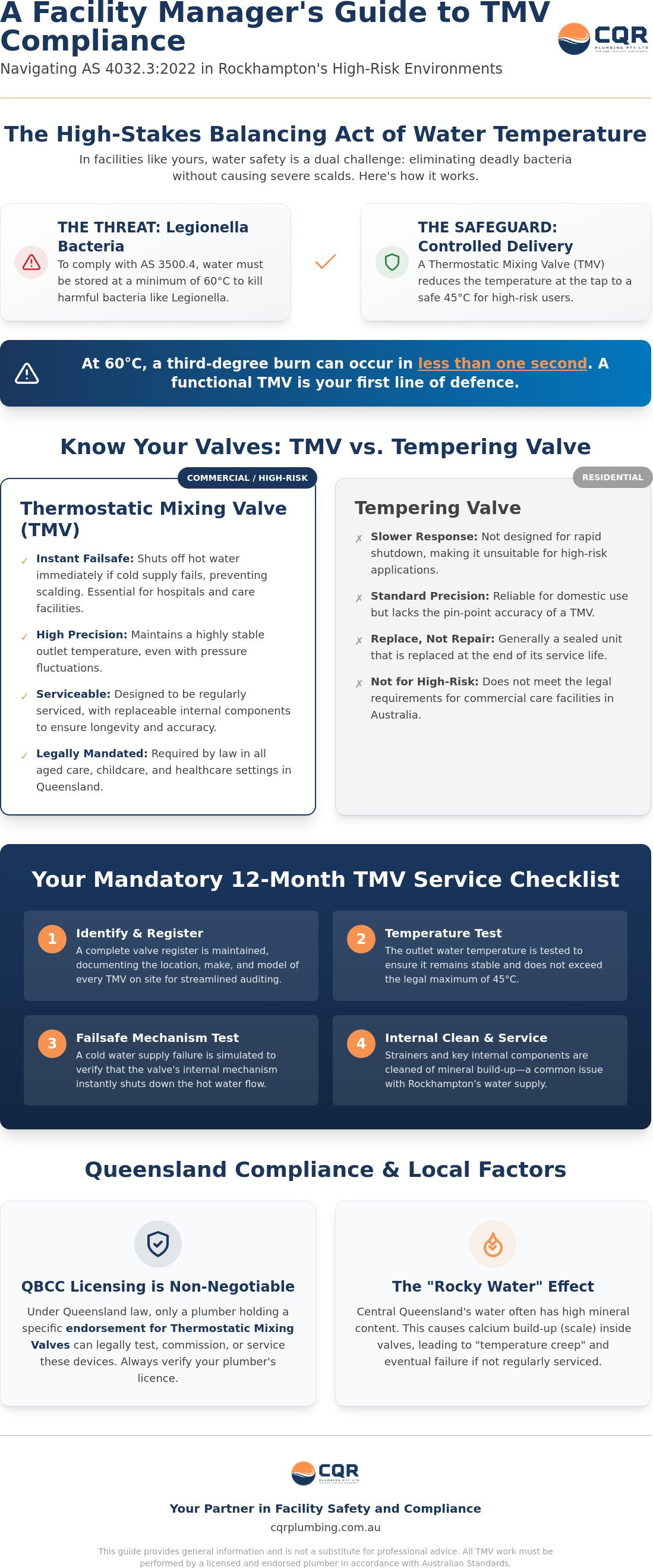
The reason we store hot water at high temperatures (at least 60°C) is to kill off nasty bacteria like Legionella. However, water at that temperature can cause third-degree burns in less than a second. A TMV allows you to keep your storage tank at a "kill zone" temperature while delivering water to the user at a much safer level. For most high-risk facilities in Central Queensland, this limit is strictly 45°C, while other commercial settings might allow for 50°C. Regular TMV testing Rockhampton ensures these internal components haven't failed due to mineral build-up or wear and tear.
TMV vs. Tempering Valves: Know the Difference
It's a common mistake to think a tempering valve and a TMV are the same thing. While they both mix water, they operate on very different levels of precision. Tempering valves are the standard for residential homes across Rockhampton; they're reliable enough for a family bathroom but have a slower response time to pressure changes.
In contrast, a TMV is a heavy-duty commercial device. It reacts almost instantly to a drop in cold water pressure by shutting down the hot water flow entirely. This "failsafe" feature is why they're mandatory in healthcare. They're also built to be serviced rather than replaced; we can pull them apart, replace the internal O-rings and thermal elements, and put them back into service. This level of accuracy requires more frequent maintenance, which is why TMV and backflow services are such a big part of commercial facility management.
The Legal Landscape in Central Queensland
Compliance isn't just a suggestion in our industry; it's a strict legal requirement under the Queensland Plumbing and Drainage Act. The Queensland Building and Construction Commission (QBCC) keeps a close eye on these installations. You can't just have any plumber tinker with these valves. To legally perform TMV testing Rockhampton, a plumber must hold a specific endorsement on their licence. This means they've undergone specialised training to commission and maintain these complex devices. Every time we test a valve, we're required to submit detailed reports to ensure your facility remains on the right side of the law and, more importantly, that your residents stay safe.
Why Annual TMV Testing is Non-Negotiable for Safety
Safety in a high-risk facility relies on a delicate balance. To keep your water supply free from Legionella bacteria, Australian standards require hot water to be stored at a minimum of 60°C. However, water at this temperature is incredibly dangerous. It can cause a third-degree burn in as little as one second. This is why TMV testing Rockhampton is a vital part of your maintenance schedule. The valve acts as the final gatekeeper, ensuring that while the bacteria are killed in the tank, the water reaching the resident is at a safe, controlled temperature.
Over time, the internal components of these valves naturally degrade. The thermal element, which is the "brain" of the valve, can lose its ability to react quickly to pressure changes. If this element fails, the valve might allow water to "creep" past the set limit, or worse, fail to shut down during a cold-water failure. Regular servicing involves stripping the valve down, cleaning the internal parts, and checking that the failsafe mechanism still works perfectly under real-world conditions.
How Rockhampton Water Affects Your Valves
Central Queensland water can be particularly tough on precision plumbing components. Our local water supply often contains higher levels of minerals and sediment, which can lead to significant calcium build-up inside the valve body. When scale forms on the thermal element or the internal strainers, the valve's response time slows down. We often see "valve creep" in Rockhampton facilities, where the delivery temperature slowly drifts upwards over several months due to mineral interference.
During a standard service, we don't just check the temperature; we clean the stainless steel strainers and flush out any debris that has travelled through the lines. Ignoring this build-up can lead to the valve seizing entirely, resulting in an expensive replacement rather than a simple service. If you haven't had your devices checked lately, it's worth getting a professional assessment of your valve health to avoid unexpected failures.
The Consequences of Skipping a Test
The risks of neglecting your annual testing go far beyond a simple plumbing fault. From a legal standpoint, business owners and facility managers in Queensland carry the "duty of care" for their residents. If a scalding incident occurs and you cannot produce a current QBCC compliance report, the legal ramifications can be severe. This includes potential fines, loss of accreditation for healthcare providers, and the very real possibility of your property insurance being voided. Most insurers view a lack of mandatory safety testing as a breach of policy conditions. Staying compliant isn't just about ticking a box; it's about protecting your residents and your business from a catastrophic event.
The Rockhampton Facility Manager’s TMV Checklist
Managing a large-scale facility in Central Queensland often feels like a balancing act between operational costs and safety standards. When you have dozens of mixing valves spread across multiple wings or buildings, it is easy for maintenance schedules to slip through the cracks. The most effective way to stay ahead of your compliance obligations is to treat TMV and backflow services as a structured asset management programme rather than a reactive fix. A well-maintained site begins with a clear understanding of your infrastructure.
Before your next scheduled inspection, run through these essential checks to ensure your facility is ready for a TMV testing Rockhampton specialist:
- Maintain a Valve Register: Identify every valve location on-site and keep a digital or physical log. This should include the make, model, and the specific area it serves, such as "Aged Care Wing B, Room 12 Ensuite."
- Inspect for Visible Faults: Check valve enclosures for signs of green copper corrosion or active leaks. If a cabinet is damp, the internal seals are likely failing.
- Watch for Cross-Connection: If staff report lukewarm water coming from cold-water taps, your TMV check valves may be bypassing. This is a common sign that the internal non-return valves need replacing.
- Ensure Clear Access: It sounds simple, but we often find valves buried behind storage boxes or furniture. Ensure your Rockhampton plumber has unobstructed access to every unit to avoid delays.
Pre-Test Preparation for Your Site
A professional test requires a brief interruption to the hot water supply at each outlet. To keep your facility running smoothly, notify your staff and residents at least 24 hours in advance. We also need access to the main hot water plant to verify storage temperatures, so ensure all plant room keys are available. Having your previous compliance reports or QBCC Form 9s ready for the technician allows us to compare "as-found" data, which helps in identifying valves that are consistently drifting out of calibration due to our local water hardness.
What Happens During a Professional TMV Test?
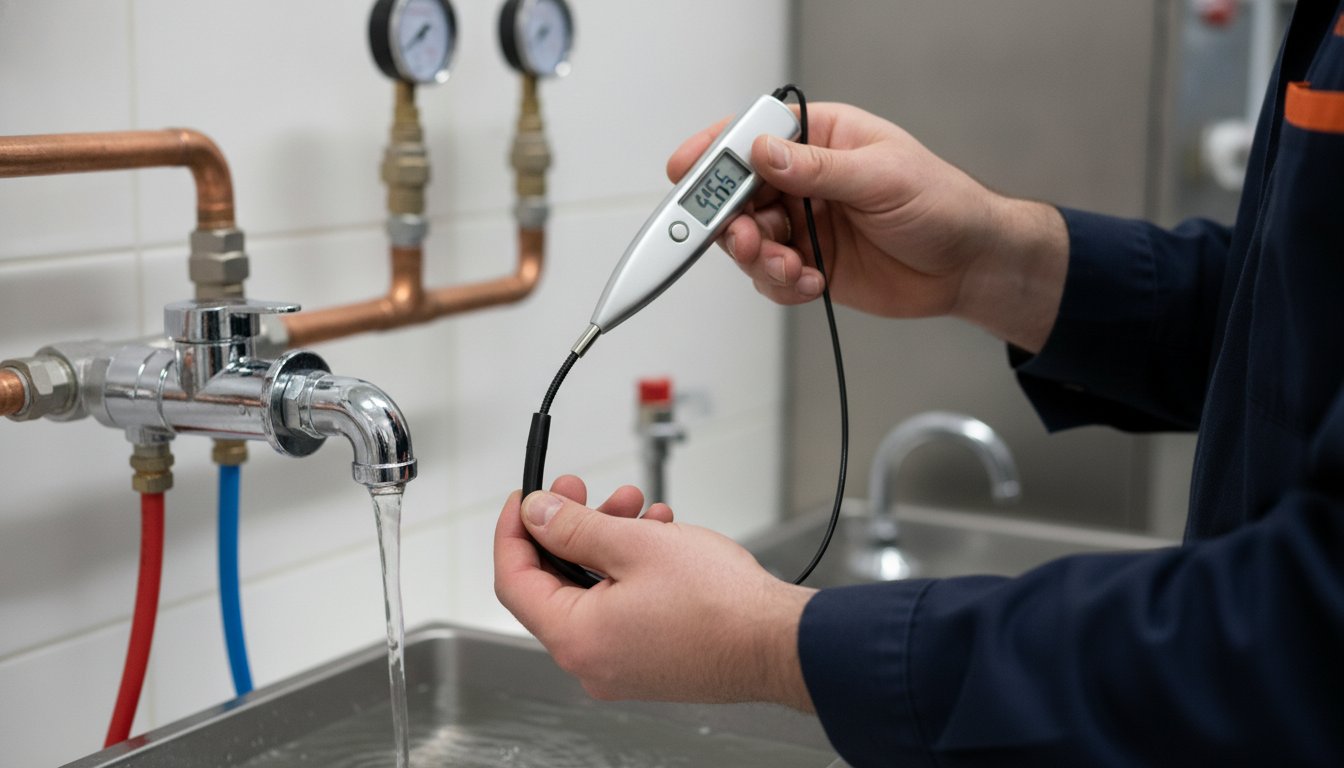
During a standard TMV testing Rockhampton visit, we follow a strict technical protocol. We start by verifying the delivery temperature at the furthest outlet using a calibrated digital probe. We then perform a "thermal shut-off test," where we simulate a cold-water supply failure. If the valve is working correctly, it must stop the flow of hot water instantly to prevent scalding. We also strip the valve to clean the internal stainless steel strainers and check the non-return valves for debris. Finally, we recalibrate the device to your facility’s required limit (typically 45°C) and document the results for your official compliance audit.
Compliance Standards: AS3500 and QBCC Requirements
In the plumbing trade, we live and breathe by the Australian Standards. Regarding hot water safety, AS 3500.4 is the primary regulation governing how heated water services are installed and maintained. This standard isn't just a set of suggestions; it's a legal framework ensuring every TMV in a commercial or healthcare setting operates with absolute precision. Under these regulations, TMV testing Rockhampton must be carried out at least once every 12 months. High-risk environments, such as surgical wards or specialised aged care units, often require more frequent intervals based on their specific risk assessment or manufacturer guidelines.
The Queensland Building and Construction Commission (QBCC) oversees this process through a strict reporting system. In Queensland, the "Form 9" is the critical document proving your devices have been tested by a licensed professional with the correct endorsements. This form acts as your legal shield. If a health inspector or workplace safety auditor walks through your doors, they’ll want to see your current Form 9 register first. Many of our clients find these requirements overlap with other safety obligations, so we often bundle this work with backflow prevention testing Yeppoon to keep the entire facility’s water protection compliant in one visit.
Record Keeping and Auditing
You are legally required to keep on-site maintenance records for at least 7 years. A compliant TMV report needs to be more than just a tick in a box. It must include the specific "as-found" and "as-left" temperatures, the results of the thermal shut-off fail-safe test, the date of service, and the licence number of the technician. We’ve moved away from messy paper logs in favour of digital reporting. This ensures your records are clear, timestamped, and easily retrievable during an audit, which reduces the administrative burden on facility managers.
When to Replace Instead of Repair
Even a high-quality, well-maintained TMV has a finite lifespan. In Rockhampton, where the water can be quite aggressive, we typically see a service life of 5 to 10 years for these valves. While we can replace individual O-rings, wax elements, and check valves using genuine manufacturer parts, there comes a point where a full replacement is more cost-effective. If the internal brass body is pitted or showing signs of dezincification, a repair kit won't provide a reliable seal. Deciding when to replace rather than repair is a key part of TMV testing Rockhampton, as it ensures you aren't throwing good money after bad. If you are unsure about the current state of your hardware, you can request a quote for a compliance inspection to get an honest appraisal of your system.
Professional TMV Servicing with CQR Plumbing
CQR Plumbing isn't just a general repair shop; we've built our reputation on a specialised focus on commercial plumbing in Rockhampton. We understand that for a facility manager, the plumbing is often the last thing you want to worry about until something goes wrong. Our approach is built on quiet competence and absolute reliability. We don't just "check" a valve; we manage your entire compliance profile so you can focus on your residents and operations. We know the local landscape and the specific challenges that Central Queensland's climate and water quality pose to your infrastructure.
Our "no-fuss" reporting system is designed specifically for the busy professional. Once our technician completes your TMV testing Rockhampton, you will receive a detailed, digital report that meets all current QBCC requirements. There is no chasing us for paperwork or trying to decipher handwritten notes. We provide clear, transparent documentation that is ready for your next audit or insurance review. If a valve fails outside of standard business hours, our 24/7 emergency response ensures that your facility doesn't have to go without safe hot water for a moment longer than necessary. We also maintain open lines of communication with strata and property managers, ensuring that every stakeholder is aware of the site's compliance status.
Our Comprehensive Maintenance Programs
The easiest way to avoid a compliance breach is to take the guesswork out of the calendar. We organise recurring annual testing schedules for our clients, sending out reminders well before your certification expires. This proactive approach prevents the last-minute scramble that often happens when an auditor is due. We also offer the convenience of bundling your TMV testing Rockhampton with other essential services like backflow prevention and general maintenance plumbing.
By combining these tasks into a single site visit, we reduce the disruption to your facility and provide a more cost-effective solution. If our testing reveals a component that is nearing the end of its life, we provide a transparent, fixed-price quote for the repair or replacement. We use only genuine manufacturer parts to ensure your valves maintain their warranty and safety ratings. This honest, balanced advice helps you plan your maintenance budget without the surprise of sudden, large-scale failures.
Book Your Rockhampton TMV Audit Today
Whether you manage a single strata complex or a multi-site healthcare organisation, we have the technical skills and local experience to help. Our service area extends across the entire region, providing expert support to clients in Yeppoon, Gracemere, and throughout the Capricorn Coast. We pride ourselves on being a dependable neighbour with high-level technical skills, positioning ourselves as a partner to your business rather than just another service provider.
Don't wait for a compliance notice or a hardware failure to address your water safety. Reach out to our team today for a comprehensive site-wide audit and find out why we are the trusted partner for commercial facilities across Central Queensland. You can easily request a quote for TMV testing through our website, and one of our licensed specialists will be in touch to discuss your specific requirements.
Securing Your Facility’s Compliance and Safety
Managing a commercial or healthcare facility in Central Queensland means staying ahead of the unique environmental factors that impact your plumbing infrastructure. We've explored how regular TMV testing Rockhampton serves as a vital safety net, protecting vulnerable residents from scalding while allowing for high-temperature storage to control Legionella. Staying on top of your valve register and ensuring every device has a current QBCC Form 9 report is the only way to guarantee full regulatory compliance and peace of mind during an audit.
Our team of licensed QBCC specialists is dedicated to providing comprehensive compliance reporting and reliable maintenance across Rockhampton and Yeppoon. We operate 24/7 to ensure your facility remains safe and operational at all times. Don't leave your safety standards to chance or let your maintenance schedule fall behind. Keep your facility compliant—book your TMV test with CQR Plumbing today.
We look forward to helping you maintain a safe and efficient environment for everyone in your care. Reach out to our team whenever you're ready to secure your site's plumbing health.
Frequently Asked Questions
How often is TMV testing required in Rockhampton?
TMV testing is required at least once every 12 months according to the current AS 4032.3:2022 standards. In high-risk healthcare environments, your specific facility risk assessment might dictate even more frequent checks. This annual schedule ensures that internal thermal elements haven't drifted and that the valve still reacts instantly to pressure fluctuations, keeping your residents safe from scalding.
What is the difference between a TMV and a tempering valve?
The main difference lies in the precision and the failsafe mechanism. While both mix hot and cold water, a TMV is a high-performance commercial device that shuts down hot water flow immediately if the cold supply fails. Tempering valves are standard for residential homes; they're reliable but don't offer the same near-instant response time or the ability to be fully serviced and recalibrated like a true TMV.
Can any plumber perform TMV testing in Queensland?
No, only a plumber with a specific endorsement on their QBCC licence can legally perform this work. They must have completed specialised training to commission and maintain these devices. Hiring an unendorsed plumber for TMV testing Rockhampton can void your insurance and leave your facility non-compliant during a health or safety audit. Always ask to see a plumber's endorsement before they start work.
What happens if a TMV fails the fail-safe test?
If a valve fails the thermal shut-off test, it must be taken out of service and repaired or replaced immediately. A failure means the valve won't stop the flow of 60°C water if the cold supply drops, creating an extreme scalding risk. We usually find that a failed test is caused by mineral build-up or a worn thermal element, both of which are common issues in Central Queensland due to local water hardness.
How long does a typical TMV test take for a commercial site?
A professional test and service usually takes between 30 and 45 minutes per valve. This timeframe allows us to check the delivery temperatures, perform the fail-safe shut-off test, and strip the valve to clean the internal strainers and check valves. If your site has multiple valves, we coordinate a schedule to minimise the temporary hot water shutdown for your staff and residents during the process.
Do I need TMV testing for a standard residential home?
Standard residential homes generally don't require registered TMV testing, as they use tempering valves instead. While tempering valves should be checked during your regular plumbing maintenance, they aren't subject to the same mandatory annual reporting as commercial mixing valves. However, if you have a high-risk individual or someone with specific disability needs living at home, installing a TMV can provide an extra layer of safety.
What records do I need to keep for council or health audits?
You must keep your QBCC Form 9 compliance reports and a detailed maintenance register on-site for at least 7 years. These records should include the specific as-found and as-left temperatures, the date of service, and the licence details of your plumber. Having these documents organised and accessible is essential for passing council health inspections or workplace safety audits without any administrative hiccups.
Does CQR Plumbing provide TMV testing in Yeppoon and Gracemere?
Yes, we provide comprehensive TMV testing Rockhampton services across Yeppoon, Gracemere, and the wider Capricorn Coast. Our team is fully licensed for commercial compliance work throughout the region. We understand the local water conditions in these areas and can help you manage your maintenance schedules across multiple sites, ensuring every facility stays safe, functional, and fully compliant with state regulations.
Disclaimer
The information in this article is provided for general educational purposes only and should not be relied upon as professional plumbing, gasfitting, or legal advice. Every property and plumbing system is different, and the information may not be applicable to your specific circumstances. CQR Plumbing recommends that all plumbing and gasfitting work be inspected and carried out by a licensed professional in accordance with applicable Australian Standards and Queensland regulations. If you require advice specific to your property, please contact CQR Plumbing for an assessment.