
Underground Water Leak Detection and Repair in Rockhampton & Yeppoon
What if the lushest, greenest patch of lawn in your Yeppoon garden is actually the most expensive feature on your property? Many homeowners in Central Queensland don't realise they have a problem until a shocking water bill arrives or a mysterious damp spot appears near the house slab. It is incredibly stressful to think about potential structural damage or the cost of a plumber digging up your manicured garden just to find a pipe.
I understand that anxiety, but finding an underground water leak doesn't have to mean immediate destruction. You can actually perform several simple checks yourself to confirm if a leak exists before you pay for a professional call-out. In this guide, I will walk you through how to spot the warning signs common in our local reactive soils and how to use your water meter to test the system. You will also learn about the latest non-invasive repair options and how to access concealed leak rebates from the Rockhampton or Livingstone Shire councils. By the end, you'll have a clear plan to protect your home and get your water bill back under control without breaking the bank.
Key Takeaways
- Identify subtle clues like unexplained damp spots or lush lawn patches that suggest a hidden problem before your water bill spikes.
- Learn how to perform a simple, cost-free water meter test to confirm if an underground water leak is present on your property.
- Understand how modern acoustic and tracer gas technology pinpoints the exact source of a leak without unnecessary digging.
- Compare the pros and cons of spot repairs versus pipe rerouting to find the most durable and least invasive solution for your home.
- Discover how Rockhampton’s reactive clay soils and extreme heat impact your plumbing and what you can do to prevent future pipe failures.
Recognising the Warning Signs of an Underground Water Leak
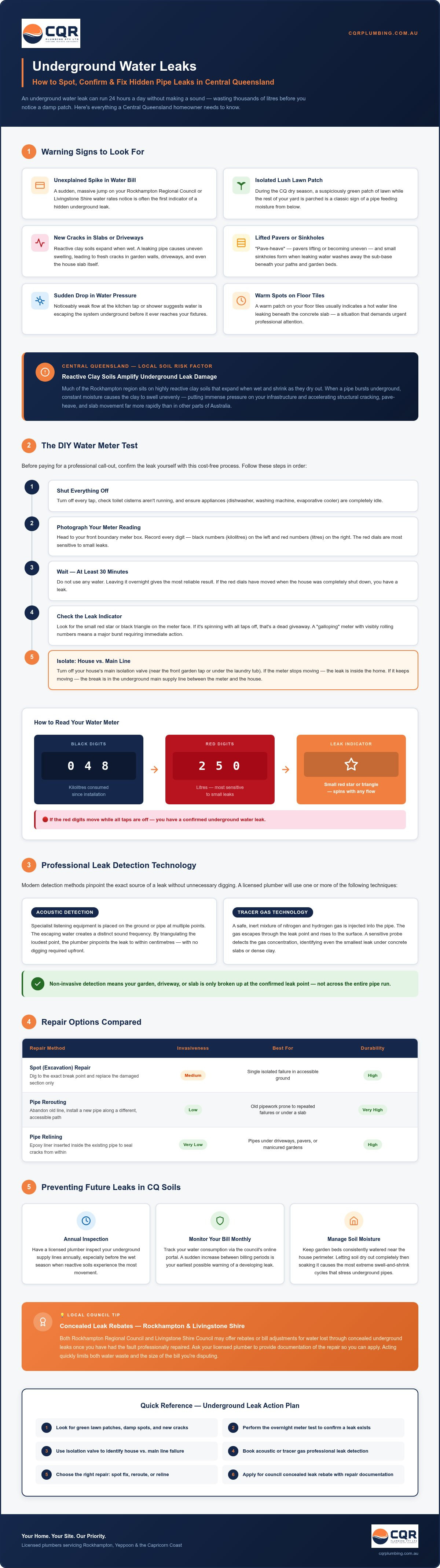
The first sign of a problem often arrives in your letterbox. If your latest water rates notice from Rockhampton Regional Council or Livingstone Shire Council shows a sudden, massive spike in consumption that you can't explain, it's time to investigate. Unlike a dripping tap in the bathroom, an underground water leak can run 24 hours a day without making a sound, wasting thousands of litres before you even notice a damp patch.
In Central Queensland, our local geography plays a huge role in how leaks manifest. Much of the Rockhampton region sits on highly reactive clay soils. These soils expand when wet and shrink as they dry out. When a pipe bursts underground, the constant moisture causes the surrounding clay to swell unevenly. This movement puts immense pressure on your infrastructure, often leading to fresh cracks in garden walls, driveways, or even the house slab itself. If you notice new structural cracks appearing alongside a high bill, you likely have a significant sub-surface issue.
You should also keep an eye on your lawn during our dry season. While your neighbours are struggling to keep their grass alive in the CQ heat, a burst pipe will create an isolated patch of lush, vibrant green grass. If one section of your yard is thriving while the rest is parched, the soil is being fed from below.
Visual Clues in Your Garden and Driveway
Walk around your property and look for "pave-heave." This occurs when moisture under pavers causes them to lift or become uneven. You might also find permanent damp spots on your concrete or lawn that never seem to dry out, even after a week of clear skies. In some cases, the leaking water washes away the sub-base of your soil, creating small sinkholes or visible depressions in the ground. If you see your garden beds sinking or pavers shifting, don't wait for the bill to double before calling a professional.
Internal Indicators You Might Miss
Sometimes the clues are inside the home. A sudden drop in water pressure at the kitchen tap or in the shower often suggests that water is escaping the system before it reaches your fixtures. Listen closely when the house is quiet; the sound of hissing or running water behind walls when no taps are on is a classic warning sign. If you feel a warm spot on your floor tiles, it usually indicates a leak in a hot water line buried beneath the slab. These internal signs, combined with unusual mildew or mould growth in dry areas, mean you need professional leak detection techniques to find the source. If you are in Yeppoon or the Capricorn Coast, these signs are often the only warning you'll get before significant damage occurs.
The DIY Water Meter Test: How to Confirm a Hidden Leak
You've spotted a damp patch or received a high bill. Now you need to know for certain if there is a problem. Before you call a plumber, you can confirm a suspected underground water leak yourself using a simple process of elimination. First, walk through the house and ensure every tap is tightly shut. Check that the toilet cisterns aren't running and that the dishwasher or washing machine isn't mid-cycle. Even a small evaporative cooler can skew your results, so make sure everything is completely off.
Once the house is "dry", head out to the front boundary to find your water meter box. Take a photo or write down every digit on the face. You'll see black numbers on the left and red ones on the right. The red dials represent litres and decimal points of litres; these are the most sensitive to small leaks. Wait at least 30 minutes. I always recommend leaving it overnight if you can manage without the loo for a few hours. If those red numbers have ticked over while the house was shut down, you have a leak.
Understanding Your Water Meter Dials
Most modern meters in Rockhampton and Yeppoon feature a small "leak indicator" dial. This is usually a tiny red star or a black triangle that spins even with the slightest flow. If that indicator is moving while your taps are off, it's a dead giveaway. A "galloping" meter, where the numbers are visibly rolling over while you watch, indicates a major burst that needs immediate attention. Knowing how to check your water meter for leaks correctly can save you hours of guesswork and prevent further damage to your foundations.
Isolating the Leak: House vs. Main Line
If the meter is spinning, the next step is to work out where the water is escaping. Locate your house's main isolation valve, often found near the front garden tap or under the laundry tub. Turn it off and check the meter again. If the meter stops moving, the leak is somewhere inside the house or under the slab. If it keeps spinning, the underground water leak is in the main line between the meter and the house, likely under your lawn or driveway.
Before you panic, check your hot water system's pressure relief valve. These valves can sometimes stick open, sending water straight into the overflow pipe. It is a common fault that looks like a hidden pipe burst but is a much simpler fix. If the test confirms a problem you can't see, it's time to get a professional assessment to pinpoint the exact location.
Professional Leak Detection: How We Pinpoint the Source
Once you've confirmed a problem exists, the next step is finding the exact point of failure. I've seen many homeowners make the mistake of "guessing and digging," which is easily the most expensive way to find an underground water leak. Digging up a driveway or a manicured garden based on a hunch often leads to multiple holes, higher restoration costs, and a lot of unnecessary stress. Modern plumbing technology allows us to find the burst within a few centimetres, ensuring we only disturb the ground where it's absolutely necessary.
Precision is vital in Central Queensland, where our reactive clay soils can shift and crack pipes in unpredictable ways. When you call for an emergency response, we bring a range of diagnostic tools to the site. We don't just look for wet mud; we use science to "see" through the earth and concrete. This methodical approach saves time and prevents your backyard from looking like a construction site for weeks on end.
Acoustic Sounding and Frequencies
High-pressure water escaping through a crack in a pipe creates a distinct "hiss" or vibration. We use sensitive ground microphones and acoustic amplifiers to listen for these specific frequencies. It sounds simple, but the skill lies in filtering out background noise like passing traffic or a neighbour’s pool pump. Different materials require different sensors; PVC pipes carry sound differently than copper or galvanised steel. An experienced plumber knows how to interpret these acoustic signatures to determine if the leak is a tiny pinhole or a major split in the line.
Tracer Gas and Thermal Technology
Sometimes, acoustic methods aren't enough, especially if the underground water leak is deep or the water pressure is low. In these cases, we use tracer gas detection. We drain the line and pump in a safe, non-toxic mixture of hydrogen and nitrogen. Because these gas molecules are so small, they escape through the leak and rise through the soil or concrete slabs, where our "sniffer" probes detect them. For hot water leaks, we often employ thermal imaging cameras. These allow us to track heat signatures through tiles and floorboards, identifying the exact spot where the hot water is pooling under your house. This technology is particularly effective for properties in Yeppoon where coastal winds can sometimes interfere with acoustic equipment.
Repair Options: Digging, Rerouting, and Relining
Once we have pinpointed an underground water leak, we need to decide on the most permanent and cost-effective fix. There isn't a one-size-fits-all solution for Rockhampton homes. The right choice depends on where the burst is located, what the pipe is made of, and how much of your landscaping you are willing to disturb. We generally look at three main paths: a spot repair, a full reroute, or trenchless relining. Each has its place depending on whether we are dealing with a single garden burst or a major failure under your house slab.
The Pros and Cons of Spot Repairs
A spot repair involves digging a targeted hole to replace the damaged section of pipe. This is often the most straightforward option for a single burst in an accessible garden bed or under a lawn. It's cost-effective because we are only replacing about half a metre of pipe. However, there is a catch. If your pipes are older galvanised steel or brittle plastic, fixing one spot can sometimes cause another leak further down the line due to the pressure change. While we aim to minimise the mess, excavation always leaves a mark on your garden that will take time to grow back. It's a great "quick fix" for healthy systems, but it may be a band-aid on a larger problem if your plumbing is reaching the end of its lifespan.
Rerouting and Trenchless Technology
When an underground water leak occurs under a house slab, a concrete driveway, or expensive tiles, digging is rarely the best answer. In these scenarios, I often recommend rerouting the line. This involves abandoning the leaking pipe in the ground and running a new, high-quality poly or copper line through a less invasive path, such as around the perimeter of the house or through the roof space. Rerouting is a permanent solution that bypasses the problem area entirely without the need for a jackhammer. It’s often faster and cleaner than trying to tunnel under a foundation.
For larger lines, we might discuss trenchless relining. This process creates a "pipe within a pipe" using a resin-saturated liner that hardens to be even stronger than the original material. It is a brilliant way to save a driveway, though it is more commonly used for drainage than main water lines. We weigh the lifespan of the materials carefully; while copper has been the standard for decades, modern poly pipes are often better suited to the shifting soils of the Capricorn Coast because they offer more flexibility during ground movement.
Preventing Future Leaks in Central Queensland Soils
Fixing an underground water leak is only half the battle. If your property is located in Rockhampton or Yeppoon, the local environment is constantly working against your plumbing infrastructure. Our region is famous for its reactive clay soils, which act like a sponge. This soil swells significantly during summer storms and shrinks during our long dry spells. This constant "heave" puts immense stress on rigid pipe joins, eventually causing them to snap or pull apart. When you combine this ground movement with extreme CQ heatwaves that make older PVC pipes brittle, you have a recipe for frequent bursts.
Proactive maintenance is the only way to get ahead of these environmental factors. While you can't change the soil under your home, you can manage how it affects your pipes. Regular plumbing inspections are far cheaper than emergency repairs, especially when you consider the cost of lost water and potential foundation damage. I always tell my customers that a little bit of prevention today saves a massive headache during the next drought cycle.
Managing Reactive Soil Movement
To protect your home, try to keep moisture levels consistent around your foundations. If one side of the house is bone dry while the other is boggy, the soil will move unevenly and pull at your pipes. I also recommend avoiding large trees with invasive roots near your main water line. Species like figs or certain gums have roots that don't just "find" water; they can physically crush or penetrate pipes as they grow. When we perform a new installation, we use flexible poly pipes or specialised joins that allow for a degree of ground movement without failing. This flexibility is vital for long-term durability in Central Queensland.
The Importance of Pressure Management
Water pressure is another silent killer for pipes in our region. Some elevated areas in Yeppoon experience high mains pressure, which places constant strain on older joints and internal tapware. You can check your home’s static water pressure with a simple gauge; if it exceeds 500kPa, your system is under unnecessary stress. High pressure doesn't just lead to an underground water leak; it also voids the warranties on many modern dishwashers and hot water units. Having a licensed plumber install a Pressure Reduction Valve (PRV) at your water meter is one of the smartest investments you can make. It acts like a surge protector for your plumbing, ensuring your pipes only ever deal with a safe, steady flow regardless of fluctuations in the council mains.
Protecting Your Property from Hidden Water Damage
Dealing with a suspected underground water leak is stressful, but you now have the knowledge to take charge. By performing a simple water meter test and watching for lush lawn patches, you can confirm a problem before it undermines your house slab. Modern repairs don't always require a jackhammer. Options like pipe rerouting and trenchless technology offer a cleaner, more permanent fix for Central Queensland properties.
Our team uses advanced acoustic leak detection tech to find bursts with extreme accuracy, saving you from unnecessary excavation. As licensed and insured local experts, we understand exactly how Rockhampton’s reactive clay affects your plumbing. Whether you need a 24/7 emergency plumbing response for a major burst or a pressure reduction valve to prevent future failures, we are ready to assist.
Take the first step toward a dry property and a lower water bill today; we are standing by to help you get your home back to normal.
Frequently Asked Questions
How much water can an underground leak actually waste?
A significant underground water leak can waste thousands of litres every single day without you ever seeing a puddle. To put that into perspective, a visibly leaking toilet can waste up to 18 buckets of water daily. Because a main line is under constant pressure, even a small split can blow out your water bill by hundreds of dollars over a single billing cycle. It is much more than just a slow drip.
Will my home insurance cover the cost of an underground water leak?
In most cases, home insurance policies cover the "resultant damage" caused by the leak, such as a ruined driveway or water damage to your foundations, but they rarely cover the cost of the pipe repair itself. You should check your specific policy for "escape of liquid" coverage. We frequently assist homeowners in Rockhampton and Yeppoon by providing the detailed plumbing reports required by insurers to process these types of claims.
Can I fix an underground water leak myself?
No, you cannot legally perform this work yourself. In Queensland, all regulated plumbing and drainage work must be completed by a plumber licensed by the Queensland Building and Construction Commission (QBCC). Attempting a DIY repair on a high-pressure line is dangerous and can lead to heavy fines. Additionally, you will need a statement from a licensed professional to apply for a concealed leak refund from your local council.
How long does it take for a plumber to find and fix a leak?
We can usually pinpoint the exact location of a leak within one to two hours using specialised acoustic or tracer gas equipment. The time required for the repair depends on the depth and location of the pipe. A straightforward garden repair might be finished in a few hours, while rerouting a line under a house slab can take a full day. We prioritise getting your water back on as quickly as possible.
What causes pipes to burst underground in Rockhampton?
The main cause is Rockhampton's highly reactive clay soil. This earth expands when wet and shrinks as it dries, which physically pulls at your pipes and joints. Over time, this constant movement causes older PVC or galvanised steel pipes to become brittle and snap. Extreme heatwaves in Central Queensland also accelerate this process, making older plumbing systems particularly vulnerable to bursts during the peak of summer or after heavy rain.
Should I replace the whole pipe or just patch the leak?
If your pipes are relatively new and the damage was caused by a tree root, a targeted patch is often a sensible, cost-effective fix. However, if the pipe is old and brittle, patching one section often causes a new burst nearby due to the restored pressure. We provide honest advice on whether a spot repair or a full reroute is the best long-term investment for your property's specific plumbing material and age.
Is a high water bill the only sign of an underground leak?
While a shocking council rates notice is a common indicator, there are other subtle signs to watch for. You might notice a single patch of grass that stays green during a dry spell, or find damp spots on your driveway that never dry out. A sudden drop in water pressure or the sound of hissing behind your walls are also major red flags. New structural cracks in garden walls can also indicate shifting soil.
What happens if I leave an underground leak alone?
Leaving an underground water leak unaddressed can lead to serious structural issues. The constant flow of water can wash away the sub-soil under your driveway or house slab, potentially causing sinkholes or foundation failure. In our local reactive soils, the excess moisture causes the ground to swell unevenly, which puts immense pressure on your home's structure. It is always cheaper to fix a pipe than it is to repair a cracked foundation.
Disclaimer
The information in this article is provided for general educational purposes only and should not be relied upon as professional plumbing, gasfitting, or legal advice. Every property and plumbing system is different, and the information may not be applicable to your specific circumstances. CQR Plumbing recommends that all plumbing and gasfitting work be inspected and carried out by a licensed professional in accordance with applicable Australian Standards and Queensland regulations. If you require advice specific to your property, please contact CQR Plumbing for an assessment.