
When to Replace Your Hot Water System: A Plumber's Guide
Imagine stepping into your shower on a brisk Central Queensland morning, only to be met with a sudden blast of icy water that leaves you shivering and late for work. It's a scenario we see across Rockhampton and Yeppoon all too often, usually because the subtle warning signs of a failing tank were overlooked. Knowing when to replace hot water system units isn't just about avoiding a cold start to your day; it's about protecting your home from the devastating water damage and mould growth that a burst tank can cause.
You likely believe that as long as the water stays warm, the system is healthy, but ignoring minor leaks or strange noises often leads to an expensive emergency. This guide will help you identify the critical red flags that your unit is on its last legs and explain how to choose a replacement that actually lowers your household running costs. We'll examine the realistic lifespans of different systems under local conditions, the long-term ROI of upgrading to high-efficiency heat pumps, and how to ensure your new installation meets the latest Australian Standards and QBCC requirements.
Key Takeaways
- Identify the 10-year "danger zone" and learn exactly when to replace hot water system units before a minor drip turns into a catastrophic burst tank.
- Recognise the critical red flags, such as rusty water, inconsistent temperatures, or strange rumbling noises, that signal your tank's internal lining is failing.
- Apply the "50% Rule" to determine if a repair is a sensible investment or if you are simply throwing money away on a system nearing the end of its life.
- Compare the long-term ROI of electric and gas units against modern heat pumps, which can reduce water heating energy use by up to 75% in Central Queensland.
- Understand why licensed installation is mandatory under QBCC regulations to ensure your home remains insured and your manufacturer’s warranty stays valid.
When to Replace a Hot Water System: The Lifespan Lowdown
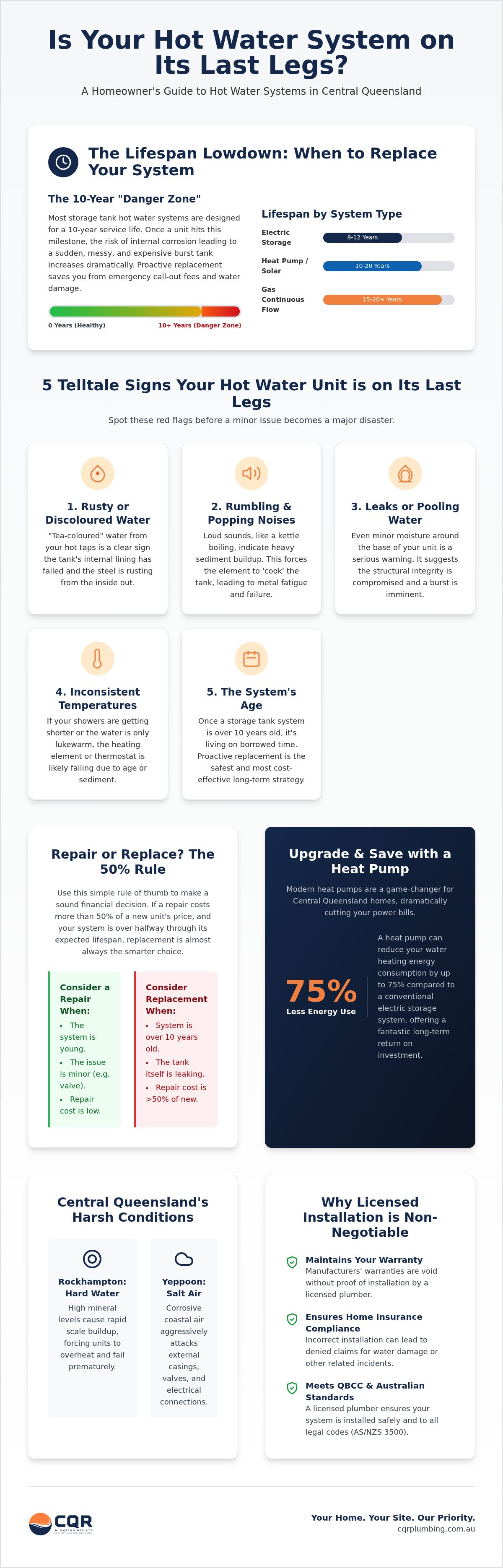
Most hot water tanks are tucked away in a cupboard or behind the house, forgotten until they stop working. Deciding when to replace hot water system units usually happens in a panic after a burst, but the smart move is watching the calendar. Most storage tanks are designed for a 10 year service life; once you hit that decade mark, you're officially in the "danger zone" where internal corrosion can lead to a sudden, messy failure. Pre-emptively replacing an aging unit allows you to research efficient models on your terms, rather than paying emergency call-out fees for whatever stock is available on a Sunday night.
Lifespan Expectations by System Type
Different technologies have different expiry dates. Electric storage units generally last 8 to 12 years before the tank lining gives up. Gas continuous flow systems often reach 15 to 20 years because they don't store water, which significantly reduces corrosion risks. Modern heat pumps and solar systems can last 10 to 20 years, though the electronic components or the tank itself might fail at different rates. If your system is older than 12 years, you are likely using more electricity than necessary, as older units lose their thermal efficiency over time.
The Central Queensland Factor
Our local conditions are tougher on plumbing than what you'll find in southern states. In Rockhampton, fluctuating mineral levels in the water supply can lead to rapid scale buildup on heating elements and inside tanks. This sediment acts like an insulator, forcing the unit to work harder and eventually "cook" itself from the inside out. This is why we often see tanks failing earlier here than the national average.
Down on the coast in Yeppoon, the salt air is the primary enemy. It aggressively attacks the external casing, valves, and electrical connections. Without regular hot water servicing to check the sacrificial anode, a tank that might last 12 years inland could fail in 7 or 8 years near the beach. When we install a new system, we ensure it meets the latest AS/NZS 3500 standards and the 1 May 2026 lead-free requirements, giving you the best chance at a long service life despite the Capricorn Coast's harsh environment.
5 Telltale Signs Your Hot Water Unit is on its Last Legs
Waiting for a total system failure often results in a flooded laundry and an expensive emergency call-out. Knowing when to replace hot water system units involves spotting the subtle cues your tank gives off before it finally quits. While some issues like a faulty thermostat or a leaking pressure relief valve are quick fixes, others indicate the tank has reached the end of its life. If you notice any of these five signs, it's time to assess whether your system is still safe and efficient.
Visual Red Flags: Rust and Discolouration
Have you noticed muddy or "tea-coloured" water coming from your hot taps? This is a classic sign that the internal glass lining of your steel tank has cracked, allowing the metal to rust. If the discolouration only appears when the hot water is running, the tank is the culprit. However, if you see rust on the external casing or pooling around the base, the structural integrity of the unit is compromised. This often happens when the sacrificial anode has been completely depleted.
The sacrificial anode is a magnesium or aluminium rod inside the tank designed to corrode so the steel doesn't. In the hard water conditions often found in Rockhampton, these rods can disappear in as little as three to five years. If you haven't had a plumber check your anode recently, the rust you see is likely the tank itself beginning to dissolve. If you're unsure about the state of your unit, you can book a professional inspection to avoid a sudden burst.
Performance Issues: Fluctuating Temps and Strange Noises
Does your hot water system sound like a kettle boiling or make loud popping and rumbling noises? This isn't just "character"; it's a sign of heavy sediment buildup. Over time, minerals from the Capricorn Coast water supply settle at the bottom of the tank. As the burner or element heats the water, it has to cook through this layer of sludge, causing the water trapped underneath to boil and "pop." This process creates hotspots that eventually fatigue the metal and cause the tank to split.
You should also pay attention to recovery times and water temperature. If your morning shower is getting shorter or the water never seems to get past "lukewarm," your system is struggling. Under Australian Standards, water must be stored at a minimum of 60°C to prevent Legionella bacteria growth. If your system can no longer maintain this temperature, it poses a genuine health risk to your family. A puddle of water at the base of the unit is the final warning; if the tank is weeping, it cannot be repaired and requires immediate replacement.
Repair vs. Replacement: Which Option Saves You More Money?
Deciding whether to patch up an old unit or start fresh is a common dilemma for homeowners. We use the "50% Rule" as a benchmark: if the repair bill is more than half the cost of a new system, replacement is usually the smarter financial move. This is particularly relevant if your unit is approaching the end of its typical service life. You can request a quote to get a professional evaluation of your current system's condition.
When a Repair Makes Sense
If your hot water unit is under 6 years old, a repair is often the logical choice. Most failures at this age are confined to specific, replaceable parts rather than the tank itself. Common repairs that offer good value include:
- Replacing thermostats or heating elements: These are relatively straightforward fixes that can restore service quickly.
- Swapping a leaking Temperature Pressure Relief (TPR) valve: This prevents water wastage and maintains safe pressure levels.
- Flushing the tank: This clears out sediment that causes the rumbling noises mentioned earlier, helping the unit run more quietly and efficiently.
The Argument for Full Replacement
Continuing to repair a 12 year old tank is often a losing game. While a new part might solve a minor issue, the internal corrosion doesn't stop. Upgrading to a modern system offers a fresh warranty and significantly lower running costs. New heat pumps can reduce energy consumption for water heating by 60% to 75% compared to traditional electric units. This efficiency is a primary factor in deciding when to replace hot water system units, as the energy savings often offset the initial purchase price over time.
A repair might be cheaper today, but an inefficient old unit keeps your power bills high. Upgrading provides long-term predictability and protects your home from the risk of a burst tank. For a detailed look at your upgrade options, read our hot water system installation Rockhampton guide. Every new system installed after 1 May 2026 must also use certified lead-free copper alloy components, ensuring your household drinking water remains safe and compliant with the latest regulations.
Choosing Your Next Hot Water System for Central Queensland
Once you've decided when to replace hot water system units, the next challenge is selecting a technology that handles the Central Queensland heat while keeping your power bills under control. Local families often struggle with the choice between lower upfront costs and long-term efficiency. In our region, the high humidity and consistent warmth actually work in your favour if you choose the right unit, as these conditions are ideal for modern energy-saving technologies.
Heat Pumps: The CQ Powerhouse
Heat pumps are rapidly becoming the standard choice across Australia. They operate like a refrigerator in reverse, extracting heat from the ambient air to warm your water. In Rockhampton and Yeppoon, this process is incredibly efficient because our air is rarely cold. A quality heat pump can reduce your water heating energy consumption by 60% to 75% compared to a standard electric storage tank. While the initial investment is higher, the federal government's STC (Small-scale Technology Certificate) scheme provides a point-of-sale discount, typically valued between $950 and $1,050 as of 2026.
You do need to consider placement; heat pumps contain a fan and compressor, which creates a moderate humming sound. We recommend installing them away from bedroom windows to ensure a quiet night's sleep. Sizing is also critical for heat pumps because their "reheat rate" is slower than electric elements. For a family of four, a 270L or 315L unit is usually the sweet spot to ensure you have enough delivery capacity for back-to-back morning showers.
Gas and Electric Options
For smaller modern blocks in Yeppoon where yard space is at a premium, a continuous flow gas system is often the best fit. These units are roughly the size of a suitcase and mount to an external wall, heating water instantly only when you turn the tap on. This means you never run out of hot water, regardless of how many guests are staying over. However, you will need to factor in the cost of LPG bottle rental if you don't have a natural gas connection.
Traditional electric storage is still a common choice for Rockhampton homes due to the lower upfront installation cost. While the law mandating energy-efficient systems was repealed in Queensland in 2013, allowing for any system type, traditional electric remains the most expensive to run. If you choose this route, we recommend a larger tank to take advantage of off-peak tariffs. You can explore our hot water services to see which brands we trust to survive the Capricorn Coast's high mineral water and coastal salt air.
Regardless of the system you choose, all installations performed after 1 May 2026 must use certified lead-free copper alloy products. This mandatory National Construction Code requirement ensures your household drinking water is safe and compliant. Sizing your system correctly involves more than just counting bedrooms; we look at your peak usage times and the flow rates of your existing tapware to ensure you get the best return on your investment.
Professional Installation & Maintenance in Rockhampton and Yeppoon
Attempting to install a hot water unit yourself might seem like a way to save a few dollars, but in Queensland, this is strictly illegal. Plumbing is a licensed trade for a reason. Incorrectly installed systems can lead to catastrophic tank explosions, electrical fires, or severe scalding. Beyond the physical risks, insurance companies will almost certainly reject any claim for water damage if the work wasn't performed by a licensed professional and lodged with the appropriate authorities.
Compliance and Safety Standards
Every professional installation by our Rockhampton plumber team concludes with the provision of a Form 4 compliance certificate. This document is your proof that the work meets the National Construction Code and QBCC requirements. It's an essential piece of paperwork for your home warranty and future property valuations. We also ensure that all new installations after 1 May 2026 utilise lead-free copper alloy fittings, protecting your family from heavy metal contamination in your drinking water.
Safety devices like tempering valves are a non-negotiable part of a compliant install. These valves mix hot and cold water to ensure that what comes out of your bathroom taps never exceeds 50°C. This prevents life-changing scald injuries, which can happen in seconds at higher temperatures. While the water is delivered safely to your taps, we set the tank thermostat to at least 60°C to ensure Legionella bacteria cannot survive inside the storage unit.
The CQR Maintenance Plan
Once you've decided when to replace hot water system units, your goal should be to make that new investment last as long as possible. Establishing a preventative maintenance schedule can effectively double the service life of a tank. We've seen well-maintained units reach 15 years in Rockhampton, while neglected ones in the same street fail at seven. The most critical task is an anode check every three to five years. Since these rods "sacrifice" themselves to stop the tank from rusting, replacing a depleted anode is the cheapest insurance policy you can buy.
Homeowners can perform simple safety checks every six months to keep things running smoothly. We recommend gently lifting the lever on the Temperature Pressure Relief (TPR) valve for a few seconds to ensure water flows freely and the valve reseats properly. If the valve is stuck or constantly weeping, it's a sign of high pressure that could eventually split the tank. Our team provides 24/7 emergency support across Yeppoon and the Capricorn Coast, ensuring that if a maintenance issue turns into a burst tank at midnight, you aren't left without help. Regular professional servicing ensures your system remains efficient, safe, and compliant with Australian Standards.
Secure Your Home's Hot Water Future
Recognising the 10 year danger zone and spotting the signs of internal corrosion are the most effective ways to prevent a sudden household emergency. By applying the 50% rule and considering the high efficiency of modern heat pump technology, you can turn a failing unit into a long term investment that slashes your monthly power bills. Deciding when to replace hot water system units is far easier when you have a clear understanding of your current unit's health and the latest Australian Standards.
Our team provides expert advice tailored to the unique mineral content and coastal conditions found throughout Rockhampton and Yeppoon. We ensure every installation is fully licensed and QBCC compliant, giving you the peace of mind that your home and insurance are protected. We offer 24/7 emergency response for burst tanks and are ready to help you choose the most reliable system for your family's needs.
Take the guesswork out of your plumbing maintenance and ensure your home stays dry and your showers stay warm. We look forward to helping you find the most efficient solution for your home and providing the quiet competence you expect from a local professional.
Frequently Asked Questions
How many years does a hot water system usually last in Australia?
Typical lifespans for electric and gas storage units range between 8 and 15 years, while instantaneous gas systems can last up to 20 years. Solar and heat pump units generally serve for 10 to 20 years, provided they receive regular professional maintenance. In Central Queensland, the high mineral content in the water often pushes these units toward the lower end of those ranges. Knowing when to replace hot water system units often involves tracking these installation dates.
Is it worth repairing a 10-year-old hot water heater?
Repairing a decade-old unit is rarely the most cost-effective choice because it has already entered the "danger zone" for structural tank failure. We generally apply the 50% rule; if the repair costs more than half the price of a new unit, replacement is the better investment. A new system provides a fresh warranty and superior energy efficiency, whereas a patched-up old tank remains a high risk for a major burst in the near future.
What are the signs that my hot water tank is going to burst?
A tank is likely to burst if you see water pooling around the base or notice deep rust on the external casing. Loud popping or rumbling noises are another critical warning, as they indicate heavy sediment buildup that creates hotspots on the tank lining. If your hot water appears muddy or tea-coloured, the internal glass lining has likely failed, meaning the steel tank is actively corroding and could split at any moment.
Why is my hot water suddenly turning cold halfway through a shower?
This issue often indicates a failing heating element, a faulty thermostat, or a broken internal dip tube. In storage systems, the dip tube directs cold water to the bottom of the tank to be heated; if it breaks, cold water mixes with the hot water at the top, resulting in a sudden temperature drop. A licensed plumber can diagnose if it’s a simple component swap or a sign that the whole unit requires replacement.
Can I change from an electric hot water system to a gas one?
Yes, converting from electric to gas is a common upgrade, but it requires a licensed gas fitter to install new pipework or LPG bottle regulators. While instantaneous gas systems offer an endless supply of hot water and take up less space, you must consider the ongoing cost of gas bottle rentals if natural gas isn't available in your street. We often recommend comparing the long-term ROI of gas against modern, high-efficiency heat pumps.
Does a leaking hot water system always need to be replaced?
Not every leak requires a full replacement, as many issues stem from faulty valves or loose fittings. If water is dripping from the Temperature Pressure Relief (TPR) valve, it might just need a simple replacement or a system flush. However, if water is weeping directly from the tank cylinder or through the base of the unit, it indicates a terminal structural failure. In these cases, there is no reliable way to patch the leak.
How much does it cost to replace a hot water system in Rockhampton?
The total investment for a replacement in Rockhampton depends on the system type, site access, and whether you are upgrading to a heat pump. While we don't provide fixed quotes here, factors like the 1 May 2026 lead-free requirements and federal STC rebates for energy-efficient models will influence the final figure. Identifying when to replace hot water system units before an emergency occurs allows you to compare these costs without the pressure of an icy shower.
What maintenance should I be doing on my hot water unit myself?
Homeowners should perform a safety check on their Temperature Pressure Relief (TPR) valve every six months. Gently lift the lever to ensure water flows into the drain line and the valve snaps shut correctly. You should also keep the area around the unit clear of debris and check for signs of rust or dampness. Tasks involving electrical components, gas lines, or internal anode replacements must always be handled by a licensed professional to remain compliant.
Disclaimer
The information in this article is provided for general educational purposes only and should not be relied upon as professional plumbing, gasfitting, or legal advice. Every property and plumbing system is different, and the information may not be applicable to your specific circumstances. CQR Plumbing recommends that all plumbing and gasfitting work be inspected and carried out by a licensed professional in accordance with applicable Australian Standards and Queensland regulations. If you require advice specific to your property, please contact CQR Plumbing for an assessment.