Commercial Hot Water System Rockhampton: The Ultimate Business Guide 2026
Could a single component in your plant room be the silent killer of your quarterly profit margins? For many local businesses, an inefficient or poorly configured commercial hot water system in Rockhampton isn't just a minor inconvenience; it's a constant financial drain and a looming compliance risk. You likely already know the frustration of seeing energy costs climb while worrying if your current setup will survive the next peak demand period. It's a stressful balancing act between keeping the doors open and keeping the water at the right temperature.
We've put this guide together to help you regain control over your facility's plumbing infrastructure. You'll learn how to select a high-performance system tailored to the unique climate of Central Queensland, ensuring you only pay for the energy you actually use. We'll also demystify the complex world of QBCC compliance, including mandatory Thermostatic Mixing Valve (TMV) testing and backflow prevention. From sizing your unit correctly to establishing a preventative maintenance schedule that actually works, this article provides the practical, field-tested advice you need to ensure your business stays fully operational and audit-ready.
Key Takeaways
- Calculate your facility's specific hot water demand using fixture units so you're never caught short during peak trade periods.
- Stay on the right side of the law by mastering QBCC requirements for TMV testing and backflow prevention to keep your site compliant.
- Compare the running costs of gas, electric, and heat pump setups to find the best commercial hot water system Rockhampton has for your budget.
- Protect your investment from the local tropical climate by selecting components designed to handle high humidity and prevent premature corrosion.
- Avoid costly downtime and keep your manufacturer warranties valid by establishing a professional, scheduled maintenance plan.
The Unique Demands of Commercial Hot Water in Rockhampton
Running a business in Central Queensland presents challenges that southern counterparts rarely face. When we talk about a commercial hot water system Rockhampton, we're dealing with a high-stakes environment where "near enough" is never good enough. A standard household unit simply can't keep up with the relentless cycle of a commercial kitchen, a busy medical centre, or a multi-storey office block. The demands on the hardware are significantly higher, and the environment itself is far more aggressive.
Commercial vs. Residential: Understanding the Gap
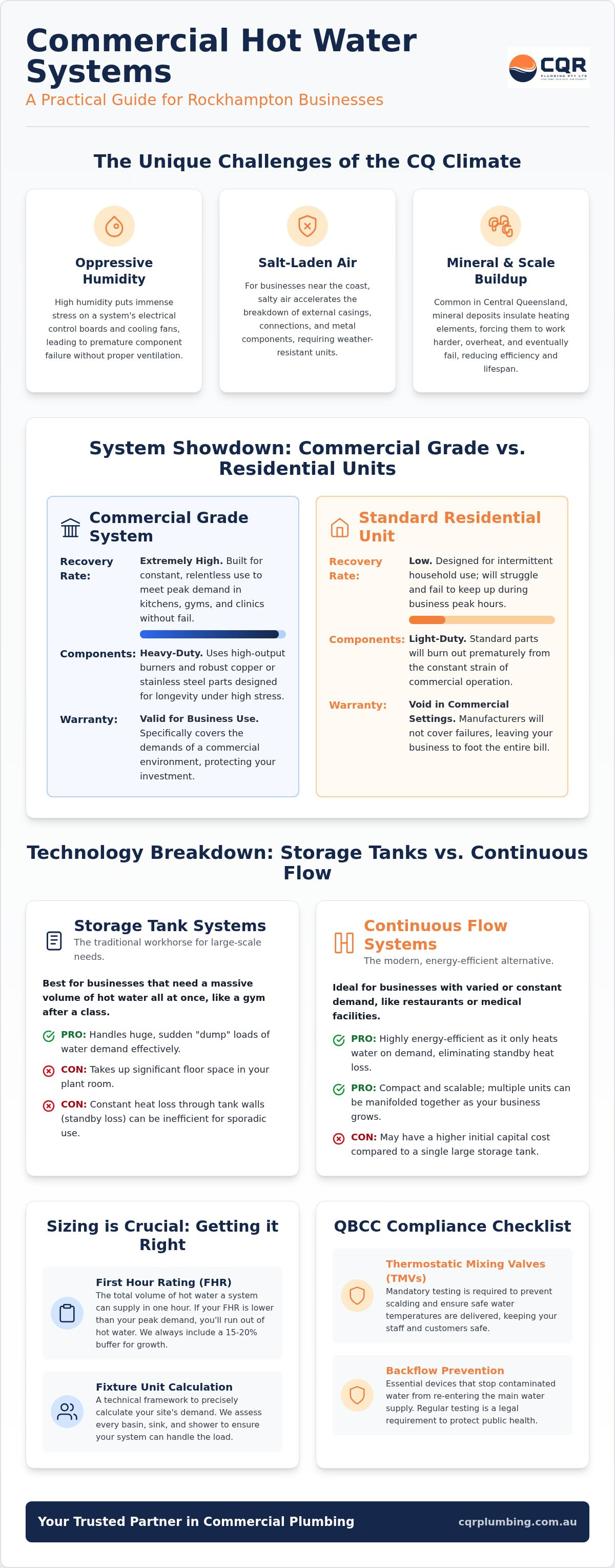
The primary difference between these systems is the recovery rate. This refers to the speed at which the unit can heat a full tank of cold water back up to the required temperature after a period of heavy use. In a home, you might have two showers in the morning and some laundry. In a commercial setting, you might have ten taps running simultaneously during a peak lunch rush or a shift change at a local gym.
Residential units are designed for intermittent use. If you install one in a high-demand business, the heating elements or gas burners will burn out prematurely because they're constantly working to keep up. Most importantly, manufacturers specifically exclude commercial applications from their residential warranties. If that unit fails, you're on your own. High-performance commercial systems use heavy-duty copper or stainless steel components and high-output burners to ensure that the 100th litre of water is just as hot as the first.
The Central Queensland Environmental Factor
Rockhampton's climate is notoriously tough on outdoor infrastructure. Our high ambient temperatures and oppressive humidity create a breeding ground for corrosion. For businesses closer to the coast in areas like Yeppoon, the salt-laden air accelerates the breakdown of external casings and electrical connections. We often see systems that look ten years old after only three years of service because they weren't specified for coastal conditions.
While it's true that warmer incoming water requires less energy to reach temperature, the external heat puts immense stress on the system's electrical control boards and cooling fans. Without proper ventilation and high-grade insulation, efficiency drops and components fail. We also have to account for local water quality. Mineral deposits and scale buildup are common in Central Queensland, which can insulate heating elements and cause them to overheat and snap. Investing in a robust commercial hot water system Rockhampton businesses can rely on is about protecting your bottom line as much as it is about the plumbing. A failure isn't just an inconvenience; it's a safety risk and a revenue killer that can force an immediate site closure.
Choosing the Right System: Capacity, Sizing, and Technology
Selecting a commercial hot water system Rockhampton business owners can rely on starts with precise engineering. We don't just look at the number of taps; we calculate the "fixture unit" value for every point on the property. This technical framework ensures the system handles the specific load of your industry, whether you're running a 24-hour medical clinic or a high-turnover cafe. Guesswork leads to cold water during a rush, while over-sizing leads to wasted energy and higher capital costs.
Sizing Your System for Peak Usage
To get the sizing right, we focus on the First Hour Rating (FHR). This is the total volume of hot water the system can supply in one hour, starting with a full tank. If your FHR is lower than your peak usage, your staff will be waiting for water to reheat, which kills productivity. We also factor in a 15-20% buffer for future growth. You don't want to replace the entire plant just because you added two more basins next year.
Peak demand for a Rockhampton commercial kitchen is the maximum volume of 60°C water required to satisfy all sanitisation and food preparation fixtures during the busiest hour of service.
Storage vs. Continuous Flow: Which Wins?
Storage tank systems are the traditional workhorse for large-scale needs. They're excellent for businesses that need a massive "dump" of water all at once, such as a gym where everyone showers after a 5:30 PM class. However, they take up significant floor space and lose heat through the tank walls over time, which can be inefficient if your usage is spread out throughout the day.
Manifolded continuous flow systems are the modern alternative. By linking multiple instantaneous units together, we create a system that only fires up when a tap is turned on. This offers two major benefits:
- Redundancy: If one unit requires a repair, the others continue to operate, meaning your business never loses hot water.
- Space Efficiency: These units are wall-mounted, freeing up valuable floor space for storage or operations.
For many sites, a hybrid solution works best. This involves a smaller storage tank paired with continuous flow units to manage the "lag" time and ensure instant delivery. If you're unsure which setup fits your floor plan, you can request a technical site assessment to see what’s feasible. Getting the technology right now prevents expensive retrofitting later when your commercial hot water system Rockhampton setup can't keep pace with your success.
Energy Efficiency and Running Costs for Local Businesses
Operational expenses can make or break a commercial venture. When selecting a commercial hot water system Rockhampton businesses must weigh up the capital cost against the projected ten-year running expenses. In our experience, the system that seems cheapest on day one often becomes the most expensive by year three. Energy ratings aren't just stickers; they represent real-world savings on your quarterly utility bills.
Time-of-use tariffs play a critical role in these calculations. Many commercial properties in Central Queensland are on plans where electricity prices spike during business hours. If your system is constantly reheating water during these peak windows, you're paying the highest possible rate. Smart controllers and larger storage capacities can help by "load shifting," allowing the system to do the heavy lifting during off-peak periods when rates are lower.
The Rise of Commercial Heat Pumps in CQ
Heat pumps have become the preferred choice for many local facilities. Because Rockhampton enjoys high ambient temperatures year-round, these units operate at peak efficiency almost every day. They work like a refrigerator in reverse, extracting heat from the air to warm your water. While the initial investment is higher than a standard electric tank, the energy reduction is often between 60% and 75% compared to traditional elements. To keep these savings consistent, you must ensure the evaporator coils and fans are kept clear of debris and dust, which can build up quickly in our tropical environment.
Gas Fitting and Efficiency
Gas remains a powerhouse for industries requiring immediate, high-volume recovery. If your site has access to natural gas, the running costs are generally very competitive. For those relying on LPG, efficiency becomes even more vital. Modern condensing gas units now feature modulating burners that adjust the flame size based on the actual water flow. This prevents the "all or nothing" approach of older units, which wastes significant fuel.
Installing or repairing these systems requires specific expertise. You must engage a licensed gas fitter Rockhampton businesses trust to ensure the gas pressure is tuned correctly and the flueing meets safety standards. A poorly tuned burner doesn't just waste gas; it can produce dangerous carbon monoxide and shorten the lifespan of the heat exchanger. Check your gas bills for sudden spikes, as this is often the first warning sign that your burners need a professional service.
Compliance and Safety: TMVs, Backflow, and QBCC Standards
Managing a commercial facility involves more than just keeping the lights on. In Queensland, the regulatory landscape for water safety is strict, and for good reason. Your commercial hot water system Rockhampton installation must adhere to the Plumbing Code of Australia and AS/NZS 3500. These standards ensure that your system doesn't just produce hot water, but does so without risking the health of your staff, customers, or the wider community. Failure to maintain these standards can result in heavy penalties from the QBCC or, worse, liability in the event of an accident.
Understanding TMV Testing Obligations
Thermostatic Mixing Valves (TMVs) are the frontline defence against scalding. In environments like aged care, childcare, and hospitality, the water at the tap must be delivered at a precise, safe temperature. While your storage tank must keep water at 60°C to kill Legionella bacteria, a TMV blends this with cold water to ensure it's safe for skin contact. Under Queensland law, these valves require annual testing by a licensed professional to ensure they haven't seized or failed. Once tested, we lodge a QBCC Form 9 to certify the device is operational. You can learn more about our specific backflow and TMV testing protocols to see how we manage this for local facilities.
Backflow Prevention for Commercial Sites
Backflow occurs when contaminated water flows backward from your property into the Rockhampton mains water supply. This can happen during a sudden drop in mains pressure, such as a burst pipe down the street. To prevent this, commercial sites must have backflow prevention devices installed. These are categorised by hazard levels:
- High Hazard: Sites using chemicals, cooling towers, or industrial processing.
- Medium Hazard: Commercial kitchens, laundries, and public pools.
- Low Hazard: Standard domestic-style connections.
Council regulations mandate that high and medium hazard devices are tested every 12 months. This isn't a suggestion; it's a legal requirement to maintain your business's water connection. Working with a commercial plumbing services Yeppoon expert ensures your devices are registered correctly with the local authority and tested on schedule. This proactive approach prevents administrative headaches and potential service disconnections for your commercial hot water system Rockhampton setup.
Professional Installation and Preventative Maintenance
Don't let a "handyman" or general maintenance worker touch your plant room. It's the quickest way to void a multi-thousand-dollar manufacturer warranty and potentially your building insurance. Commercial systems are sophisticated pieces of engineering that operate under high pressure and temperature. If a commercial hot water system Rockhampton installation or repair isn't signed off by a licensed plumber with the correct endorsements, you're carrying 100% of the risk. Insurance providers are notoriously strict; if uncertified work leads to property damage, your claim will likely be rejected before the assessor even arrives on site.
Preventative maintenance is about protecting your business continuity. You shouldn't wait for a total system failure that forces a site closure. Watch for the warning signs that indicate a professional check is overdue. Discoloured water suggests internal tank corrosion, while rumbling or "kettling" noises often mean a significant buildup of sediment around the heating elements. If you notice water pooling around the base of the unit or a sudden drop in delivery temperature, call a professional before a small leak becomes a catastrophic burst.
The Importance of Licensed Installation
A professional installation ensures every safety component is correctly configured. This includes the Pressure Relief Valve (PRV) and its associated drainage lines. If these aren't installed to Australian Standards, excessive pressure can't escape, leading to tank failure or even an explosion in extreme cases. For gas-fired units, proper flueing is non-negotiable to prevent carbon monoxide buildup. Licensed plumbers ensure the system is tuned to the specific gas pressure of your site, which maximises the lifespan of the heat exchanger and reduces operational stress from day one.
Maintenance Plans for Facility Managers
Effective maintenance for a commercial hot water system Rockhampton relies on a structured schedule. The sacrificial anode is your system's first line of defence against Central Queensland's water quality. This rod corrodes so your tank doesn't have to; replacing it every few years can effectively double the life of a storage tank. We also recommend the following regular checks:
- Anode Inspection: Checking the rod's wear level every 12 to 24 months.
- Tank Flushing: Removing mineral sediment that settles at the bottom of the tank.
- TPR Valve Testing: Manually lifting the Temperature and Pressure Relief valve every six months to ensure it hasn't seized.
- Burner or Element Service: Cleaning and testing for efficiency to keep running costs low.
Future-Proofing Your Commercial Facility's Hot Water
Managing a commercial facility is a high-stakes responsibility where small oversights lead to significant expenses. You now understand that selecting the right commercial hot water system Rockhampton requires more than just picking a tank off the shelf. It's about engineering a solution that handles your peak demand while meeting non-negotiable QBCC safety standards. From ensuring your TMVs are tested annually to choosing energy-efficient heat pumps that thrive in our tropical climate, every decision impacts your bottom line and your operational safety.
As licensed QBCC commercial plumbers, we specialise in maintaining these complex systems and keeping your site compliant with backflow and TMV regulations. We also provide 24/7 emergency response for Rockhampton businesses to ensure a minor fault doesn't turn into a costly shutdown. Taking a proactive approach today prevents the stress of a total system failure tomorrow. You've got the knowledge to make an informed decision that protects your assets and your profit margins. We're ready to help you implement a system that works as hard as your business does.
Frequently Asked Questions
How often do commercial TMVs need to be tested in Rockhampton?
Commercial Thermostatic Mixing Valves (TMVs) must be tested every 12 months to remain compliant with Queensland regulations. This annual requirement ensures the valve accurately blends hot and cold water to prevent scalding in sensitive environments like cafes or medical centres. After the test, your plumber must lodge a Form 9 with the QBCC to certify the device is safe. Regular testing also prevents the internal thermal element from seizing due to local water sediment.
What is the best hot water system for a high-demand restaurant?
A manifolded gas continuous flow system is often the superior choice for high-demand Rockhampton restaurants. These systems link multiple units together to provide a massive volume of hot water without the heat loss associated with large storage tanks. Because they only heat water on demand, you'll save on gas bills during quiet periods. This setup also provides built-in redundancy; if one unit requires a repair, the others continue to supply your kitchen.
Does my business legally require a backflow prevention device?
Most Rockhampton commercial properties require a backflow prevention device to protect the town’s potable water supply from contamination. If your business involves high-hazard activities like chemical processing or even medium-hazard tasks in a commercial kitchen, a testable device is mandatory. These units must be certified annually by a licensed plumber with a backflow endorsement. Failure to provide this certification to the local council can lead to fines or the disconnection of your water service.
How long does a commercial hot water system typically last in Central Queensland?
A well-maintained commercial hot water system Rockhampton businesses rely on typically lasts between 8 and 12 years. Our harsh tropical climate and local mineral content can be aggressive on steel tanks and electrical components. You can extend this lifespan significantly by replacing the sacrificial anode every few years and flushing the tank to remove sediment. Systems left without a preventative maintenance schedule often fail prematurely due to internal corrosion or element burnout.
Can I switch from electric to gas hot water for my commercial building?
You can certainly switch from electric to gas, provided your building has access to natural gas or space for LPG cylinders. This transition is a popular way for local businesses to reduce peak electricity costs and improve recovery times. A licensed gas fitter will need to install new pipework and ensure the flueing meets current Australian Standards. While the initial conversion requires an investment, the long-term operational savings and increased hot water capacity are substantial.
What should I do if my commercial hot water system is leaking from the bottom?
If you spot water pooling at the base of your unit, shut off the energy supply and the cold water inlet valve immediately. A leak from the bottom often indicates the internal tank has corroded through, which usually requires a full replacement. However, it could also be a faulty Temperature and Pressure Relief (TPR) valve or a loose fitting. You should call for a 24/7 emergency response to diagnose the fault before the leak causes structural property damage.
Are there energy-efficient rebates for Rockhampton businesses upgrading hot water?
There are often state and federal incentives available for Rockhampton businesses that upgrade to high-efficiency technology like commercial heat pumps. These programmes change frequently, so it's best to check the current Small-scale Technology Certificate (STC) eligibility or Queensland government energy saving schemes. Beyond initial rebates, the primary financial benefit is the drastic reduction in your quarterly energy bills. Modern heat pumps can reduce hot water energy consumption by up to 75% compared to old electric units.
How do I know if my commercial hot water unit is undersized?
The most obvious sign your unit is undersized is running out of hot water during your busiest trade periods. If your staff report that the water turns lukewarm during the lunch rush or shift changes, the system's recovery rate cannot keep up with your fixture units. You might also notice the system is constantly running or "kettling" as it struggles to reheat. We calculate your actual demand based on peak usage to ensure your next system handles the load comfortably.
Disclaimer
The information in this article is provided for general educational purposes only and should not be relied upon as professional plumbing, gasfitting, or legal advice. Every property and plumbing system is different, and the information may not be applicable to your specific circumstances. CQR Plumbing recommends that all plumbing and gasfitting work be inspected and carried out by a licensed professional in accordance with applicable Australian Standards and Queensland regulations. If you require advice specific to your property, please contact CQR Plumbing for an assessment.