Expert Hot Water System Installation in Yeppoon: The Essential Homeowner’s Guide
Did you know that your hot water system could be responsible for up to a quarter of your home's total energy consumption? It's a sobering thought, especially when you're already dealing with the sting of rising quarterly electricity bills. If you've been dreading your morning shower because the pressure is lagging or the water is lukewarm, you aren't alone. Many homeowners across the Capricorn Coast find themselves stuck between choosing a quick fix and a proper, long-term solution. When it comes to a professional hot water system installation Yeppoon residents need a setup that can withstand our unique coastal conditions while keeping running costs under control.
I've spent years in the field replacing rusted-out tanks and faulty valves, so I know exactly what works in Central Queensland. In this guide, I'll help you cut through the confusion of choosing between electric, gas, and high-efficiency heat pumps. You'll learn how to identify the warning signs of a failing unit before it floods your laundry. We'll also cover the critical regulatory requirements under AS/NZS 3500.4: 2025, including why the QBCC Form 4 is your most important piece of paperwork for insurance and warranty protection. By the end, you'll have the technical knowledge to secure consistent water pressure and lower your bills.
Key Takeaways
- Understand how to choose between electric, gas, and heat pump systems specifically engineered to handle the Central Queensland climate and high ambient temperatures.
- Learn why Yeppoon’s water quality requires a sacrificial anode check every two to three years to prevent internal tank corrosion and extend the life of your unit.
- Calculate your household’s peak demand to ensure your storage tank capacity, from 125L to over 315L, can handle the morning rush without running cold.
- Discover why a compliant hot water system installation Yeppoon must include a QBCC Form 4 submission to protect your home insurance and manufacturer warranty.
- Identify the professional installation standards required for a long-lasting setup, including stable base preparation and the mandatory use of tempering valves for safety.
Selecting the Ideal Hot Water System for the Yeppoon Climate
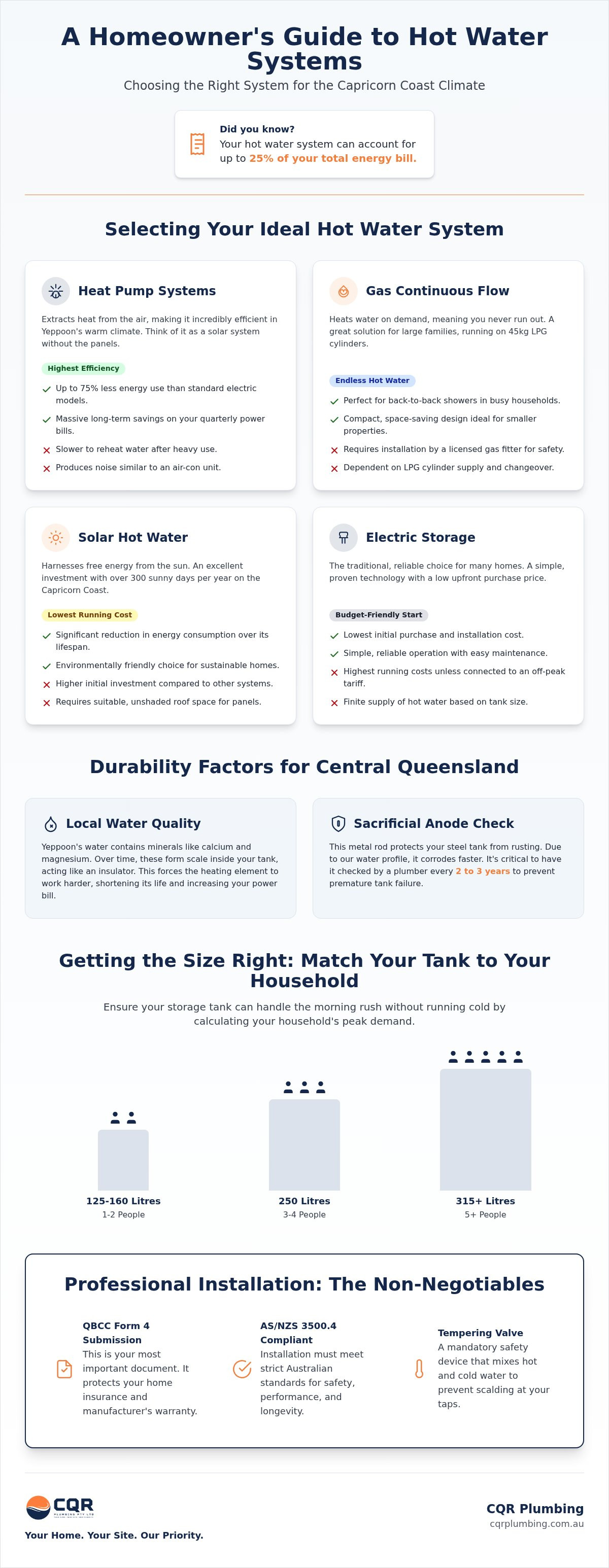
Choosing between different types of water heating systems isn't just about the price tag. In Central Queensland, our humidity and salt air can be brutal on appliances. When planning a hot water system installation Yeppoon homeowners must weigh up the upfront purchase price against the long-term running costs. While traditional electric storage units remain a reliable, low-cost entry point, they often lead to higher quarterly bills if you aren't on an off-peak tariff. For those with limited space on smaller coastal blocks, gas continuous flow systems offer a compact alternative that only heats water as you use it.
Solar hot water remains a popular choice along the Capricorn Coast, and for good reason. With over 300 sunny days a year, these systems allow you to harvest free energy from the sun. Although the initial investment is higher than other options, the reduction in energy consumption is significant over the unit's lifespan. However, if your roof space is already occupied by solar power panels, a heat pump might be the smarter path forward.
Electric vs Heat Pump: The Energy Efficiency Debate
Heat pumps are often described as "solar without the panels" because they extract heat from the surrounding air to warm your water. In our warm Yeppoon climate, these units are incredibly effective. A quality heat pump can be up to 300% efficient, using approximately 70-75% less energy than a standard electric storage tank. This makes them a powerhouse for slashing household overheads.
You should consider the recovery time before switching. While an electric element heats water relatively quickly, a heat pump compressor takes longer to recover after heavy use. Noise is another factor to manage. Because the unit uses a fan and compressor, it sounds similar to an outdoor air conditioning unit. I always recommend placing these away from bedroom windows to ensure your sleep isn't disturbed during a midnight heating cycle.
Is Gas Hot Water Viable in Central Queensland?
While reticulated natural gas isn't available in most parts of Yeppoon, gas hot water is still a very viable option using 45kg LPG cylinders. These "instant" systems are a lifesaver for large families where back-to-back showers are the norm. You never have to worry about the last person in the house getting a cold rinse because the system doesn't rely on a finite storage tank.
If you decide to go with gas, remember that safety and compliance are non-negotiable. Every gas hot water system installation Yeppoon wide must be completed by a licensed gas fitter. This ensures the gas lines are sized correctly and the ventilation meets strict Australian standards. A professional install protects your property from potential leaks and keeps your manufacturer's warranty intact.
Durability Factors: CQ Water Quality and Tank Longevity
Yeppoon's water supply is managed by the Livingstone Shire Council, sourced from Water Park Creek and supplemented by the Fitzroy River. While this water is professionally treated, it carries a mineral profile that can be quite aggressive toward household appliances. Over time, calcium and magnesium minerals settle at the bottom of your tank, forming a thick layer of scale. This scale acts as an insulator between the heating element and the water, forcing your system to work harder and driving up your energy bills. This mineral build-up is a leading cause for a premature hot water system installation Yeppoon wide, as many homeowners don't realise their tank is essentially being "cooked" from the inside out.
Choosing the right tank material is your first line of defence against our local water chemistry. Vitreous enamel (glass-lined) tanks are the most common choice in Central Queensland. These are steel cylinders with a ceramic coating, but they rely entirely on a sacrificial anode to prevent rust. Alternatively, stainless steel tanks offer high resistance to corrosion and don't require an anode, though they are often more expensive upfront and can be sensitive to high chloride levels. Reviewing Australian Government energy advice can help you weigh up which material provides the best thermal efficiency and longevity for your specific property.
Understanding Sacrificial Anodes
The sacrificial anode is a long rod made of magnesium or aluminium that sits inside your tank. Its sole purpose is to corrode so your steel tank doesn't. Through a process called electrolysis, the anode attracts the corrosive elements in the water to itself, sacrificing its own metal to keep the tank wall intact. A $100 anode replacement can double the system’s life by preventing the internal rust that eventually leads to a catastrophic burst. You'll know your anode has likely expired if you notice discoloured, rusty-looking water or a slight "rotten egg" odour when you turn on the hot tap.
Preventative Maintenance for Long-Term Reliability
A "set and forget" mentality is the quickest way to a flooded laundry and an expensive emergency call-out. I recommend flushing your storage tank every year to remove heavy sediment build-up. This simple task involves opening the drain valve to clear out the grit that settles at the bottom. You should also manually test the Pressure Temperature Relief (PTR) valve every six months by lifting the lever briefly. This ensures the valve hasn't been seized by mineral scale. Our professional maintenance services are designed to catch these small faults before they turn into major failures. If you haven't had your system inspected in the last few years, it's a good idea to request a quote for a comprehensive system health check.
Sizing and Capacity: From Units to Family Homes
Getting the size of your hot water unit wrong is a mistake you'll feel every single morning. If the tank is too small, the last person in the shower is guaranteed a cold rinse. If it's too large, you're paying to heat water that nobody ever uses. As a rule of thumb, I usually allow roughly 50 litres of hot water per person for a typical morning rush. This figure changes quickly if you have a teenager who spends twenty minutes under the shower or if you've installed high-flow rain-head fixtures. For a new hot water system installation Yeppoon households need to look closely at their actual daily habits rather than just following a generic chart on a box.
Your choice of electricity tariff also dictates the storage volume you need. If your home is set up on a controlled supply tariff, like Tariff 33, the power is only available for a certain number of hours each day. This means you need a larger tank to bank enough hot water to last through the periods when the power is switched off. For homeowners moving toward heat pumps, we often recommend oversizing the tank. By installing a 315 litre unit for a four person home, you can program the system to run only during the warmest part of the day. This maximises efficiency and uses your rooftop solar power instead of drawing from the grid at night.
Matching Tank Size to Household Residents
To help you narrow down the options, I've put together a quick guide for storage-based systems based on what I see working best in local homes:
- 1 to 2 Residents: 125L to 160L storage tank.
- 3 to 4 Residents: 250L storage tank or a 20LPM to 26LPM gas continuous flow unit.
- 5 or More Residents: 315L+ storage tank or high-capacity gas units.
If you prefer gas continuous flow, these are rated in Litres Per Minute (LPM) rather than total storage. A 26LPM unit is usually the sweet spot for family homes as it can comfortably supply two showers running simultaneously. Heating water can increase the concentration of dissolved solids, so understanding water quality and hot water systems is essential for maintaining both your health and the appliance's internal components.
Space and Location Constraints
Modern sub-divisions in the region often have tighter side-access, which makes the physical footprint of your system a major factor. When planning a hot water system installation Yeppoon homeowners must consider that a 315 litre electric tank is a heavy, bulky piece of equipment requiring a solid, level base. If we are installing a heat pump, we must ensure there is adequate clearance for airflow. These units need to breathe to extract heat from the air; if they're tucked into a narrow, unventilated breezeway, their efficiency will plummet. Gas units are excellent space-savers, but they require strict clearances from windows and doors for their exhaust flues. You can find more information on our hot water service page regarding specific local installation requirements.
The Installation Process: What a Licensed Plumber Does
Professional installation isn't just about connecting two pipes. It starts with the safe removal and eco-friendly disposal of your old, leaking unit. We then prepare the site to prevent future structural issues. For a hot water system installation Yeppoon homeowners need a stable, level base that won't shift or sink over time. Whether we use a pre-cast concrete slab or a heavy-duty UV-stabilised plastic base, it must be capable of supporting the massive weight of a full tank. A 315 litre system weighs over 350kg once filled, which can easily crack thin pavers or cause unlevel ground to subside. Our team handles the entire process, including the plumbing of mandatory safety valves like the Pressure Temperature Relief (PTR) valve, which prevents the tank from over-pressurising.
Mandatory Compliance and Safety Standards
Every installation must strictly adhere to Australian Standard AS/NZS 3500. A critical component is the tempering valve, which limits water at your taps to 50°C to prevent scalding. While the tank stays at 60°C to kill bacteria, the valve protects your family from high-temperature burns. After the work, we lodge a QBCC Form 4. This official notification is vital for your home insurance validity and keeping your manufacturer's warranty active.
Beyond the valves and pipes, the electrical and gas connections require precise coordination. If you're switching from a standard electric tank to a heat pump, the wiring may need an upgrade to handle the compressor's load. Similarly, gas continuous flow units require specific pipe sizing to ensure consistent pressure when multiple taps are running. We manage these technical details so you don't have to worry about the system failing during a cold snap.
Post-Installation Quality Checks
We finish with rigorous quality checks, testing all connections under Yeppoon's mains pressure to ensure there are no leaks. We also ensure the PTR overflow pipe drains to a visible, safe location away from your home's foundations to prevent soil erosion. During the handover, I'll show you the cold water isolation valve and the electrical or gas shut-off points. This knowledge is essential so you can act quickly if you ever need to isolate the system.
Why Choose CQR Plumbing for Your Yeppoon Installation?
When you need a hot water system installation Yeppoon residents can rely on, local experience is everything. We understand the specific challenges of the Capricorn Coast, from the corrosive salt air near Main Beach to the water pressure variations in the newer sub-divisions. Our team isn't just passing through; we live and work here, which means our reputation is built on every single job we complete. We don't hide behind technical jargon or complex industry terms. Instead, we provide straightforward, honest advice so you can make an informed decision for your home without the stress.
Safety and legal compliance are the foundations of our service. As licensed gas fitters and plumbers, we ensure every installation meets the strict requirements of the *Plumbing and Drainage Act 2018*. We've seen the consequences of DIY attempts or unlicensed work, which often result in voided manufacturer warranties and rejected insurance claims. By choosing a fully insured professional, you gain the peace of mind that your system is safe and compliant with all Queensland regulations. If your unit fails in the middle of the night, our 24/7 emergency response ensures you aren't left with cold showers for long.
The CQR Difference: Reliability and Expertise
Our approach is built on reactive maintenance and technical precision. We don't just swap one box for another. We analyse why your previous system failed and recommend a solution that prevents it from happening again. You'll have direct access to experienced tradespeople who prioritise long-term reliability over quick, cheap fixes. Whether it's adjusting a tempering valve or resizing a gas line, we get the technical details right the first time. If you're ready to upgrade to a more efficient unit, you can request a quote for your new system today.
Supporting the Capricorn Coast Community
We're a locally owned and operated business with deep roots in the region. While we're a top choice for a hot water system installation Yeppoon wide, we also proudly serve Emu Park, Rockhampton, and Gracemere. We respect your property, which is why we have a strict policy of being clean, tidy, and punctual. We arrive when we say we will and never leave a mess behind on your driveway or in your laundry. For more tips on maintaining your plumbing, check out our guide on 5 signs of a failing hot water system to stay ahead of potential issues before they become emergencies.
Secure Reliable Hot Water for Your Coastal Home
Investing in a new hot water unit is about more than just replacing a tank; it's about securing long-term comfort and energy efficiency for your family. By choosing a system engineered for the Central Queensland climate and maintaining it with regular anode checks, you can effectively double the lifespan of your appliance. Remember that a professional hot water system installation Yeppoon is a legal requirement that protects your household from scalding and ensures your home insurance remains valid. Our team of licensed gas fitters and plumbers is committed to providing transparent advice and QBCC-compliant installations.
Whether you need an urgent replacement or want to upgrade to a high-efficiency heat pump, we are ready to help with 24/7 emergency support. Taking the time to size your system correctly now will prevent frustrating cold showers and shockingly high electricity bills in the future. We pride ourselves on being a dependable local resource for Capricorn Coast homeowners. You can rely on our expertise to deliver a system that stands up to local water conditions while providing consistent pressure for your entire household.
We look forward to helping you enjoy lower running costs and reliable hot water for many years to come.
Frequently Asked Questions
How much does it cost to install a hot water system in Yeppoon?
Installation costs vary based on whether you are doing a like-for-like replacement or changing the system's location and technology. Factors include the unit's capacity, the complexity of the pipework, and whether electrical or gas line upgrades are required. Because every property on the Capricorn Coast has different requirements, we provide tailored quotes. This ensures you get a fair price for a compliant setup without any hidden surprises after the job is finished.
How long does a typical hot water system installation take?
A standard like-for-like hot water system installation Yeppoon wide typically takes between two and four hours. If you are switching from electric to a heat pump or gas, the process might take a full day. This extra time allows for new electrical circuits, gas line plumbing, or the construction of a new concrete base. We always aim to have your hot water back on before the evening rush to minimise disruption.
Can I switch from an electric hot water system to a heat pump?
You can certainly switch from electric to a heat pump, and many Yeppoon homeowners are doing so to slash their energy bills. These units require adequate outdoor space for airflow and a solid base to support the weight. While the upgrade involves some initial plumbing and electrical modifications, the long-term savings often justify the effort. It's an excellent way to leverage our high ambient temperatures for more efficient water heating.
Do I need a council permit for a new hot water system in Yeppoon?
You don't usually need a separate council permit, but the work is classified as "notifiable work" under Queensland law. As licensed plumbers, we are required to lodge a Form 4 with the Queensland Building and Construction Commission (QBCC) within 10 business days of completion. This document serves as your official proof of a compliant installation. It's essential for your home insurance and provides peace of mind that the work meets Australian Standards.
What are the signs that my hot water system is about to burst?
Watch for water pooling around the base of the tank or rust-coloured water coming from your taps. Strange rumbling or popping sounds often indicate a heavy sediment build-up that's overheating the tank floor. If you notice a steady stream of water from the Pressure Temperature Relief (PTR) valve, the system is likely over-pressurising. Identifying these warning signs early can prevent a catastrophic burst and potential water damage to your home foundations.
Why is my hot water pressure lower than my cold water pressure?
Low hot water pressure is often caused by a faulty pressure limiting valve or a blockage in the tempering valve. Because Yeppoon water can be mineral-heavy, sediment can also clog the duo valve at the tank's inlet. If your cold water pressure is fine but the hot side is lagging, it usually indicates a component failure within the hot water circuit rather than a problem with the main council supply line.
How often should I have my hot water system serviced in Central Queensland?
I recommend a professional service every two to three years to inspect the sacrificial anode and the overall health of the unit. In Central Queensland, our water chemistry can deplete anodes quickly, leaving your tank vulnerable to rust. Homeowners should also manually test the PTR valve every six months by briefly lifting the lever. Regular maintenance is the most effective way to extend the lifespan of your system and avoid emergency failures.
Is a gas hot water system cheaper to run than electric in Yeppoon?
Gas continuous flow systems can be more economical than standard electric storage units, especially for large families with high demand. Since natural gas is limited in Yeppoon, most residents use 45kg LPG cylinders. While gas provides an endless supply, high-efficiency heat pumps often offer the lowest running costs in our sunny climate. We can help you compare these options based on your specific household usage patterns and existing solar power setup.
Disclaimer
The information in this article is provided for general educational purposes only and should not be relied upon as professional plumbing, gasfitting, or legal advice. Every property and plumbing system is different, and the information may not be applicable to your specific circumstances. CQR Plumbing recommends that all plumbing and gasfitting work be inspected and carried out by a licensed professional in accordance with applicable Australian Standards and Queensland regulations. If you require advice specific to your property, please contact CQR Plumbing for an assessment.