
Underground Water Leak Signs: Rockhampton Homeowner Guide
Imagine opening your quarterly water notice only to find a figure that looks more like a phone number than a standard utility bill. For many Rockhampton families, this is the first and only sign of a serious underground water leak hidden deep beneath their driveway or front lawn. It's a stressful situation, especially when you start worrying about the cost of digging up your entire yard just to find a single burst pipe or a failing poly fitting.
It's completely normal to feel overwhelmed by the thought of massive excavation or the confusion over whether the council or the homeowner is responsible for the repairs. I've spent years in the field as a licensed plumber across Central Queensland, and I can tell you that finding a leak doesn't have to mean destroying your landscaping. This guide will show you how to use a simple four to five hour DIY meter test to confirm a problem exists, explain the Rockhampton Regional Council's latest rebate policies, and walk you through the professional technology we use to pinpoint the exact location of a burst without a shovel in sight.
Key Takeaways
- Recognise subtle signs like unexplained spikes in your quarterly council water rates or patches of lush, green grass during a dry Rockhampton winter.
- Learn how to perform a simple DIY meter test to confirm if an underground water leak is active on your property before calling in the professionals.
- Discover how modern acoustic technology finds the exact location of a burst, saving your landscaping from unnecessary and expensive "guess and dig" excavation.
- Compare the pros and cons of localised spot repairs versus full line replacements to find the most cost-effective long-term solution for your home.
- Understand how Rockhampton’s reactive black soils and seasonal weather shifts put unique stress on your underground plumbing infrastructure.
Warning Signs of a Hidden Underground Water Leak
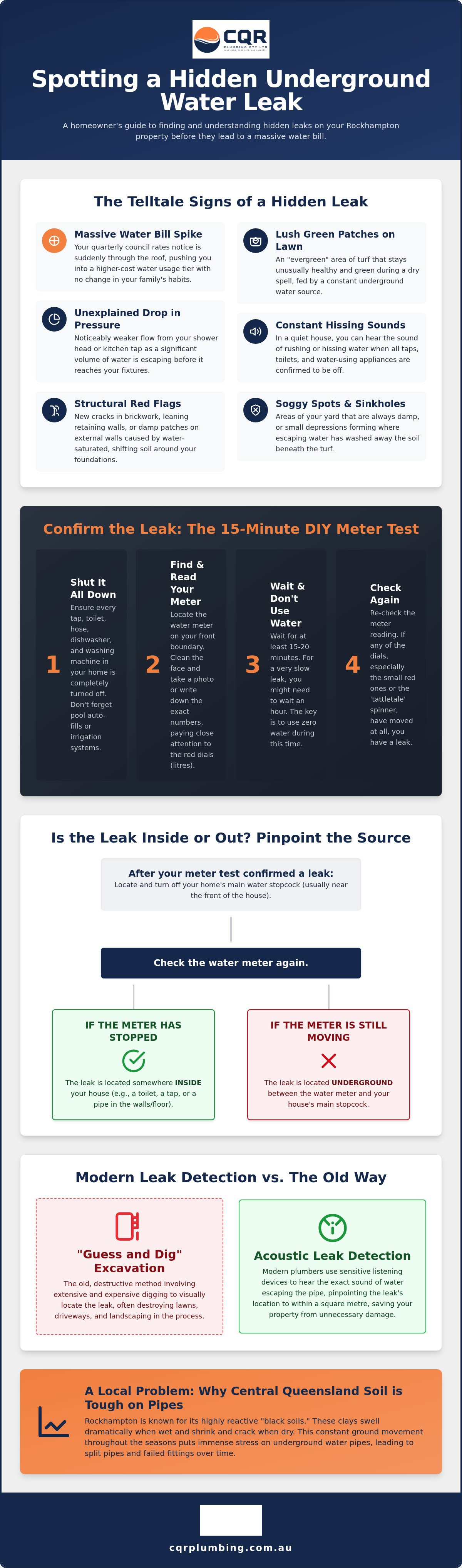
Most Rockhampton homeowners first discover an underground water leak when the quarterly council rates notice lands in the letterbox. Because the Rockhampton Regional Council uses a tiered charging system, even a small, steady leak can quickly push your household into the highest consumption bracket. If your bill has spiked but your daily habits haven't changed, you're likely losing thousands of litres into the soil every week. This isn't just a waste of a precious resource; it's a direct hit to your household budget that only gets worse the longer it's ignored.
Beyond the financial hit, your property will start showing physical symptoms. In Central Queensland, our weather is quite predictable. During a dry winter, your lawn should be uniform in colour. If you notice a patch of "evergreen" grass that stays lush while the rest of the yard browns off, you've found a primary suspect. This is often accompanied by a noticeable drop in water pressure at your kitchen tap or shower head, as the water is escaping into the ground before it ever reaches your fixtures. You should also listen carefully when the house is quiet. A constant hissing or the sound of rushing water when every tap is firmly off is a clear indicator of a pipe failure.
Surface indicators in your garden and lawn
Keep a close eye on the texture of your turf. Localised subsidence or small sinkholes often form when a high-pressure burst washes away the sub-base under your lawn or garden beds. You might also notice damp spots that never seem to dry out, even after a string of thirty-degree days. If you have paved areas or concrete paths near your water mains, look for new moss or algae growth. These plants don't survive in our harsh sun without a constant, hidden water source keeping the ground saturated.
Structural red flags on your property
Rockhampton is known for reactive clay soils that shift significantly when moisture levels change. An underground water leak near your foundations can lead to sudden structural movement. Look for fresh cracks in your brickwork, especially those appearing near where the mains pipe enters the house. You might also see garden walls or fences starting to lean as the soil beneath them loses its integrity. While these visual checks are a great starting point, Professional Leak Detection is necessary to pinpoint the exact source of the problem before you start digging up your driveway. Mould or dampness appearing on the lower sections of external walls is another critical sign that water is being drawn up from a saturated ground-base through capillary action.
The 15-Minute DIY Water Meter Test
Before you start worrying about the cost of repairs, you need to confirm that the water loss is actually occurring on your side of the meter. In Rockhampton, your water meter is typically located near the front boundary of your property, often housed in a plastic or concrete box. Don't be surprised if the box is full of dirt or the odd spider; simply clear it out until you can see the glass face clearly. If the box is full of water, bail it out first to see if the water returns, which can be a sign of a leak right at the meter connection or a faulty coupling.
To start The 15-Minute DIY Water Meter Test, you must ensure every water-using fixture in your home is completely shut off. This includes checking that the dishwasher and washing machine aren't mid-cycle. Don't forget the hidden items that often run on autopilot, such as pool auto-fill valves, solar hot water boosters, or evaporative air conditioners. Once you're certain no water is being used, head out to the meter and record the exact reading. Pay close attention to the red numbers, as these represent individual litres and will show movement much faster than the black kilolitre dials.
Wait for at least 15 minutes without using any water. If the dials have moved even slightly, you have a leak. For very slow drips, you might need to leave it for an hour or even overnight to see a change. If you see the small "tattletale" dial spinning rapidly while everything is off, you likely have a significant underground water leak that requires immediate professional attention to prevent property damage.
Isolating the leak: Indoor vs Outdoor
If the meter is moving, you need to determine if the issue is inside the house or in the line under your garden. Locate your house's main stopcock, usually found where the pipe enters the building or near the front tap, and turn it off. Check the meter again. If it's still ticking over, the water is escaping from the underground pipe between the meter and the house. If the meter stops, the leak is somewhere inside your home's internal plumbing.
Common culprits to check before calling a plumber
Before assuming the worst, check the "silent" water wasters. A leaking toilet cistern can lose hundreds of litres a day without making a sound. You should also inspect your hot water unit. Faulty pressure relief valves often discharge a constant stream of water into the drain, which can mimic a burst pipe on your meter. If you suspect your unit is the problem, professional hot water system repairs can often fix the issue without needing a full replacement. If these checks come up clear and the meter is still spinning, it's time to request a professional leak detection service to find the exact location of the underground water leak.
Professional Leak Detection: Finding the Needle in the Haystack
If your meter test confirmed a loss of water, the next step is locating the exact point of failure. In the past, many plumbers relied on the "guess and dig" method, which involved excavating large sections of a garden based on where the surface was dampest. This is rarely effective. Water travels the path of least resistance; a leak under your driveway could easily surface ten metres away in your flower bed. Taking this approach is a recipe for a ruined landscape and a massive bill for unnecessary labour.
Modern leak detection is a non-invasive science. We use a combination of technologies to pinpoint an underground water leak with centimetre-level accuracy. This precision ensures that when we finally do break ground, we only dig a small, targeted hole directly over the fault. This saves you money on both the repair and the subsequent restoration of your garden or driveway.
Acoustic detection technology
Acoustic detection is our primary tool for finding high-pressure bursts. When water escapes a pipe under pressure, it creates a distinct high-frequency hiss or low-frequency rumble. We use sensitive ground microphones and amplifiers to "listen" through soil, concrete, and bitumen. The material of your pipes plays a big role here. Copper pipes are excellent conductors of sound, making leaks relatively easy to hear from a distance. Polyethylene (poly) pipes, common in newer Rockhampton estates, tend to dampen the sound. This requires more specialised equipment and a highly trained ear to filter out background noise.
Testing is most effective during quiet periods. Ambient noise from heavy traffic or household appliances can interfere with the signal. We often perform these tests when local activity is at its lowest to ensure we are hearing the pipe, not the neighbourhood.
Tracer gas and electronic pipe locating
For difficult pinhole leaks or failures under thick concrete slabs where sound won't travel, we use tracer gas. This involves draining the line and injecting a safe, inert mixture of hydrogen and nitrogen. Because hydrogen molecules are incredibly small and light, they rise through the soil and even penetrate solid concrete. We then use a sensitive "sniffer" probe to detect the gas at the surface. This method is foolproof for finding an underground water leak that is too small to be heard acoustically.
Before any excavation begins, we also use electronic pipe locators to map the exact path of your mains. Mapping the line prevents accidental damage to other services like power or data. If you have a major burst that is flooding your property right now, our emergency plumbing services are available 24/7 to isolate the line and begin the diagnostic process immediately.
Underground Pipe Repair Options: Excavation vs Replacement
Once we have identified the exact location of your underground water leak, we need to determine the most practical way to fix it. Not every burst requires a major excavation. If the rest of your plumbing is in good condition, a localised spot repair is often the most efficient solution. This involves digging a small, targeted hole to expose the damaged section, cutting out the fault, and installing high-quality mechanical or electrofusion couplings. It is a surgical approach that keeps your garden intact and your costs down.
However, the age and material of your pipes play a massive role in this decision. If we find that your copper pipes are suffering from "pitting" corrosion or your old poly lines have become brittle and prone to cracking, a simple patch might only be a temporary fix. In these cases, the pressure from a new repair can often cause the next weakest point in the line to fail just weeks later. This leads to a frustrating and expensive cycle of recurring leaks that can eventually cost more than a complete upgrade.
When to repair a single section
A localised repair is the ideal choice for accidental damage. I often see this when a homeowner or landscaper accidentally puts a spade or fence post through a poly pipe. If the pipe is relatively new and the surrounding material is flexible and healthy, we can have the water back on in a matter of hours. This method is cost-effective and perfectly suitable for modern installations where the pipe has decades of service life remaining.
Why full replacement is often the smarter long-term move
If your home still relies on old galvanised steel pipes or thin-walled copper, a full line replacement is usually the best investment. Modern materials like heavy-duty polyethylene (poly) or high-density PEX are designed to withstand the movement of Rockhampton’s reactive clay soils without cracking. Replacing the entire run from the meter to the house ensures your system meets current Australian Plumbing Standards (AS/NZS 3500) and gives you total peace of mind.
For properties with expensive driveways or established gardens, we can sometimes use trenchless technology, such as directional boring, to install a new line without digging a continuous trench. Regardless of the method, we focus on proper site restoration. This includes backfilling with appropriate bedding sand to protect the pipe and compacting the soil correctly so you don't end up with a sunken path or a trip hazard once the rain hits.
Preventing Leaks in Central Queensland’s Reactive Soils
Rockhampton is famous for its "black soil," a type of heavy clay that acts like a sponge. During our long, hot dry spells, this clay shrinks and cracks, pulling away from anything buried within it. When the heavy Capricorn Coast rains eventually arrive, the soil swells rapidly. This constant expansion and contraction puts immense physical stress on your plumbing infrastructure. Reactive soil is the primary cause of pipe failure in the Rockhampton region.
This "soil heave" is particularly dangerous for older, rigid pipe materials like galvanised steel or thin-walled copper. As the ground shifts, these pipes are often bent or crushed, leading to a sudden underground water leak. One of the best ways to protect your home is to maintain consistent moisture levels around your house slab. By using a simple irrigation system or mulch to prevent the ground from drying out completely during a drought, you can reduce the severity of soil movement and keep your pipes in a more stable environment.
Landscaping and your underground pipes
Your choice of garden plants can have a direct impact on the lifespan of your water mains. Thirsty trees with invasive root systems, such as certain Fig or Eucalyptus species, will actively seek out the moisture around your pipes. Even a tiny "weep" at a joint can attract roots that will eventually penetrate the pipe and cause a massive burst. Always research the root spread of a tree before planting it near your front boundary or house entry point.
We also suggest installing flexible connectors where your main water line enters the house structure. These fittings allow the pipe to move slightly with the soil without snapping at the connection point. Effective roof plumbing and stormwater management is another critical factor. Ensuring that rainwater is directed well away from your foundations prevents the uneven soil saturation that often leads to sheared pipes and foundation damage.
The importance of preventative maintenance
The most effective way to manage the risk of an underground water leak is through regular observation. I recommend that homeowners record their meter readings once a month as a standard habit. It only takes a moment and provides an early warning system that can save you thousands in excess water charges. Catching a leak when it’s just a small drip is always cheaper than fixing a full-scale burst under your driveway.
You should also perform a quick visual health check of your garden taps and external fittings. Look for dampness around the base of tap stands or any green algae growth on nearby bricks. If a tap feels stiff or continues to drip after being turned off, it’s a sign that the internal washers or spindles are failing. Replacing these components is a simple task for a licensed plumber and prevents larger issues from developing within your broader plumbing system.
Securing Your Rockhampton Property Against Pipe Failure
Dealing with a hidden burst doesn't have to be a disaster for your garden or your bank account. By performing regular meter checks and staying alert for subtle warning signs, you can catch an underground water leak before it causes structural damage or results in a massive council bill. Modern detection technology finds the problem with surgical precision, ensuring that any necessary repairs are targeted and efficient.
Our team are licensed and insured local plumbers with deep experience in Rockhampton and Yeppoon local infrastructure. We are specialists in insurance repairs and provide a 24/7 emergency response for major bursts that require immediate attention. Whether you've confirmed a leak through a DIY test or simply have a gut feeling that something isn't right, getting professional advice early is the best way to protect your property's value.
Take the stress out of your next water notice by ensuring your home's infrastructure is sound, compliant, and leak-free.
Common Questions About Underground Water Leaks
Who is responsible for an underground water leak, me or the council?
Property owners are responsible for all pipework and fittings on their side of the water meter. The Rockhampton Regional Council, via Fitzroy River Water, maintains the infrastructure from the street up to and including the meter itself. If the leak occurs anywhere between the meter and your house, you are responsible for the repair costs and any excess water charges incurred during the burst.
How much does it cost to find an underground water leak in Rockhampton?
The cost for detection depends on the technology required, such as acoustic listening devices or tracer gas, and the size of the property. While I don't provide fixed quotes without an assessment, professional detection is far more cost-effective than paying for hours of manual excavation. Most licensed plumbers will provide a clear estimate once they understand the site conditions and the suspected severity of the water loss.
Can a small underground leak cause my house to sink or crack?
Yes, even a minor underground water leak can lead to serious structural damage in Central Queensland's reactive clay soils. Constant saturation causes the soil to swell or wash away, which undermines your foundations and leads to cracks in brickwork or subsiding floors. Addressing water loss early is the only way to prevent the soil movement that compromises the structural integrity of your home.
Will my home insurance cover the cost of repairing an underground leak?
Most Australian policies cover "resultant damage," such as fixing a wall or floor damaged by water, but they often exclude the actual repair of the pipe itself. However, some insurers include "trace and access" cover which helps with the cost of finding the burst. It's best to check your Product Disclosure Statement (PDS) to see if you are covered for accidental damage to underground services before booking a repair.
How long does it take for a plumber to find and fix a hidden leak?
A specialist can usually pinpoint the exact location of a leak within one to three hours using modern diagnostic tools. The time required for the actual repair depends on the depth of the pipe and whether it is located under a garden or a concrete slab. Most standard bursts can be repaired on the same day, though more complex site restorations might require additional time to complete correctly.
Is it possible to have a leak if my water meter isn't moving?
It's very unlikely to have a mains pressure leak if your meter dials remain completely still during a test. If you still see damp patches but the meter isn't spinning, you likely have a fault in your sewer or stormwater drainage. These pipes aren't under pressure and won't show up on a meter reading, so they require a CCTV drain camera inspection to find the source of the moisture.
What is the most common cause of underground pipe bursts in Yeppoon?
Ground movement from seasonal weather shifts is the most frequent cause of pipe failure along the Capricorn Coast. When we move from a dry winter into a wet summer, the soil expands and puts mechanical stress on older copper or brittle poly pipes. This pressure often causes pipes to shear at the joints or develop pinhole leaks where the line rubs against abrasive rocks in the trench.
Can I fix an underground water leak myself using a patch kit?
DIY patch kits are not suitable for high-pressure water mains and will almost certainly fail under the constant stress of the supply. In Queensland, all work on a main water line must be performed by a licensed plumber to comply with Australian Plumbing Standards. A professional repair uses certified mechanical couplings or fusion welding to provide a permanent, legal solution that protects your property and your insurance status.
Disclaimer
The information in this article is provided for general educational purposes only and should not be relied upon as professional plumbing, gasfitting, or legal advice. Every property and plumbing system is different, and the information may not be applicable to your specific circumstances. CQR Plumbing recommends that all plumbing and gasfitting work be inspected and carried out by a licensed professional in accordance with applicable Australian Standards and Queensland regulations. If you require advice specific to your property, please contact CQR Plumbing for an assessment.